
JUS DIVINUM,
LEX REX,
& MEDIIS GRATIAE
Why Not Voting is Not an Option.
The above is a pretty well thought out piece on a process that the United States American’s have performed for over 200 years now.
Also you might take a look at this…
JUS DIVINUM,
LEX REX,
& MEDIIS GRATIAE
Why Not Voting is Not an Option.
The above is a pretty well thought out piece on a process that the United States American’s have performed for over 200 years now.
Also you might take a look at this…

Dear Reformation Society Friends,
We are excitedly anticipating our fall RSI conference, Solus Christus: the Supremacy of Jesus Christ on November 16-17, 2012 at Second Reformed Presbyterian Church with speakers Rev. Anthony Selvaggio and Dr. Cornel P. Venema. This conference will shine the spotlight on the main character of redemption – it will fix your eyes on Jesus, the Author and Finisher of your faith. Our speakers are gifted in teaching on this topic of Solus Christus, so you will not want to miss these sessions. We know it will be a weekend of spiritual encouragement and fellowship, so please plan to join us!
The brochure which contains all of the important information for the Conference is posted on the Puritanboard at the link below.
You may register by sending an email to Jenny Blankenship at office@secondrpc.org. Please be sure to include the names of all those in your party for whom you are registering. Payment will be made at the door the night of the conference.
We are pleased to have Reformation Heritage Books supply the materials for our bookstore this year! The bookstore will once more be open before and after all sessions, and we encourage to you avail yourself to its helpful resources.
Finally, would you help us inform your church and community of this conference? We encourage you to invite your family members and friends. Printed brochures and posters are available upon request to help spread the word. Please email Jenny with specific quantities if interested.
We hope to see you next month! In the meantime, invite your neighbors and friends and don’t forget to register at office@secondrpc.org!
Sincerely,
Pastor Richard Johnston
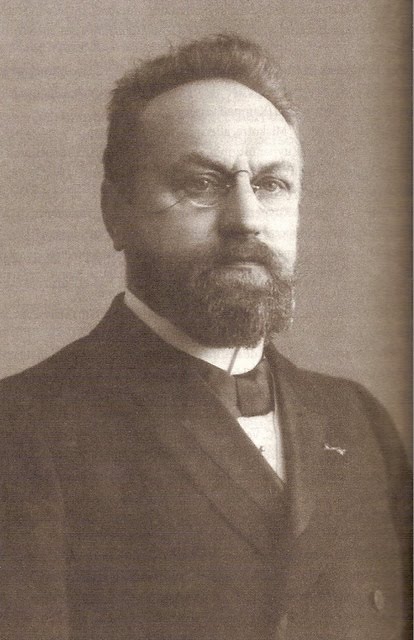
Why would anyone want to read my thoughts when they could read Herman Bavinck? Enjoy this tidbit. It is very, very, very good.
RMS.
The universal reality of misery evokes in all people a need for deliverance, a deliverance from above. Pagans who construe misery as basically physical know neither the essential character of sin nor the deliverance of grace. Scripture, however, sees our misery as sin, as an ethical violation of communion with God, who alone can restore it. This requires grace, which in biblical revelation assumes the form of a covenant.
This covenant begins immediately after the fall as evidenced by Adam and Eve’s shame in their nakedness, a sign of lost innocence. Guilt and shame reveal both God’s wrath and his grace, but the latter is shown especially when God seeks out Adam and Eve and interrogates them. In his punishment on the serpent and on humanity, God’s mercy triumphs over judgment as he annuls the covenant made with evil and puts enmity between the seed of the serpent and the seed of the woman. Now the path of glory must pass through suffering for man and woman. In the promise of Genesis 3, we find the gospel in a nutshell and, in principle, the entire history of the human race.
The word “covenant” is not found in Genesis 3, but the reality is. Modern critics judge that covenant ideas arose late in Israel’s history but need circular arguments for their case. A history of Israel is constructed by alleging that certain biblical sources are inauthentic, which history is then used to demonstrate the inauthenticity of documents that witness against it. It is better scholarship to see the latter prophets as standing on the foundation of a real covenant made with the patriarchs.
Covenant (ברית) is characterized by three factors: an oath or promise including stipulations, a curse for violation, and a cultic ceremony that represents the curse symbolically. Covenant making is a religious and social act. The covenant of grace is unilateral, indissolubly grounded in the merciful promises of the sovereign God. God cannot break his promise; he has sworn himself to uphold it. The unilateral divine origin and character attributed to the covenant in Hebrew is likely the reason why the Septuagint translates ברית by διαθηκη, or “testament,” rather than συνθηκη.
The doctrine of the covenant achieved dogmatic significance in the Christian church because the Christian religion had to understand its relation to and distinction from Judaism. Over against Gnosticism and Marcion, the church had to maintain the unity of and, over against Judaism, the distinction between the two covenants. Law and gospel, Old Testament and New Testament, are to be distinguished but never separated. During the Reformation this issue became crucial as Anabaptists and others (Arminians, Socinians) devalued the Old Testament. Key differences also arose between the Lutheran and Reformed traditions. It is in the latter, beginning with Zwingli and Calvin, that the doctrine of the covenant is most fully developed, notably in the German Reformed theology of Olevianus and Ursinus, English Puritanism, and the Westminster Confession.
Among the Dutch Reformed, Cloppenburg and Cocceius made the covenant the fundamental premise and controlling principle of dogmatics as a whole. Cocceius had an eccentric view of the covenant, notably the notion of successive covenantal abrogations, which in fact undermined the key element of grace, making it uncertain. After Cocceius, a more general disparagement of the Old Testament took place among modern thinkers such as Spinoza, Kant, Hegel, and Schleiermacher. Judaism was then seen as no better than paganism as preparation for Christianity.
In the Reformed church and theology, covenant became a very important practical encouragement for Christian living. Here the basis of all covenants was found in the eternal counsel of God, in a covenant between the very persons of the Trinity, the pactum salutis (counsel of peace). The work of salvation is an undertaking of the one God in three persons in which all cooperate and each one performs a special task. It is the triune God—Father, Son, and Spirit—who together conceive, determine, carry out, and complete the entire work of salvation. The benefit to the believer is in knowing that the covenant of grace executed and revealed in time and history nevertheless rests on an eternal, unchanging foundation, the counsel of the triune God. The Father is the eternal Father, the Son the eternal Mediator, the Holy Spirit the eternal Paraclete.
Care must be taken in considering the execution of the pact of salvation in time and history. Though God elects Abraham and Israel as his chosen people, his salvific purpose is universal, with all peoples. In the fullness of time, humanity as a whole, Jew and Gentile, is reconciled in the one man, Jesus Christ, at the cross. After the fall, grace and judgment alike are extended to the whole human race. In the beginnings of human history, we see great blessing in remarkable longevity and the great judgment of the flood. After the flood, God makes a covenant with nature not to destroy the world with water again, reduces human life span, and spreads humanity across the world, preventing humans from reaching heaven itself with their ambition. Despite letting the Gentiles walk in their own ways, God providentially grants them significant cultural and social development. He did not leave them without witnesses to himself through the works of his hands. In this way God is present to all people, and they are in some sense “prepared” for the message of salvation.
The universal scope of God’s intention for all peoples—Jew and Gentile—must never obscure the special favor of God to Israel. While Israel is drawn from the nations and there are analogies between Israel’s religious practices and those of the nations, the essential difference is that special grace is reserved for Israel and is not known among the pagans. Pagan religion is self-willed and legalistic. The covenant made with Abraham is new and comes from God alone. Through his covenant with Abraham and Israel, the Creator proves himself to also be the Re-creator and Savior. Elohim, Creator of heaven and earth, is Yahweh, the God of the covenant.
The old covenant with Israel is the necessary preparation for the new covenant in Christ. Though the covenant is one, there are two dispensations. In God’s own time, the promise of the old covenant was fulfilled in the new. The shadow and particularity of the letter became the substance, universality, and freedom of the Spirit. Nothing of the Old Testament is lost in the New, but everything is fulfilled, matured, has reached its full growth, and now, out of the temporary husk, produces the eternal core.
The covenant of grace, fulfilled in the New Testament, was and is surrounded and sustained by God’s covenant with nature, with all creatures. Unlike what Cocceius taught, the covenant of grace is not the successive abolition of the covenant of works but its fulfillment and restoration. “Grace repairs and perfects nature.” God’s demand of obedience remains as the only way to eternal life. The difference between the covenant of works and grace is that God now approaches us not in Adam but in Christ, who fulfilled all the obedience required of Adam. Christ is the second and last Adam who restores what the first Adam had corrupted; he is the head of a new humanity.
The covenant of grace is also integrally united with the counsel of peace, though it should be distinguished from it. In the counsel of peace, Christ is the guarantor and head; in the covenant of grace, he is the mediator. In this way the doctrine of the covenant maintains God’s sovereignty in the entire work of salvation. It is the Father who conceives, plans, and wills the work of salvation; it is the Son who guarantees it and effectively acquires it; it is the Spirit who implements and applies it.
At the same time, the covenant of grace also allows the rational and moral nature of human beings to come into their own. Here it differs from election, in which humans are strictly passive. The covenant of grace describes the road by which elect people attain their destiny; it is the channel by which the stream of election flows toward eternity. Christ sends his Spirit to instruct and enable his own so that they consciously and voluntarily consent to this covenant. The covenant of grace comes with the demand of faith and repentance, which may in some sense be said to be its “conditions.” Yet, this must not be misunderstood. God himself supplies what he demands; the covenant of grace is thus truly unilateral—it comes from God, who designed, defines, maintains, and implements it. It is, however, designed to become bilateral, to be consciously and voluntarily accepted by believers in the power of God. In the covenant of grace, God’s honor is not at the expense of but for the benefit of human persons by renewing the whole person and restoring personal freedom and dignity.
The covenant of grace, with Christ as the new head of humanity, reminds us of the organic unity of the church. The covenant of grace reminds us that election is about not only individual persons but also organic wholes, including families and generations. Therefore, some who remain inwardly unbelieving will for a time, in the earthly administration and dispensation of the covenant of grace, be part of the covenant people. The final judgment belongs to God alone, and in this life the church must regard such with the judgment of charity.*
*Bavinck, H., Bolt, J., & Vriend, J. (2006). Reformed Dogmatics, Volume 3: Sin and Salvation in Christ (193–196). Grand Rapids, MI: Baker Academic.

I have been greatly challenged about Loving others and being like Christ by Jeremiah Burroughs. He has stretched my thinking greatly concerning my conduct and attitude towards others. I pray my soul is not just gaining knowledge but that it will actually spill forth the truths and life of the Gospel of Christ by His Spirit.
Yea, and when you are reconciled to your brother, be so reconciled as to be firm in your reconciliation. Not as some; there is a peace made between them, but how? So as they are ready to take advantage against one another upon any miscarriage afterwards. God does not do this with you. The Gospel does not hold for such a peace as this, that God shall be at peace with you for the moment, but look to yourselves afterwards; as though God will take all advantages against you as He can. If there had been such a peace made between God and you as that, you would have been in hell long before this time. And therefore, let your peace be a firm, settled, and constant peace.
p.95Gospel Conversations
What’s that but as Christ Himself said, “Be ye merciful as your heavenly Father is merciful.” Oh, have a merciful heart one towards another; look with a merciful eye upon those who are in great misery! This is that which becomes the gospel of Jesus Christ. Oh, a harsh rugged, and cruel disposition is infinitely unbecoming the gospel of Christ! To see a Christian, one who professes the gospel, who makes more profession of the knowledge of God and of the free grace of God in Christ than others, and yet, when it comes to dealing with such as are in misery he has a hard heart? Oh, a hard-hearted Christian is a monster! I say a hard-hearted Christian is a monster in the world, not to be ready to forgive others, and to do anything for others who are in misery is devilish; but to rejoice that they may have any object to show pity and compassion unto, Oh, this is that which becomes the gospel of Christ! Though they are strangers to you in that misery, yet be merciful to them, for you were strangers to God.
Yea, be merciful to your enemies, not only be willing to be at peace, but be merciful. Do not let them perish, but let the bowels of compassion even work towards them. Oh, that our hearts yearned towards all! Christ, when He came near to Jerusalem, wept over it. Oh, that the same spirit were in us as was in Jesus Christ!
p.99
Gospel Conversations
Jeremiah Burroughs
Thank God for all of those who have lived the life of the Gospel being breathed out through them by the Spirit of God. For the Gospel is the Power of God unto salvation to those who believe. We are living by the fruit of Christ’s working in and through many forefathers who shed their lives sacrificially that we might obtain an incorruptible inheritance given to us in the Person and Work of Christ.
Every Christian should make it appear that he is so set upon peace that, if the laying down of his life could procure peace, he should be willing to do it, that if we may make up breaches by standing in the gap and offering up ourselves as a sacrifice of atonement and pacification, let us thus prove ourselves to be the true followers of Christ our Lord and Master, who has left us His own example here in for our imitation. This would be an excellent thing, becoming the gospel that we profess. Yea, we should not only be willing to admit peace, but seek it. Seek it for our inferiors. Do not say that such a man has wronged me and, therefore, let him seek me. Oh no! It becomes you who make profession of the gospel of Christ not to stay until he who has wronged you comes to you, but for you who are wronged by another to seek those who have wronged you so that they would be at peace with you.
Gospel Conversation
Jeremiah Burroughs
p. 93
(Rom 1:16) For I am not ashamed of the gospel of Christ: for it is the power of God unto salvation to every one that believeth; to the Jew first, and also to the Greek.
(Rom 1:17) For therein is the righteousness of God revealed from faith to faith: as it is written, The just shall live by faith.
(Gal 2:20) I am crucified with Christ: nevertheless I live; yet not I, but Christ liveth in me: and the life which I now live in the flesh I live by the faith of the Son of God, who loved me, and gave himself for me.
(Php 1:27) Only let your conversation be as it becometh the gospel of Christ: that whether I come and see you, or else be absent, I may hear of your affairs, that ye stand fast in one spirit, with one mind striving together for the faith of the gospel;
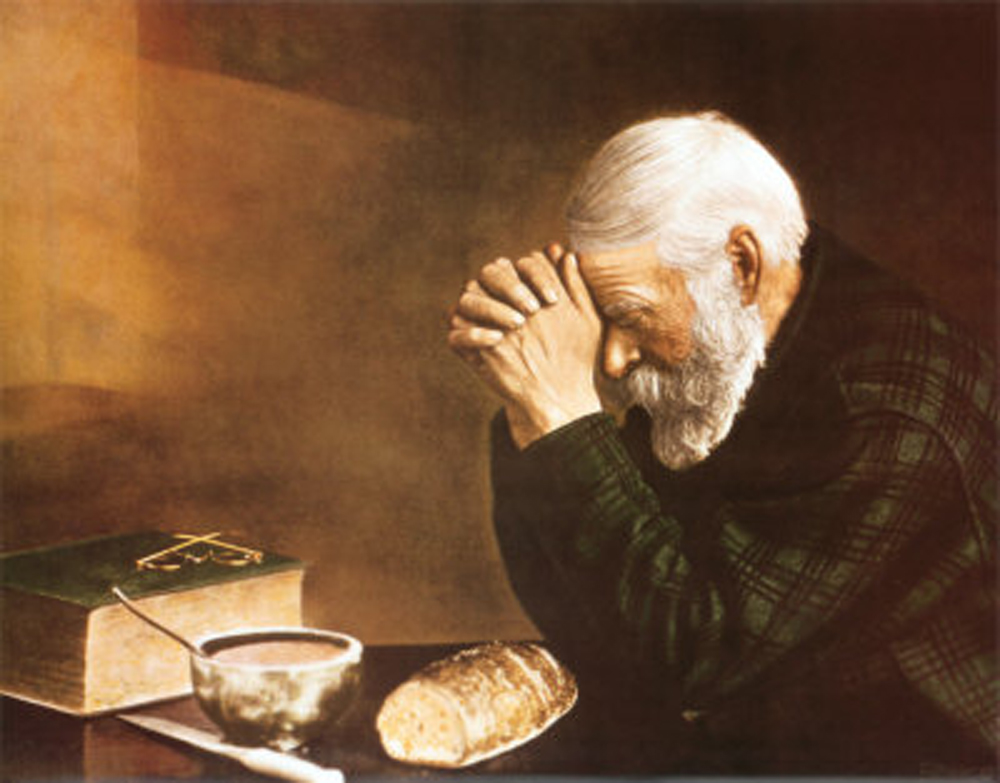
(1Pe 2:2,3) As newborn babes, desire the sincere milk of the word, that ye may grow thereby: If so be ye have tasted that the Lord is gracious.
I am writing this for open encouragement to myself and my household so that we might examine ourselves. It is time for a spiritual examination. It can be hard if not harder than the physical one. It is a lost art that I have grown negligent of during seasons of my life and I ended up grieving the Holy Spirit of God and hurting the ones I loved. Fortunately for those around me and myself I didn’t grow totally deaf and still heard God during those times and found God to be faithful in chastising me and granting me repentance. What a loving faithful God we have.
So I thought I would just share some passages and a few short thoughts that have kept me from totally losing it and going completely off the rails a few times in life. God always remained faithful and kept telling me where I needed to be and what I needed to do even if I didn’t want to listen to him. I just didn’t want to listen sometimes. So metaphorically God patiently would make me march another time around the mountain and dessert to teach me about my rebelliousness and His goodness as he did with the Hebrews after the great Exodus from their bondage in Egypt. One scripture that always comes to my mind for examination is 2 Corinthians 13:5. After I note that passage I will just keep on posting others and hope you are edified.
2Co 13:5 Examine yourselves, to see whether you are in the faith. Test yourselves. Or do you not realize this about yourselves, that Jesus Christ is in you?—unless indeed you fail to meet the test!
The Lord’s table is a great place for this examination and as a means of Grace it is quite effective to ponder upon anytime.
1Co 11:27 Whoever, therefore, eats the bread or drinks the cup of the Lord in an unworthy manner will be guilty concerning the body and blood of the Lord.
1Co 11:28 Let a person examine himself, then, and so eat of the bread and drink of the cup.
1Co 11:29 For anyone who eats and drinks without discerning the body eats and drinks judgment on himself.
1Co 11:30 That is why many of you are weak and ill, and some have died.
1Co 11:31 But if we judged ourselves truly, we would not be judged.
1Co 11:32 But when we are judged by the Lord, we are disciplined so that we may not be condemned along with the world.
1Pe 4:17 For it is time for judgment to begin at the household of God; and if it begins with us, what will be the outcome for those who do not obey the gospel of God?
Heb 12:1 Therefore, since we are surrounded by so great a cloud of witnesses, let us also lay aside every weight, and sin which clings so closely, and let us run with endurance the race that is set before us,
Heb 12:2 looking to Jesus, the founder and perfecter of our faith, who for the joy that was set before him endured the cross, despising the shame, and is seated at the right hand of the throne of God.
Heb 12:3 Consider him who endured from sinners such hostility against himself, so that you may not grow weary or fainthearted.
Heb 12:4 In your struggle against sin you have not yet resisted to the point of shedding your blood.
Heb 12:5 And have you forgotten the exhortation that addresses you as sons? “My son, do not regard lightly the discipline of the Lord, nor be weary when reproved by him.
If the Lord is not prodding your conscience about sin or encouraging you in righteousness then you should be fearful He isn’t chastising you for acting sinfully or encouraging you in your time of abiding. God loves to encourage us by His word and he is faithful to convict us when we are out of line. He leads us in paths of righteousness for His own names sake according to Psalm 23:3. If we do sense conviction, encouragement, and prodding we have much to rejoice for since God is our Father. If we are not sensing a prodding or a nagging conscience when we are acting sinful we should be greatly concerned that the Lord is not our Father and that we might be bastards concerning the faith. The reason why that is true is because the very essence of Grace is active and influential in a child of God’s life. It is divine empowering influence from the Spirit of God witnessing and encouraging us that we are the Children of God as we cry out Abba Father from our hearts. Let’s confirm some of what I have just mentioned with what the writer of Hebrews says.
Heb 12:6 For the Lord disciplines the one he loves, and chastises every son whom he receives.”
Heb 12:7 It is for discipline that you have to endure. God is treating you as sons. For what son is there whom his father does not discipline?
Heb 12:8 If you are left without discipline, in which all have participated, then you are illegitimate children and not sons.
Another thing I like to consider in light of this is the Parable of the Sower and the Seed. Jesus gives us a lot to understand here in this parable as he compares the word and soil with our intake of His Word and our lives. We all receive the word at some point of our lives. When we receive it and it bares fruit we have much to rejoice over. If we don’t bare fruit we should be alarmed. We should try to consider why it isn’t or hasn’t bore fruit if we have heard it.
Mar 4:3 “Listen! Behold, a sower went out to sow.
Mar 4:4 And as he sowed, some seed fell along the path, and the birds came and devoured it.
Mar 4:5 Other seed fell on rocky ground, where it did not have much soil, and immediately it sprang up, since it had no depth of soil.
Mar 4:6 And when the sun rose, it was scorched, and since it had no root, it withered away.
Mar 4:7 Other seed fell among thorns, and the thorns grew up and choked it, and it yielded no grain.
Mar 4:8 And other seeds fell into good soil and produced grain, growing up and increasing and yielding thirtyfold and sixtyfold and a hundredfold.”
Mar 4:13 And he said to them, “Do you not understand this parable? How then will you understand all the parables?
Mar 4:14 The sower sows the word.
Mar 4:15 And these are the ones along the path, where the word is sown: when they hear, Satan immediately comes and takes away the word that is sown in them.
Mar 4:16 And these are the ones sown on rocky ground: the ones who, when they hear the word, immediately receive it with joy.
Mar 4:17 And they have no root in themselves, but endure for a while; then, when tribulation or persecution arises on account of the word, immediately they fall away.
Mar 4:18 And others are the ones sown among thorns. They are those who hear the word,
Mar 4:19 but the cares of the world and the deceitfulness of riches and the desires for other things enter in and choke the word, and it proves unfruitful.
Mar 4:20 But those that were sown on the good soil are the ones who hear the word and accept it and bear fruit, thirtyfold and sixtyfold and a hundredfold.”
Mar 4:21 And he said to them, “Is a lamp brought in to be put under a basket, or under a bed, and not on a stand?
Mar 4:22 For nothing is hidden except to be made manifest; nor is anything secret except to come to light.
Mar 4:23 If anyone has ears to hear, let him hear.”
Mar 4:24 And he said to them, “Pay attention to what you hear: with the measure you use, it will be measured to you, and still more will be added to you.
Mar 4:25 For to the one who has, more will be given, and from the one who has not, even what he has will be taken away.”
The Christian life is about a reconciled relationship between God and man. Its basis is the life, death, burial, and resurrection of Jesus Christ. It is about being conformed to the image of Christ which is a long and hard process. It is a joyous one because it is about being reconciled to God (solely based upon His work of earning our salvation and not our earning it) and establishing a familial relationship with Him. But the process of being conformed to Christ’s image varies from person to person and some of us experience seasons of life when we wish we had not been called by Christ at all. I know that is hard for some people to understand but it is true. Some of us have acted pretty sinful and dealt with spiritual wickedness that is life draining. As examples I will mention King David in Psalm 51 and Elijah in 1 Kings 19. But God has called us to Glory and is doing a work in us if we are called.
One important sign of that calling is that we grow in our desire for the sincere milk of the Word as it is called. As a newborn baby desires milk at feeding time a Christian should desire to hear and take in God’s word. If that desire is gone something is wrong. Either sin has choked a lot of life out of an individual and they are spiritually anemic or the individual is simply a spiritual bastard who doesn’t have God for their spiritual father. Both are situations which should invoke great fear but the later should have more urgency placed upon it for seeking a remedy since it leads to a worse consequence for not heeding the warning signs. Eternity without God will hold nothing good for that individual. Nothing good! No good at all. No relief. They only have misery to look forward to and separation from everything good and blessed. And that is for all eternity after they pass from what life they had here.
So let me make a simple recommendation at this point. Jesus said that man cannot live by bread alone. We are to live by every word that proceeded from the Mouth of God according to Him. Let’s see if we can first confess what God says about our sin and seek forgiveness. 1 John 1:8-10 was placed in His book for a reason.
1Jn 1:8 If we say we have no sin, we deceive ourselves, and the truth is not in us.
1Jn 1:9 If we confess our sins, he is faithful and just to forgive us our sins and to cleanse us from all unrighteousness.
1Jn 1:10 If we say we have not sinned, we make him a liar, and his word is not in us.
In response to His word above we can all probably just call out to him the same way, “Lord, Please forgive me for my neglect of you and your word and for following my sinful desires.” He knows we need this promise concerning confession and forgiveness. After that prayer of confession let us stir up that natural desire that is found in New Creatures of Christ. As newborn babes crave milk let’s drink in the milk of the word and stir up the gift that is in us. He said he knocks on the door and seeks to fellowship with His Church in Revelation 3:20. Let us open it and fan the flame of our relationship with God by opening up our Bibles and reading them. After all, He did pay an unfathomable price to ransom our lives so that we could be His children. Let’s start listening to His word. It is life giving. Faith comes by hearing and hearing comes by the Word of God. So maybe it is time to put down the Xbox controllers or things that want to choke the word out of our lives and go listen to our Father. He loves us. I know as an older struggling brother in the faith. Randy

Kingdoms Apart
Engaging the Two Kingdoms Perspective
Ryan C McIlhenny
There is a portion of this book that has been made available and downloadable. I heartily recommend you download it and read it. Dr. Venema’s part is most excellent. It correctly and clearly brings David VanDrunnen’s views and interpretation of Calvin’s Two Kingdom / Natural Law Theology into question.
After you open the link just click on ‘Sample Chapters: PDF’
Then click ‘save page as’ in your browser so you can retain a copy. I will buy the book as soon as it is made available. It is suppose to be available Oct. 2012.
There are three broad topics that are considered in Venema’s critique of Van Drunnen’s interpretation of Calvin concerning Two Kingdom’s / Natural Law.
First, Does Calvin view them (the two kingdoms) primarily in terms of two separate realms? Does he make clear identification of the spiritual kingdom with the institutional church and the natural kingdom with the remainder of human life and culture?
Second, Is there a strict correlation between the natural kingdom, which is governed by Christ as Mediator of Creation through natural law, and the spiritual kingdom, which is governed by Christ as Mediator of redemption through moral law as it is set forth in scripture?
Third, What is the relation that Calvin emphasizes between God’s purpose and work as Creator and as Redeemer. How does Calvin construe the relation between God’s purposes in creation and redemption?
http://www.prpbooks.com/samples/9781596384354.pdf
Please sit up and take notice of this issue. I couldn’t agree more with the assessment of Gideon Strauss, Senior Fellow, Center for Public Justice, Washington, DC, “This is not only an academic debate. The outcome of the debate will have broad implications for Christian schools, colleges, seminaries, and churches and for Christians in the academy, politics, business, the arts, and other realms of cultural activity.”
I venture to even go a bit farther and state that this effects our understanding of Christ (Christology) and how we live our life inwardly as well as outwardly.
The download to this might be rather short lived so get it while you can.

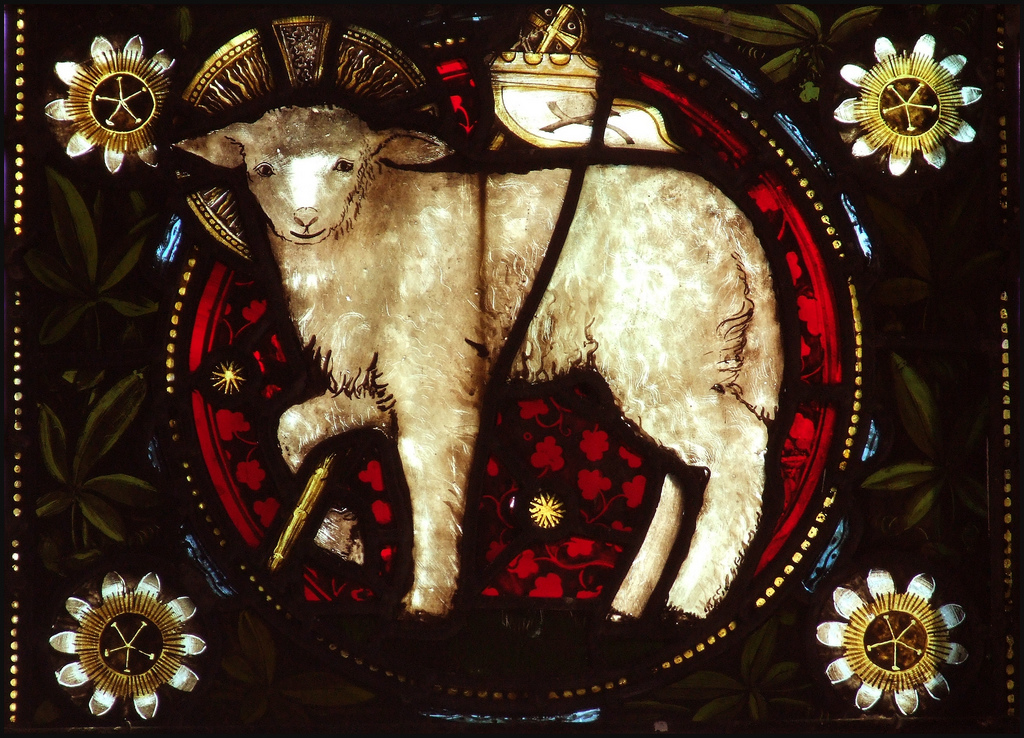
This little portion is so good I just have to put it somewhere for others to read. So please just bare with me and tolerate my love for things simply put down in a simple matter. I am a bear of very little braiin as A. A. Milne’s Edward Bear. (Winnie ther Pooh) Please enjoy this little tidbit.
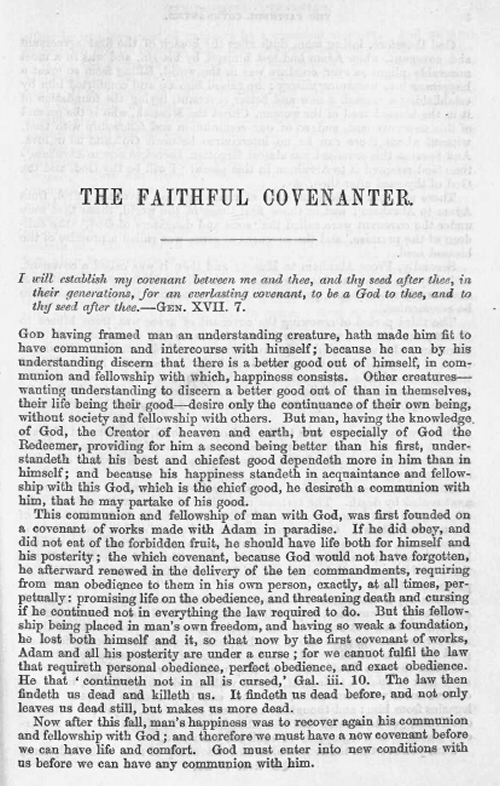
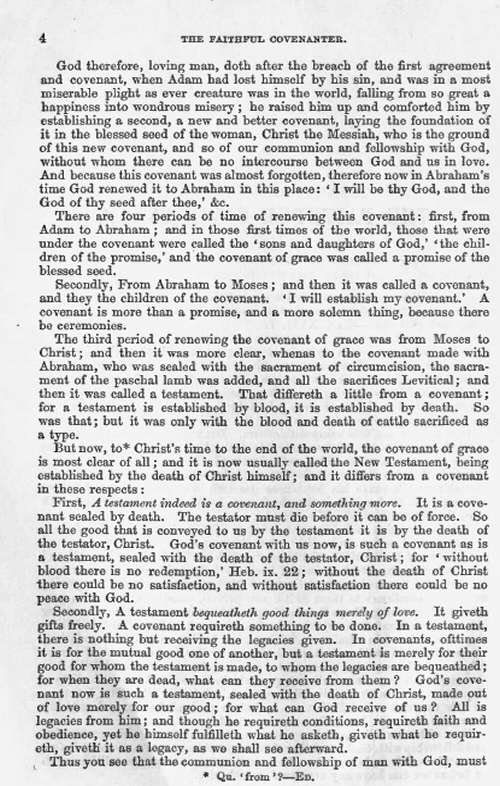
THE FAITHFUL COVENANTER
Richard Sibbes
Works
Volume 6 pp. 3,4.
I will establish my covenant between me and thee, and thy seed after thee, in their generations, for an everlasting covenant, to be a God to thee, and to thy seed after thee. — Gen. XVII. 7.
God having framed man an understanding creature, hath made him fit to have communion and intercourse with himself; because he can by his understanding discern that there is a better good out of himself, in communion and fellowship with which, happiness consists. Other creatures wanting understanding to discern a better good out of than in themselves, their life being their good desire only the continuance of their own being, without society and fellowship with others. But man, having the knowledge of God, the Creator of heaven and earth, but especially of God the Redeemer, providing for him a second being better than his first, understandeth that his best and chiefest good dependeth more in him than in himself; and because his happiness standeth in acquaintance and fellowship with this God, which is the chief good, he desireth a communion with him, that he may partake of his good.
This communion and fellowship of man with God, was first founded on a covenant of works made with Adam in paradise. If he did obey, and did not eat of the forbidden fruit, he should have life both for himself and his posterity; the which covenant, because God would not have forgotten, he afterward renewed in the delivery of the ten commandments, requiring from man obedience to them in his own person, exactly, at all times, perpetually: promising life on the obedience, and threatening death and cursing if he continued not in everything the law required to do. But this fellowship being placed in man’s own freedom, and having so weak a foundation, he lost both himself and it, so that now by the first covenant of works, Adam and all his posterity are under a curse; for we cannot fulfil the law that requireth personal obedience, perfect obedience, and exact obedience. He that continueth not in all is cursed, Gal. iii. 10. The law then findeth us dead and killeth us. It findeth us dead before, and not only leaves us dead still, but makes us more dead.
Now after this fall, man’s happiness was to recover again his communion and fellowship with God; and therefore we must have a new covenant before we can have life and comfort. God must enter into new conditions with us before we can have any communion with him.
God therefore, loving man, doth after the breach of the first agreement and covenant, when Adam had lost himself by his sin, and was in a most miserable plight as ever creature was in the world, falling from so great a happiness into wondrous misery; he raised him up and comforted him by establishing a second, a new and better covenant, laying the foundation of it in the blessed seed of the woman, Christ the Messiah, who is the ground of this new covenant, and so of our communion and fellowship with God, without whom there can be no intercourse between God and us in love. And because this covenant was almost forgotten, therefore now in Abraham’s time God renewed it to Abraham in this place: I will be thy God, and the God of thy seed after thee,’ &c.
There are four periods of time of renewing this covenant: first, from Adam to Abraham; and in those first times of the world, those that were under the covenant were called the ‘sons and daughters of God, ‘the children of the promise,’ and the covenant of grace was called a promise of the blessed seed.
Secondly, From Abraham to Moses; and then it was called a covenant, and they the children of the covenant. ‘I will establish my covenant. ‘A covenant is more than a promise, and a more solemn thing, because there be ceremonies.
The third period of renewing the covenant of grace was from Moses to Christ; and then it was more clear, whenas to the covenant made with Abraham, who was sealed with the sacrament of circumcision, the sacrament of the paschal lamb was added, and all the sacrifices Levitical; and then it was called a testament. That differeth a little from a covenant; for a testament is established by blood, it is established by death. So was that; but it was only with the blood and death of cattle sacrificed as a type.
But now, to Christ’s time to the end of the world, the covenant of grace is most clear of all; and it is now usually called the New Testament, being established by the death of Christ himself; and it differs from a covenant in these respects:
First, A testament indeed is a covenant, and something more. It is a covenant sealed by death. The testator must die before it can be of force. So all the good that is conveyed to us by the testament it is by the death of the testator, Christ. God’s covenant with us now, is such a covenant as is a testament, sealed with the death of the testator, Christ; for ‘without blood there is no redemption’ Heb. ix. 22; without the death of Christ there could be no satisfaction, and without satisfaction there could be no peace with God.
Secondly, A testament bequeatheth good things merely of love. It giveth gifts freely. A covenant requireth something to be done. In a testament, there is nothing but receiving the legacies given. In covenants, ofttimes it is for the mutual good one of another, but a testament is merely for their good for whom the testament is made, to whom the legacies are bequeathed; for when they are dead, what can they receive from them? God’s covenant now is such a testament, sealed with the death of Christ, made out of love merely for our good; for what can God receive of us? All is legacies from him; and though he requireth conditions, requireth faith and obedience, yet he himself fulfilleth what he asketh, giveth what he requireth, giveth it as a legacy, as we shall see afterward.
Thus you see that the communion and fellowship of man with God, must either be by a covenant of works or by a covenant of grace. And we must distinguish exactly between these two covenants and the periods of them.

Certainly with regard to Paul himself there should be no debate; Paul certainly was not indifferent to doctrine; on the contrary, doctrine was the very basis of his life. His devotion to doctrine did not, it is true, make him incapable of a magnificent tolerance. One notable example of such tolerance is to be found during his imprisonment at Rome, as attested by the Epistle to the Philippians. Apparently certain Christian teachers at Rome had been jealous of Paul’s greatness. As long as he had been at liberty they had been obliged to take a secondary place; but now that he was in prison, they seized the supremacy. They sought to raise up affliction for Paul in his bonds; they preached Christ even of envy and strife. In short, the rival preachers made of the preaching of the gospel a means to the gratification of low personal ambition; it seems to have been about as mean a piece of business as could well be conceived. But Paul was not disturbed. “Whether in presence, or in truth,” he said, “Christ is preached; and I therein do rejoice, yea, and will rejoice” (Phil. 1. 18). The way in which the preaching was being carried on was wrong, but the message itself was true; and Paul was far more interested in the content of the message than in the manner of its presentation. It is impossible to conceive a finer piece of broadminded tolerance.
But the tolerance of Paul was not indiscriminate. He displayed no tolerance, for example, in Galatia. There, too, there were rival preachers. But Paul had no tolerance for them. “But though we,” he said, “or an angel from heaven, preach any other gospel unto you than that which we have preached unto you, let him be accursed” (Gal. 1. 8). What is the reason for the difference in the apostle’s attitude in the two cases? What is the reason for the broad tolerance in Rome, and the fierce anathemas in Galatia? The answer is perfectly plain. In Rome, Paul was tolerant, because there the content of the message that was being proclaimed by the rival teachers was true; in Galatia he was intolerant, because there the content of the rival message was false. In neither case did personalities have anything to do with Paul’s attitude. No doubt the motives of the Judaizers in Galatia were far from pure, and in an incidental way Paul does point out their impurity. But that was not the ground of his opposition. The Judaizers no doubt were morally far from perfect, but Paul’s opposition to them would have been exactly the same if they had all been angels from heaven. His opposition was based altogether upon the falsity of their teaching; they were substituting for the one true gospel a false gospel which was no gospel at all. It never occurred to Paul that a gospel might be true for one man and not for another; the blight of pragmatism had never fallen upon his soul. Paul was convinced of the objective truth of the gospel message, and devotion to that truth was the great passion of his life. Christianity for Paul was not only a life, but also a doctrine, and logically the doctrine came first.
But what was the difference between the teaching of Paul and the teaching of the Judaizers? What was it that gave rise to the stupendous polemic of the Epistle to the Galatians? To the modern Church the difference would have seemed to be a mere theological subtlety. About many things the Judaizers were in perfect agreement with Paul. The Judaizers believed that Jesus was the Messiah; there is not a shadow of evidence that they objected to Paul’s lofty view of the person of Christ. Without the slightest doubt, they believed that Jesus had really risen from the dead. They believed, moreover, that faith in Christ was necessary to salvation. But the trouble was, they believed that something else was also necessary; they believed that what Christ had done needed to be pieced out by the believer’s own effort to keep the Law. From the modern point of view the difference would have seemed to be very slight. Paul as well as the Judaizers believed that the keeping of the law of God, in its deepest import, is inseparably connected with faith. The difference concerned only the logical—not even, perhaps, the temporal—order of three steps. Paul said that a man (1) first believes on Christ, (2) then is justified before God, (3) then immediately proceeds to keep God’s law. The Judaizers said that a man (1) believes on Christ and (2) keeps the law of God the best he can, and then (3) is justified. The difference would seem to modern “practical” Christians to be a highly subtle and intangible matter, hardly worthy of consideration at all in view of the large measure of agreement in the practical realm. What a splendid cleaning up of the Gentile cities it would have been if the Judaizers had succeeded in extending to those cities the observance of the Mosaic law, even including the unfortunate ceremonial observances! Surely Paul ought to have made common cause with teachers who were so nearly in agreement with him; surely he ought to have applied to them the great principle of Christian unity.
As a matter of fact, however, Paul did nothing of the kind; and only because he (and others) did nothing of the kind does the Christian Church exist today. Paul saw very clearly that the differences between the Judaizers and himself was the differences between two entirely distinct types of religion; it was the differences between a religion of merit and a religion of grace. If Christ provides only a part of our salvation, leaving us to provide the rest, then we are still hopeless under the load of sin. For no matter how small the gap which must be bridged before salvation can be attained, the awakened conscience sees clearly that our wretched attempt at goodness is insufficient even to bridge that gap. The guilty soul enters again into the hopeless reckoning with God, to determine whether we have really done our part. And thus we groan again under the old bondage of the law. Such an attempt to piece out the work of Christ by our own merit, Paul saw clearly, is the very essence of unbelief; Christ will do everything or nothing, and the only hope is to throw ourselves unreservedly on His mercy and trust Him for all.
Paul certainly was right. The differences which divided him from the Judaizers was no mere theological subtlety, but concerned the very heart and core of the religion of Christ.
“Just as I am without one plea,
But that Thy blood was shed for me”
—that was what Paul was contending for in Galatia; that hymn would never have been written if the Judaizers had won. And without the thing which that hymn expresses there is no Christianity at all.
J. Gresham Machen.
Christianaity and Liberalsim.
pp. 16-18


I know the language is tough but it is from the 17th Century Scottish Pastor Samuel Rutherford who bore the burdens of his parish deeply in his heart. I take comfort in his insight. His ability to comfort came at a cost. He knew what it was to suffer loss and experience much pain and sorrow. He also knew that our Children are not ours fully as they are God’s.
You can read a biography that I wrote about him here.
https://rpcnacovenanter.wordpress.com/2012/09/01/samuel-rutherford/
Here are a few small portions of The Letters of Samuel Rutherford to comfort the afflicted upon the loss of life on this side….
‘Take no heavier lift of your children, than your Lord alloweth; give them room beside your heart, but not in the yolk of your heart, where Christ should be; for then they are your idols, not your *bairns. If your Lord take any of them home to his house before the storm come on, take it well, the owner of the orchard may take down two or three apples off his own trees, before midsummer, and *ere they get the harvest sun; and it would not be seemly that his servant, the gardener, should chide him for it. Let our Lord pluck his own fruit at any season he pleaseth; they are not lost to you, they are laid up so well, as that they are coffered in heaven, where our Lord’s best jewels lie.’
‘The child hath but changed a bed in the garden, and is planted up higher, nearer the sun, where he shall thrive better than in this out-field moor ground’
‘Go on and faint not, something of yours is in heaven, beside the flesh of your exalted Saviour, and ye go on after your own.’
‘He (she) is not lost to you who is found to Christ. If he (she) hath casten his bloom and flower, the bloom is fallen in heaven in Christ’s lap; and as he (she) was lent awhile to time, so is he now given to eternity, which will take yourself; and the difference of your shipping and his (hers) to heaven and Christ’s shore, the land of life, is only in some few years, which weareth every day shorter, and some short and soon reckoned summers will give you a meeting with him.’
*bairn [bɛən (Scot) bern]
n
Scot and northern English a child
[Old English bearn; related to bearm lap, Old Norse, Old High German barn child]
*ere [ɛə]
conj & prep
a poetic word for before
[Old English ǣr; related to Old Norse ār early, Gothic airis earlier, Old High German ēr earlier, Greek eri early]
(2Co 1:2) Grace to you and peace from God our Father and the Lord Jesus Christ.
(2Co 1:3) Blessed be the God and Father of our Lord Jesus Christ, the Father of mercies and God of all comfort,
(2Co 1:4) who comforts us in all our affliction, so that we may be able to comfort those who are in any affliction, with the comfort with which we ourselves are comforted by God.
(2Co 1:5) For as we share abundantly in Christ’s sufferings, so through Christ we share abundantly in comfort too.
(2Co 1:6) If we are afflicted, it is for your comfort and salvation; and if we are comforted, it is for your comfort, which you experience when you patiently endure the same sufferings that we suffer.
(2Co 1:7) Our hope for you is unshaken, for we know that as you share in our sufferings, you will also share in our comfort.
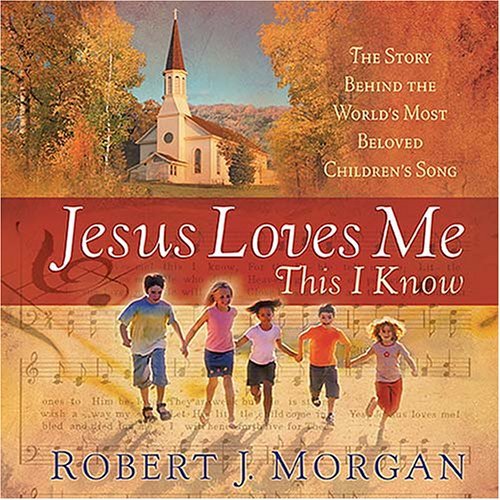
Jesus Loves Me this I know,
For the Bible Tells me So
Little Ones to Him Belong
They are weak but He is Strong.
“Jesus Loves Me” was a poem written back around 1860. It was a poem written in a Novel called Say and Seal by Susan Warner and used to comfort and dying child in the setting. It was simplistic and quite profound. It was the favorite hymn of one of America’s finest Biblical Scholars named Francis Schaeffer. He realized that the simple truth conveyed in this song applied to the intellectual adult as well as the youngest child who could comprehend the comfort of a hug. Also the great Irish missionary to India, Amy Carmichael, was converted to Christ after hearing this hymn at a children’s mission in Yorkshire, England.
Sometimes the most simplest of things can convey the most profound.
Preach the Gospel all the Time. Use Words because they are necessary.
I learned about some of this tonight while driving home from Dayton, Ohio. I was listening to an audio series that Focus on the Family puts out called Adventures in Odyssey. I am always amazed at some of the things we can learn in some of the strangest places.
(Mat 18:1) At that time the disciples came to Jesus, saying, “Who is the greatest in the kingdom of heaven?”
(Mat 18:2) And calling to him a child, he put him in the midst of them
(Mat 18:3) and said, “Truly, I say to you, unless you turn and become like children, you will never enter the kingdom of heaven.
(Mat 18:4) Whoever humbles himself like this child is the greatest in the kingdom of heaven.
Be Very Encouraged, Jesus Loves us!
Randy

Just thought this was interesting and I was blessed knowing that something so simple can be so profound. Sometimes I complicate things more than they need to be. Oh that I had eyes to see and ears to hear what the Spirit says to the church. It would definitely ring loudly with his Word and the simplicity found in Christ.


You must be logged in to post a comment.