The Mosaic Covenant, same in substance as the New? Not according to Modern Reformed Thought.

Decalogue_parchment_by_Jekuthiel_Sofer_1768

Pressing an old Blog entry…

via The Mosaic Covenant, same in substance as the New? Not according to Modern Reformed Thought..

Also look at this…
https://rpcnacovenanter.wordpress.com/2014/06/28/why-i-was-drawn-into-the-nuanced-republication-and-mosaic-covenant-study/
This is the doctrine that caused me to became a Presbyterian after having been a Reformed Baptist for 30 years.  It is also the doctrine that causes me to be alarmed over much of what is being taught today in the Reformed Camp.  They don’t understand the Mosaic Covenant.   I call today’s understanding Modern Reformed Thought.

Check out the whole thing as I post a small portion here…

I have recently been helped in understanding the Mosaic Covenant by Scripture clarification along with the help of a Pastor Patrick Ramsey. Thank You Pastor Ramsey.I have found that I disagree with Meredith Kline and others that hold to similar positions of a works paradigm in the Mosaic Covenant. While Owen’s view and Kline’s differ a bit by terminology I believe they are closer than people want to credit. I believe Kline holds to something more similar called a superadded subservient view of the Mosaic Covenant which was rejected by the Majority of Divines who wrote the Westminster Confession of Faith. You can learn about this by reading this article that was published in the Westminster Journal.  http://tinyurl.com/9xbtega

In working out this works paradigm I think Patrick Ramsey does a good job in revealing what Romans 10:5 and Leviticus 18:5 say when considering the whole Counsel of God. In fact when we look at Paul’s references we would think that Paul is pitting Moses against Moses and the Old Testament against the Old Testament in his New Testament writings. Especially if we just lift passages out of texts without considering other passages Paul also referenced. Paul isn’t pitting the OT against the OT or Moses against Moses when we look at the fuller context for understanding….

Read on brothers and sisters….  https://rpcnacovenanter.wordpress.com/2012/09/14/the-mosaic-covenant-same-in-substance-as-the-new/

Here is a great reference…. https://sites.google.com/site/themosaiccovenant/

Exposure on Dr. R. Scott Clark from Westminster West.  No wonder why I remained a Reformed Baptist and didn’t understand Covenant Theology from a truly Reformed perspective.
https://rpcnacovenanter.wordpress.com/2014/03/11/clark-is-not-teaching-the-broad-view-of-the-westminster-divines/

https://rpcnacovenanter.wordpress.com/2014/05/21/the-charge-of-lutheranism-is-not-about-distinction-it-is-about-dichotom

https://rpcnacovenanter.wordpress.com/2012/09/02/westminster-confession-of-faith-chapter-19-the-law-and-the-covenant-of-works-2/

Dr. Robert Strimple whose Chair at Westminster Seminary California  David Van Drunen occupies sets the Record straight concerning the book The Law Is Not of Faith and the Mosaic Covenant.

https://rpcnacovenanter.wordpress.com/2014/02/19/dr-robert-b-strimple-on-the-mosaic-covenant-and-republication-of-the-covenant-of-works/

I loved this piece on Klhortonian Theology… http://citeseerx.ist.psu.edu/viewdoc/download?doi=10.1.1.737.5521&rep=rep1&type=pdf&fbclid=IwAR3Djotk6sWLDlEjIiyRBcm895iEGrpYFZ5RYppsXxF7DG6A7pKKK8Oa9NE

Modern Day Reformed Thought and Two Kingdoms…  https://rpcnacovenanter.wordpress.com/2012/09/18/modern-day-reformed-thought-two-kingdoms-view-vs-the-biblical-one-kingdom-view/

The Mosaic Covenant:  a “Republication” of the Covenant of Works?

A Review article: The Law Is Not of Faith: essays on Works and Grace in the Mosaic Covenant

Cornel P. Venema
http://www.midamerica.edu/resources/journal/21/venema21.pdf

You may also want to check out my comments on Galatians 3 and 4.  Some people use this passage to show that the Law and Gospel are opposed to each other but that is a terrible misreading of the text.  The Law and Gospel are not opposed.

https://rpcnacovenanter.wordpress.com/2012/08/30/possible-misconceptions-about-galatians-law-and-gospel-are-opposed/

(What is the Gospel?) Depraved Christianity might be Antinomian Christianity pt. 3

Image

Rev. Phillips stated this in his first paragraph of his blog critiquing Rev. Tullian Tchividjian….

One of the most pressing concerns in Reformed churches today is the importance of getting the gospel right. Recently, Reformed churches have had to oppose the Federal Vision theology, which compromises justification by inserting good works into the definition of faith. Unfortunately, Christians tend to defend doctrines by erring in the opposite direction. So it is that Reformed churches are presently facing a corruption of the gospel by the virtual denial of sanctification and good works….

David Murray’s critique is very good…. Does Jesus + Nothing = Everything?  HeadHeartHand Blog
Does Jesus + Nothing = Everything? | HeadHeartHand Blog

Pastor Tullian’s quote from his book ‘Jesus Nothing Everything’…

I used to think that growing as a Christian meant I had to somehow go out and obtain the qualities and attitudes I was lacking. To really mature, I needed to find a way to get more joy, more patience, more faithfulness, and so on. Then I came to the shattering realization that this isn’t what the Bible teaches, and it isn’t the gospel. What the Bible teaches is that we mature as we come to a greater realization of what we already have in Christ. The gospel, in fact, transforms us precisely because it’s not itself a message about our internal transformation but about Christ’s external substitution. We desperately need an advocate, mediator, and friend. But what we need most is a substitute—someone who has done for us and secured for us what we could never do and secure for ourselves. (94, Kindle Edition)

Tullian Tchividjian sounds like Horton, doesn’t he? Remember the three minute video?

 Horton notes…

The term “gospel” is a very precise term, a particular kind of word, or kind of speech in the Bible.  It refers to God’s promise of salvation in Christ.  The gospel is a victory announcement.  It never tells us something to do.  That is the business of the law.  Rather, the gospel tells us something that has been done.

Consequently, those who speak of living the gospel or doing the gospel commit a category mistake.   More importantly, they make the most basic theological mistake a person could make, namely, confuse the law and the gospel.  And if we confuse the law and the gospel, then we will make ourselves partly your own saviors, adding to the work of Christ.

Is Horton Correct?  …. As a Pastor aquaintance has noted….

The most serious problem is that Horton’s indictment is based upon a shaky foundation.  Horton’s critique is predicated upon his narrow and strict definition of the term “gospel.”  But is that the only way the Bible uses or defines the term “gospel”?  The answer is no!  Romans 2:16 connects the future judgment with the gospel and 2 Thess. 1:8 and 1 Pet. 4:17 both speak of obeying the gospel.  The gospel is to be obeyed.  But how do you obey a victory announcement?  How do you obey what God has done?  So either the Bible itself confuses law and gospel or it uses the word “gospel” differently (at times) than Horton.  Since the latter must be true, then Horton shouldn’t make the strict definition of the gospel, the one and only definition of the gospel.  And he most certainly shouldn’t make any charges of legalism towards those who use a broader yet biblical definition of the gospel.

Fyi, the note on 2 Thess. 1:8 in the Reformation Study Bible is as follows:

§ 1:8 obey the gospel. The gospel must be accepted, believed, and obeyed (1 Pet. 4:17). Its divine command is for absolute surrender to God through the peace made by Jesus Christ.

Dr. David Murray writes…

I agree that the Gospel is certainly a message about Christ’s external substitution. But it does not stop there. The Gospel is also a message about internal transformation (a major part of sanctification). Christ saves us from our sins objectively and subjectively, from the penalty of sin and the presence of sin.

Guys, this is a problem. Others are seeing it. This is a truncated Gospel that is being proclaimed and one without the full truth and power of a message that has to do with the whole of Reconciliation. Reconciliation is about more than just justification before God.  The Gospel is about man’s reconciliation with God, totally.   The Gospel is about a restored relationship with God.  And this is Life Eternal that they know… (John 17:3)

Justification removes fear from Eternal Condemnation but it shouldn’t remove fear from chastisement or judgement from God when we are living in sin. That is what First Corinthians Chapter 10 is all about.  And it is precisely the Mosaic Covenant that St. Paul is referencing when appealing to how we should live as Christians in the Spirit of Christ.

In this Modern Reformed Thought some are weakening the sensitivity of the Conscience which needs to be awakened unto holy living. Sure we aren’t condemned before God in Eternity because Christ has removed the curse of the Covenant of Works, but we should fear our heavenly Father when we sin. That is something the World lacks.  It lacks a Heavenly Father who cares about how we live in His Kingdom.  Remember God chastises his children because He loves them.  If we had good fathers growing up they disciplined us because they loved us and wanted us to live peaceably with them.

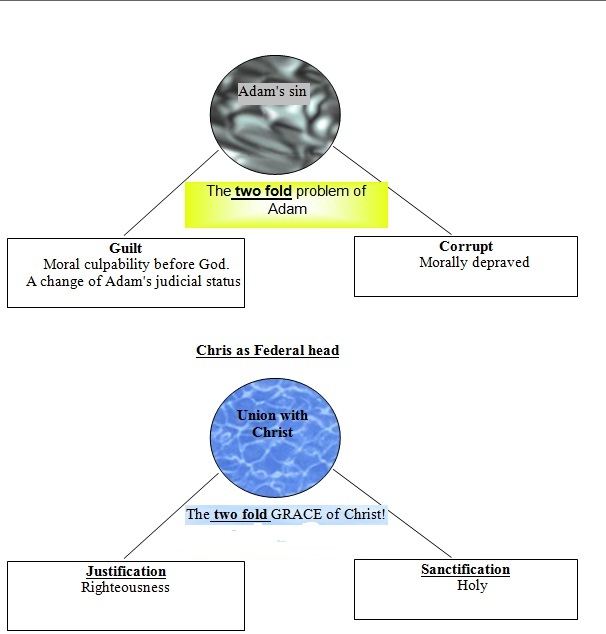
This reconciliation thing is also about 1 John 1:9 and our daily life. It is about sanctification and our daily walk with our King in His Kingdom. This truncated gospel these guys are proclaiming is growing void of the part  that runs next to our justification in the Gospel.  It takes Sanctification and removes it from the Gospel because it is supposedly of the law, which is not a part of the Gospel. They say so themselves. That is antinomian because according to them we should look only to justification for all things according them.  Our Union with Christ is where we should look for all things.  Justification and Sanctification both proceed from that.  Their scheme divorces our daily walk with God from the sanctifying grace of reconciliation.  The law is opposed to us soteriologically because the law opposes the Gospel.  The Law only Condemns in the scheme of soteriology according to them.  It is not a part of the Gospel or salvation.  The Gospel is only about justification and not about sanctification in their understanding.  The Gospel and Reconciliation have a a two fold benefit though, Justification and Sanctification.  Both are made realities by the Spirit of God in our Union with Christ.

The Gospel is about our Adoption and our living with God daily.  We should look to our Union with Christ which brings a two-fold Grace as Calvin put it. This Modern Reformed Thought Gospel that is only declarative is a subtle moving away from the Gospel of the Kingdom.

I will say this.  At least these Modern Day Reformed Thought guys get justification correct.

Edited to accommodate those whom want to defend Horton.

Depraved Christianity may be Antinomian Christianity Part 2

gospel11

http://liberatenet.org/2012/12/sin-remains-my-response-to-rick-phillips/

Pastor Tullian Responds to Rick Phillips.
But once God regenerates us by his Spirit, draws us to himself, unites us to Christ, raises us from the dead, and grants us status as adopted sons and daughters, is there any sense in which we can speak of Christian’s being totally depraved?  Yes.

Theologians speak of total depravity, not only in terms of “total inability” to come to God on our own because we’re spiritually dead, but also in terms of sin’s effect: sin corrupts us in the “totality” of our being. Our minds are affected by sin. Our hearts are affected by sin. Our wills are affected by sin. Our bodies are affected by sin. This is at the heart of Paul’s internal struggle that he articulates in Romans 7:

Me….
The terminology is incorrect and you can’t stop at Romans 7 and sit. The same guy who wrote Romans 7 wrote Romans 8. I read his response and found it lacking. Sorry guys. Which theologian uses the words total depravity together? I understand that there may be some deprivation in things but we are not deprived of things we need to be Godly. That is what is missing here. We all go hungry. That is why we pray that the Lord give us our Daily Bread. We depend upon Him for all sustenance. Total depravity is incorrect. We are complete in Christ as Colosians 2:10 states. . We are to pray to know how to walk in the Spirit. We will always depend on him. All things are unclean before Him. No one is being Pharisaical here. We just aren’t seeing Romans 8 and we are also seeing a confusion concerning justification and sanctification as they pertain to the Gospel.

Pastor Tullian wrote….
While it is gloriously true for the Christian that there is nowhere Christ has not arrived by his Spirit, it is equally true that there is no part of any Christian in this life that is free of sin.

Me…
The above was addressed by Rick. Pastor Tullian really didn’t address this. Also note Dr. David Murray’s critique on Tullian’s book. Does Jesus + Nothing = Everything? | HeadHeartHand Blog

http://headhearthand.org/blog/2011/12/12/does-jesus-nothing-everything/

Tullian really didn’t answer the charges by Rick when Rick mentioned Freedom and why the term Total Depravity is incorrect. BTW, I have heard Christians say that we are totally depraved Christians. It has always made me cringe.

But this is really about what the first paragraph of Rick’s blog stated. It is about the Gospel.  I know that many have truncated the Gospel by claiming it is only an outward declaration of Good News.  Dr. Michael Horton does the same thing in a three minute video he has posted on You Tube.

But for now I will allow some of Dr. David Murray’s comments about Sanctification speak and then in the next part or blog I will address the Gospel and antinomianism.

Pastor Tullian’s quote from his book ‘Jesus Nothing Everything’…

“I used to think that growing as a Christian meant I had to somehow go out and obtain the qualities and attitudes I was lacking. To really mature, I needed to find a way to get more joy, more patience, more faithfulness, and so on. Then I came to the shattering realization that this isn’t what the Bible teaches, and it isn’t the gospel. What the Bible teaches is that we mature as we come to a greater realization of what we already have in Christ. The gospel, in fact, transforms us precisely because it’s not itself a message about our internal transformation but about Christ’s external substitution. We desperately need an advocate, mediator, and friend. But what we need most is a substitute—someone who has done for us and secured for us what we could never do and secure for ourselves. (94, Kindle Edition)”

Dr. David Murray writes…
I agree that the Gospel is certainly a message about Christ’s external substitution. But it does not stop there. The Gospel is also a message about internal transformation (a major part of sanctification). Christ saves us from our sins objectively and subjectively, from the penalty of sin and the presence of sin.

In this next excerpt, Tullian says that Christian growth (sanctification) is looking away from self and looking to Jesus and His performance for us. But is that the whole of sanctification? It’s certainly the essence of justifying faith, and the beginning of sanctifying growth. But it’s not the whole of growth, it’s not the sum of sanctification.:

Pastor Tullian…

“The hard work of Christian growth, therefore, is to think less of ourselves and our performance and more of Jesus and his performance for us. Ironically, when we focus mostly on our need to get better, we actually get worse. We become neurotic and self-absorbed. Preoccupation with our effort instead of with God’s effort for us makes us increasingly self-centered and morbidly introspective. (95)”

Murray….
In this next paragraph, the confusing overlapping is even more obvious:

Tullian…
Again, think of it this way: sanctification is the daily hard work of going back to the reality of our justification. It’s going back to the certainty of our objectively secured pardon in Christ and hitting the refresh button a thousand times a day. (95)

Murray…
If all he is saying is that sanctification begins with our appropriating justification, and is fueled by it, then yes, I agree. But I think he’s going further than that, by suggesting that the totality of sanctification involves going back to our justification. This seems to be confirmed by what he writes in the same context:

Tulllian…
Think of what Paul tells us in Philippians 2:12: “Work out your own salvation with fear and trembling.” We’ve got work to do—but what exactly is it? Get better? Try harder? Pray more? Get more involved in church? Read the Bible longer? What precisely is Paul exhorting us to do? He goes on to explain: “For it is God who works in you, both to will and to work for his good pleasure” (v. 13). God works his work in you, which is the work already accomplished by Christ. Our hard work, therefore, means coming to a greater understanding of his work. And so it is that we move further into the gospel, into a deeper, bigger, brighter understanding of all that God has already achieved for us in Christ. (95-96)

Murray…

Is it correct to say that the “work” that we are called to, and that results from God’s work in us, is simply understanding more, believing more, trusting more? Sure, this is the core of justification, and the foundation and cement of sanctification. But it’s not the whole of sanctification. It’s not every brick of it.

Here are some further quotes that only heightened my anxiety about Tullian’s emphasis:

Tullian…
Growth in the Christian life is the process of receiving Christ’s “It is finished” into new and deeper parts of our being every day, and it happens as the Holy Spirit daily carries God’s good word of justification into our regions of unbelief—what one writer calls our “unevangelized territories.” (78)

Murray…
In this definition of growth (sanctification), where is the “being enabled to die to sin, and live to righteousness” as described by the Westminster Catechism? Where is the doing and not doing?

Tullian…
I like to remind myself and others that the only thing you contribute to your salvation and to your sanctification is the sin that makes them necessary. (104)

Murray…
Contribution to salvation = nil! Yes. Contribution to sanctification = nil! No. We are enabled to die to sin and live to righteousness. We are enabled to do and not do. Our (enabled) doing and not doing is part of our sanctification. For example, when Peter protested his love to Jesus, Jesus told him to start feeding his lambs, which involved stopping doing one thing and starting to do another (John 21).

Please read the rest of Dr. David Murray’s critique here..
http://headhearthand.org/blog/2011/12/12/does-jesus-nothing-everything/

https://rpcnacovenanter.wordpress.com/2012/12/03/depraved-christianity-may-be-antinomian-christianity/

https://rpcnacovenanter.wordpress.com/2012/12/07/depraved-christianity-might-be-antinomian-christianity-pt-3/

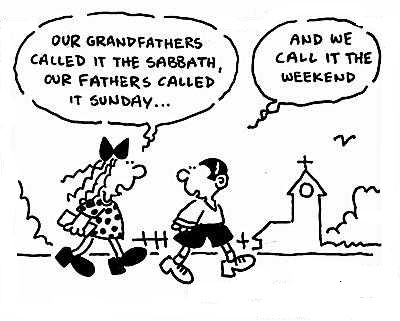
Some Reformed Baptists on the Sabbath Concerning Colossians and Hebrews

Image

The London Baptist Confession of Faith 
Chapter 22

7. As it is the law of nature, that in general a proportion of time, by God’s appointment, be set apart for the worship of God, so by his Word, in a positive moral, and perpetual commandment, binding all men, in all ages, he hath particularly appointed one day in seven for a sabbath to be kept holy unto him, which from the beginning of the world to the resurrection of Christ was the last day of the week, and from the resurrection of Christ was changed into the first day of the week, which is called the Lord’s day: and is to be continued to the end of the world as the Christian Sabbath, the observation of the last day of the week being abolished.
( Exodus 20:8; 1 Corinthians 16:1, 2; Acts 20:7; Revelation 1:10 )

8. The sabbath is then kept holy unto the Lord, when men, after a due preparing of their hearts, and ordering their common affairs aforehand, do not only observe an holy rest all day, from their own works, words and thoughts, about their worldly employment and recreations, but are also taken up the whole time in the public and private exercises of his worship, and in the duties of necessity and mercy.
( Isaiah 58:13; Nehemiah 13:15-22; Matthew 12:1-13 )

Here is part of a study of the triad mentioned in Colosians (holydays, new moon, and Sabbaths) that a friend Richard Barcellos pointed out in one of his books which I gained much benefit from. I quote a portion of it below and part of an article on Hebrews 4:9 by Robert Martin taken from the Reformed Baptist Theological Review.

http://www.rbap.net/theological-journals/

I am posting it here for an examination of Colossians 2:16 and the triad phrase that is used in this passage along next to the Old Testament passage in Hosea 2:11.

(Col 2:16) Let no man therefore judge you in meat, or in drink, or in respect of an holyday, or of the new moon, or of the sabbath days:

(Hos 2:11) I will also cause all her mirth to cease, her feast days, her new moons, and her sabbaths, and all her solemn feasts.

A lot of Baptist and non-sabbattarians like to quote Colossians 2:16 as a passage that declares we need not keep a weekly Sabbath day to the Lord. Richard Barcellos is the author. Please forgive my inept mistakes in copying it from a pdf to here.

1. The Old Testament prophesies the abrogation and cessation of the Sabbath under the New Covenant.

The OT clearly prophesies the abrogation and cessation of ancient Israel‘s Sabbaths. It does so in Hos. 2:11, which says, ―I will also cause all her mirth to cease, her feast days, her New Moons, her Sabbaths–all her appointed feasts.” We will make several observations that bear this out. First, Hosea‘s prophecy is dealing with the days of the New Covenant. The phrase ―in that day” (vv. 16, 18, 21) is used prophetically of New Covenant days in Is. 22:20. Revelation 3:7 quotes Is. 22:22 and applies it to Christ. The prophecy in Is. 22:20 mentions the Lord‘s servant, who is Christ. Isaiah 22:20-22 says:

Then it shall be in that day, that I will call My servant Eliakim the son of Hilkiah; I will clothe him with your robe and strengthen him with your belt; I will commit your responsibility into his hand. He shall be a father to the inhabitants of Jerusalem and to the house of Judah. The key of the house of David I will lay on his shoulder; so he shall open, and no one shall shut; and he shall shut, and no one shall open.

Revelation 3:7, quoting Is. 22:22, says:

And to the angel of the church in Philadelphia write, ―These things says He who is holy, He who is true, He who has the key of David, He who opens and no one shuts, and shuts and no one opens.

The phrase, ―in that day,
‘ refers to the days of Christ–the days of the New Covenant. Paul references Hos. 1:10 and 2:23 in Rom. 9:25, applying them to Christians. ―As He says also in Hosea: ‗I will call them My people, who were not My people, and her beloved, who was not beloved‘” (Rom. 9:25). Peter references Hos. 1:9-10 and 2:23 in 1 Pet. 2:10 and applies them to Christians as well. He says, ―who once were not a people but are now the people of God, who had not obtained mercy but now have obtained mercy” (1 Pet. 2:10). Hosea is clearly speaking of New Covenant days. According to the NT usage of Hosea, he is speaking of the time in redemptive history when God will bring Gentiles into a saving relationship with Jews. Much of the NT deals with this very issue.

Second, Hos. 2:11 clearly prophesies the abrogation of Old Covenant Israel‘s Sabbaths, along with ―all her appointed feasts.” Hosea uses a triad of terms (―feast days, New Moons, Sabbaths”) that is used many places in the OT (1 Chron. 23:31; 2 Chron. 2:4; 31:3; Neh. 10:33; and Is. 1:13-14). Clearly, he is speaking of the abrogation of Old Covenant ceremonial laws. When the Old Covenant goes, Israel‘s feast days, New Moons, Sabbaths, and all her appointed feasts go with it.

Third, the NT confirms this understanding of Hos. 2:11. It uses this triad of terms in Col. 2:16, which says, ―So let no one judge you in food or in drink, or regarding a festival or a new moon or Sabbaths.” In the context, Paul is combating those who were attempting to impose Old Covenant ceremonial law on New Covenant Christians. So Col. 2:16 is clear NT language that sees Hosea‘s prophecy as fulfilled. It is of interest to note that Paul uses the plural for Sabbath in Col. 2:16 (σάββατον). It is not too hard to assume that Paul had the OT triad in mind and Hosea‘s prophecy while penning these words. The NT announces the abrogation of the Old Covenant in many places. For instance, 2 Cor. 3:7-18; Gal. 3-4; Eph. 2:14-16; and Heb. 8-10 (cf. esp. 8:6-7, 13; 9:9-10, 15; 10:1, 15-18) are clear that the Old Covenant has been abrogated.

(Heb. 8:6-7)

But now He [Christ] has obtained a more excellent ministry, inasmuch as He is also Mediator of a better covenant [the New Covenant], which was established on better promises. For if that first covenant [the Old Covenant] had been faultless, then no place would have been sought for a second.

(Heb. 8:13)

In that He says, ―A new covenant, He has made the first obsolete. Now what is becoming obsolete and growing old is ready to vanish away.

(Heb. 9:9-10)

It was symbolic for the present time in which both gifts and sacrifices are offered which cannot make him who performed the service perfect in regard to the conscience–concerned only with foods and drinks, various washings, and fleshly ordinances imposed until the time of reformation.

(Heb. 9:15)

And for this reason He is the Mediator of the new covenant, by means of death, for the redemption of the transgressions under the first covenant, that those who are called may receive the promise of the eternal inheritance.

(Heb. 10:1)

For the law, having a shadow of the good things to come, and not the very image of the things, can never with these same sacrifices, which they offer continually year by year, make those who approach perfect.

(Heb. 10:15-18)

But the Holy Spirit also witnesses to us; for after He had said before, ―This is the covenant that I will make with them after those days, says the LORD: I will put My laws into their hearts, and in their minds I will write them, then He adds, ―Their sins and their lawless deeds I will remember no more. Now where there is remission of these, there is no longer an offering for sin.

The Old Covenant and all its ceremonies are obsolete and have vanished away (Heb. 8:13). Taking these passages and Col. 2:16 together, they clearly teach that when the Old Covenant goes, the triad of Col. 2:16 goes as well.

2. The Old Testament prophesies the perpetuity and continuation of the Sabbath under the New Covenant.

Just as there is evidence from the OT that the Sabbath will be abolished under the New Covenant, so there is evidence that it will continue. At first glance this appears contradictory. But on further investigation, it is not contradictory and, in fact, fits the evidence provided thus far for the creation basis of the Sabbath and its unique place in the Decalogue in its function as moral law. Two passages deserve our attention at this point, Is. 56:1-8 and Jer. 31:33. Isaiah‘s prophecy of the Sabbath under the New Covenant is explicit and Jeremiah‘s is implicit.


Isaiah 56:1-8

(Isaiah 56:1-8)

Thus says the LORD: ―Keep justice, and do righteousness, for My salvation is about to come, and My righteousness to be revealed. Blessed is the man who does this, and the son of man who lays hold on it; who keeps from defiling the Sabbath, and keeps his hand from doing any evil. Do not let the son of the foreigner who has joined himself to the LORD speak, saying, “The LORD has utterly separated me from His people; nor let the eunuch say, “Here I am, a dry tree. For thus says the LORD: “To the eunuchs who keep My Sabbaths, and choose what pleases Me, and hold fast My covenant, even to them I will give in My house and within My walls a place and a name better than that of sons and daughters; I will give them an everlasting name that shall not be cut off. Also the sons of the foreigner who join themselves to the LORD, to serve Him, and to love the name of the LORD, to be His servants–everyone who keeps from defiling the Sabbath, and holds fast My covenant–even them I will bring to My holy mountain, and make them joyful in My house of prayer. Their burnt offerings and their sacrifices will be accepted on My altar; for My house shall be called a house of prayer for all nations. The Lord GOD, who gathers the outcasts of Israel, says, ―Yet I will gather to him others besides those who are gathered to him.

Several observations will assist us in understanding how this passage prophesies explicitly the perpetuity and continuation of the Sabbath under the New Covenant. First, the section of the book of Isaiah starting at chapter 40 and ending with chapter 66 points forward to the days of Messiah and in some places to the eternal state. This section includes language pointing forward to the time primarily between the two comings of Christ, the interadvental days of the New Covenant. It is understood this way by the New Testament in several places (see Matt. 3:3; 8:16, 17; 12:15-21; and Acts 13:34).

Second, Is. 56:1-8 speaks prophetically of a day in redemptive history in which God will save Gentiles (cf., esp. vv. 7 and 8). The language of “all nations” in v. 7 reminds us of the promise given to Abraham concerning blessing all nations through his seed (see Gen. 12:3 and Gal. 3:8, 16). This Abrahamic promise is pursued by the great commission of Matt. 28:18-20. Isaiah is speaking about New Covenant days.

Third, in several New Testament texts, using the motif of fulfillment, the language of Is. 56:1-8 (and the broader context) is applied to the days between Christ‘s first and second comings (Matt. 21:12-13; Acts 8:26-40; Eph. 2:19; and 1 Tim. 3:15). Compare Matt. 21:13, “My house shall be called a house of prayer,” with Is. 56:7, “For My house shall be called a house of prayer for all nations.” This anticipates the inclusion of Gentiles in the house of God, a common NT phenomenon. Compare Acts 8:26-40 (notice a eunuch was reading from Isaiah) with Is. 56:3-5, which says:

(Is. 56:3-5)

Do not let the son of the foreigner who has joined himself to the LORD Speak, saying, ―The LORD has utterly separated me from His people; nor let the eunuch say, ―Here I am, a dry tree. For thus says the LORD: ―To the eunuchs who keep My Sabbaths, and choose what pleases Me, and hold fast My covenant, even to them I will give in My house and within My walls a place and a name better than that of sons and daughters; I will give them an everlasting name that shall not be cut off.

The Old Covenant placed restrictions on eunuchs. Deuteronomy 23:1 says, ―He who is emasculated by crushing or mutilation shall not enter the assembly of the LORD. Isaiah is prophesying about a day in redemptive history when those restrictions will no longer apply.

In Eph. 2:19 the church is called the “household of God” and in 1 Tim. 3:15 it is called “the house of God.”The context of 1 Tim. 3:15 includes 1 Tim. 2:1-7, where Paul outlines regulations for church prayer. Now consider Is. 56:7, which says:

(Is. 56:7)

Even them [i.e., the foreigners (Gentiles) of v. 6a] I will bring to My holy mountain, and make them joyful in My house of prayer. Their burnt offerings and their sacrifices will be accepted on My altar; for My house shall be called a house of prayer for all nations.

The NT sees Isaiah‘s prophecy as fulfilled under the New Covenant. However, the privileges, responsibilities, and the people of God foretold there (Is. 56) are transformed to fit the conditions brought in by the New Covenant. The people of God are transformed due to the New Covenant; the house of God is transformed due to the New Covenant; the burnt offerings, sacrifices, and altar are transformed due to the New Covenant; and the Sabbath is transformed due to the New Covenant (i.e., from the seventh to the first day). Isaiah, as with other OT prophets, accommodates his prophecy to the language of the Old Covenant people, but its NT fulfillment specifies exactly what his prophesy looks like when being fulfilled. Jeremiah does this with the promise of the New Covenant. What was promised to “the house of Israel” and “the house of Judah” (Jer. 31:31), is fulfilled in the Jew-Gentile church, the New Covenant people of God, the transformed Israel of OT prophecy.

With these considerations before us, it seems not only plausible but compelling to conclude that between the two advents of Christ, when the Old Covenant law restricting eunuchs no longer restricts them, and when the nations (i.e., the Gentiles) are becoming the Lord‘s and frequenting his house, which is his Church, a Sabbath (see Is. 56:2, 4, 6) yet remains. Isaiah is speaking prophetically of Sabbath-keeping in New Covenant days. The English Puritan John Bunyan, commenting on Isaiah 56, said, “Also it follows from hence, that the sabbath that has a promise annexed to the keeping of it, is rather that which the Lord Jesus shall give to the churches of the Gentiles.”7

Again, the essence of the Sabbath transcends covenantal bounds. Its roots are in creation, not in the Old Covenant alone. It transcends covenants and cultures because the ethics of creation are trans-covenantal and trans-cultural. The Sabbath is part of God‘s moral law.

Also concerning the Hebrews 4:9 passage concerning a Sabbath rest…

(Heb 4:4-11)

For he spake in a certain place of the seventh day on this wise, And God did rest the seventh day from all his works. And in this place again, If they shall enter into my rest. Seeing therefore it remaineth that some must enter therein, and they to whom it was first preached entered not in because of unbelief: Again, he limiteth a certain day, saying in David, To day, after so long a time; as it is said, To day if ye will hear his voice, harden not your hearts. For if Jesus had given them rest, then would he not afterward have spoken of another day. There remaineth therefore a rest to the people of God. For he that is entered into his rest, he also hath ceased from his own works, as God did from his. Let us labour therefore to enter into that rest, lest any man fall after the same example of unbelief.

Those guys who quote the Colossians and Hebrew verses need to know that there are legitimate discussions and commentaries that support a sabbatarian view. I read an article by Robert P. Martin in the Reformed Baptist Theological review were he spoke on these verses. I am going to leave a quote from this article here concerning the Hebrews passage and the terms used.

Reformed Baptist Theological Review
vl. 1.2 A Sabbath Remains.. The Place of Hebrews 4:9 in the New Testament’s Witness to the Lord’s Day by Robert P. Martin
(Heb 4:9) There remaineth therefore a rest to the people of God.

In it he notes the Word used here is σαββατισμός and not κατάπαυσις

(rest).
G4520
σαββατισμός
sabbatismos

This is an obscure term evidently that is used in just a few other places outside of the scriptures but used only once in the New Testament. Robert Martin says,

“I think that it is of interest that “in each of these places the term [σαββατισμός] denotes the observance or celebration of the Sabbath,” i.e., not “a Sabbath rest” as a state that is entered into but “a Sabbath-keeping” as a practice that is observed. This, of course, corresponds to the word’s morphology, for the suffix -μός indicates an action and not just a state. see A. T. Robertson, A Grammar of the Greek New Testament in Light of Historical Research (Nashville: Broadman Press, 1934), 151.
Reformed Baptist Theological Review Vl. 1;2 p.5

In other words there is still a 1 in 7 where we are still required to observe a Sabbath day.

Obviously the article consists of the surrounding verses but it is a good read and again, the essence of the Sabbath transcends covenantal bounds. Its roots are in creation, not in the Old Covenant alone. It transcends covenants and cultures because the ethics of creation are trans-covenantal and trans-cultural. The Sabbath is part of God‘s moral law.

Depraved Christianity may be Antinomian Christianity

https://sphotos-b.xx.fbcdn.net/hphotos-ash4/389009_183834135034072_1918459276_n.jpg?dl=1

Rev. Richard Phillips


We have been discussing the terminology Depraved Christian on the Puritanboard. You might gain some insight on this matter and why it is important at this link also.

http://www.puritanboard.com/f48/totally-depraved-christians-76968/

Reverend Richard Phillips noted…..

One of the most pressing concerns in Reformed churches today is the importance of getting the gospel right. Recently, Reformed churches have had to oppose the Federal Vision theology, which compromises justification by inserting good works into the definition of faith. Unfortunately, Christians tend to defend doctrines by erring in the opposite direction. So it is that Reformed churches are presently facing a corruption of the gospel by the virtual denial of sanctification and good works….

….

When it comes to sanctification, then, the logical implication of Tchividjian’s reasoning is this: why should I exert any effort towards holiness since I am still totally depraved? For this reason, Tchividjian’s formula, commendably designed to exalt God’s grace, actually denigrates the grace of God in regeneration by leaving sinners in their totally depraved condition….

….

Concerns that Tchividjian downplays the reality of a Christian’s sanctification are heightened when he pits Christian growth against reliance on God’s grace. Consider his statement:

Many Christians think that becoming sanctified means that we become stronger and stronger, more and more competent. And although we would never say it this way, we Christian’s (sic) sometimes give the impression that sanctification is growth beyond our need for Jesus and his finished work for us: we needed Jesus a lot for justification; we need him less for sanctification.

Notice the dichotomy. To believe that in sanctification we are becoming stronger and stronger, and more spiritually competent, must mean we think that we no longer need Jesus and his finished work. Conversely, those who rely onJesus should not expect to grow stronger or more competent.

The above was written in response to the following

http://thegospelcoalition.org/blogs/tullian/2012/11/19/are-christians-totally-depraved-2/

Are Christians Totally Depraved Tullian Tchividjian?

I absolutely think Tchividjian helps us understand and proves that antinomianism is becoming prevalent amongst the Reformed Church just by his conclusions. Rick Phillips nails this issue in his Reformation 21 blog post that he wrote in response to Pastor Tchividjian’s blog. I am grateful that Pastor T. has let us see behind the veil of what he is thinking. This is not to impose ill motive to Pastor T. He is a goodly man who wants to see Christ exalted. At the same time I pray he tunes up his understanding concerning the Gospel and salvation a bit more. Evidently, I am not the only one who thinks this needs to happen. Good men of God are seeing this also. And this tuning up will have a good effect upon us spiritually if we hear what Rick Phillips says.

I am even more grateful for Richard Phillips whom I admire for following up and speaking so boldly on this issue. Thanks Rick!

Rick has to be a cool guy. He can drive an Army Tank!

Thank God that Christians Are Not Totally Depraved – Reformation21

http://www.reformation21.org/articles/thank-god-that-christians-are-not-totally-depraved.php

“The Modern Reformed Church is in trouble, Not because of her traditional forms…”

Image

Someone in advocating a new Confessional Standard wanted to cut out some of the sticky points of contention that seem to plague the Reformed Church. His position was that minimalizing the standards a bit would bring more Unity.

http://www.puritanboard.com/f30/time-new-reformed-confession-62902/index3.html#post811544

A then Prominent PCA Pastor Jason Stellman asked,

“Wouldn’t that minimalization have a unifying effect?”

Jason Stellman is now Roman Catholic.  https://rpcnacovenanter.wordpress.com/2012/11/22/did-jason-really-know-the-gospel-and-presbyterian-covenant-theology/

Reverend Matthew Winzer responded splendidly in my opinion. His last statement is spot on as usual. 

Quote Originally Posted by armourbearer View Post

In what universe could it have that effect? While there are men who conscientiously act with the vows of God upon them there is obviously going to be a group of people who maintain, assert, and defend every article of the confession which they have subscribed with their own hand in the sight of God and men. And why shouldn’t they? Afterall, they not only promised to the church that they would do so, but the church also promised her support and nurture in the process.

The modern reformed church is in trouble, not because of her traditional forms, but because her traditional forms are being maintained without traditional values of integrity, respect, and trust

http://www.puritanboard.com/f71/why-traditional-reformed-churches-struggling-79049/#post999996

In a recent post by Reverend Winzer he made this statement.

“Who hath believed our report? and to whom is the arm of the Lord revealed?”

“But though he had done so many miracles before them, yet they believed not on him: That the saying of Esaias the prophet might be fulfilled, which he spake, Lord, who hath believed our report? and to whom hath the arm of the Lord been revealed?”

“But they have not all obeyed the gospel. For Esaias saith, Lord, who hath believed our report?”

The carnal kingdom of the Jews is a tempting prospect but in the end it comes to nothing. Christ’s kingdom is not of this world but will also outlast the world. Let’s adhere to the doctrine of our Lord Jesus Christ, be faithful to the corner of the vineyard He has committed to us, and leave the numbers with the Lord be they few or many. As Isaiah also says, “the pleasure of the Lord shall prosper in his hand. He shall see of the travail of his soul, and shall be satisfied.” If it is the Lord’s work it is not in vain regardless of what it looks like to the eyes of men.

Amen Reverend Winzer! added 5/15/13

Did Jason really know the Gospel and Presbyterian Covenant Theology?

Image

Pastor Gordon,

To avoid blog wars with the discussion Forum I moderate I need to separate myself from it and express that these are my musings separate of that Confessional Discussion Forum.

This is in response to your post here.

http://christopherjgordon.blogspot.com/2012/09/the-problem-of-theological-narcissism.html

You wrote…

 “Jason did understand the gospel and decided it was not the answer for him. I repeat, it was not that he misunderstood it, and has departed in ignorance. Jason grasped it, confessed it, was ordained to it, promised to defend it, and then defected consciously from the system of doctrine he promised to uphold. “

Note to a Pastor,

In all due respect I have a few problems with your blog concerning Jason Stellman and his turning to the Roman Papist Church.  Yes, you may know Jason.  I have been acquainted with him for years also.  If you mean he knew the Gospel the way that Horton and his Clan know the Gospel then I would have to say that Jason knew a Truncated Gospel.  Especially in light of how Dr. Michael Horton defines it in his three minute clip on YouTube and the Westminster California site.  I have listened to him and the White Horse Inn Panel for hours discussing the Great Commission and the Gospel.  I believe that poor Jason had a Truncated view of the Gospel and Covenant Theology.

Your attention drawing to Jason’s Narcissism is quite commendable if you are spot on.  If it is a man trying to strive to know what he believes then you might be incorrect.   I have seen this departure happen with other Presbyterians also.  I actually address some of this situation and issues on a theological discussion forum that brought your blog to my attention.   Gotta love Dr. Clark..

Dr. Scott Clark states…

The ISSUES should be engaged. I’ve been doing that on the HB. Responsible representatives of the Roman church should be engaged but not everyone speaking up just now meets that test.

I responded with this…

Jason might not be considered one who meets that test. But he is one who is being noted. He is worthy to be dealt with just as the Papists that Calvin dealt with in his time.

Having watched Jason do what he did I have to say that I can understand why some people get mixed up sometimes. At least Jason has the integrity to voice his understanding. Is he cocky? Maybe. I know many of our kind who have been accused of being ungracious and know-it-alls also. Okay, my hand can be raised on that also.

I have had a few friends cross from the Presbyterian side to Eastern Orthodox, Roman Catholic, and the New Paul Perspective due to a struggle with trying to understand Covenant Theology in relation to law and gospel (or grace). Some of you might not remember or know but I use to moderate another theological forum that was a split off from the PB.  I use to Moderate the Reformation Super Highway and the PB at the same time. The RSH was a home of things departing from what it means to be Reformed. I didn’t understand why they were doing it. It was hard for me since I was a Reformed Baptist. Law and Gospel were opposed but then I wasn’t as sure how it all worked out. I understand it a bit more now I think……. Well, maybe….. I can honestly say they all abandoned a form of Lutheranism or various dichotomous views of Law and Gospel which have been formulated based upon an interpretation (hermeneutic) concerning the Mosaic Covenant. I believe it is a view that the Westminster Divines rejected as it was a Minority view when they were constructing the Biblical Confession. I also believe that some of this wayward confusion could have been prevented if these persons learned the Westminster Confession’s position on Chapter 7.5,6 a bit more. I could be wrong. (BTW, I don’t sense that all Papists or deceived people are going to Hell. That is just my estimation) I also don’t feel it is right to give a free pass to those who deny the Westminster on this point. Especially when they are by name attached to Westminsterian theology and Institution. Some people are doing that in my estimation. It is confusing a lot of people. I also believe it is part of the problem. I am patiently waiting to see how this issue is going to turn out as it is being brought to the forefront more and more daily. I do know men who have Doctorates, are Professors, Teachers of History and Systematic Theology, whom I have conferred with and with whom I agree that this issue has a root problem. I believe it stems from a poor understanding of the Mosaic Covenant and dichotomizing Law and Gospel too much.

I was recently reminded that the Law / Gospel dichotomy issue was what helped me see this issue initially. So maybe…. Just maybe… It will do the same for others.  This issue is like watching a pendulum of a Grandfather clock to me.  The pendulum has swung one way (Federal Vision, NPP, etc.). It swung hard away from it (Klineanism).  Now it is going back the other way again. It saddens me. The Divines at the Westminster Assembly got it right and rejected the minority view, Roman Catholicism, and Antinomiansm. This swinging of the pendulum just needs to stop and we need to listen to the Westminster Divines in my estimation. They had to deal with it also. Oh yeah, and Bavinck also does a good job when he discusses the Reformed doctrine in comparison to the Lutheran doctrine (not necessarily Luther’s doctrine) of soteriology.

I am positive that I don’t meet the test to discuss issues in some people’s eyes. I fully understand why. I do know good men who are, have, and will meet the test. Orthodoxy leads to Orthopraxy There are many good laymen and Trained men who are capable.

As a side note. I am not fearful of Jason’s departure. I am saddened for him, His physical family, and His Church family members. As for addressing those who are competent on Roman Dogma….. Didn’t Calvin take on Roman Dogma by using the Church Fathers that the Papists claimed? The Papists back then were refuted by Calvin. Why not use Jason the same way? His distortions can be reproved and shown for what they are. Just like the Papists were refuted when Calvin confronted them by quoting their Church Fathers back to them in context.

A turning to Idolatry is never a good thing. Anyone who wants to be deceived by love for icons, Popish Ceremonies, or carnality are going to be. We have idolatry growing all around us. My advice is read Gillespies’ book Popish Ceremonies, try to discuss it calmly with them, then hand them a copy hoping that they will read it. Love them as your friends. That will go farther than getting upset with them and claiming they are brain dead and unfit for discussing it.

Randy

My opinion of your blog post is that you might have some things put down correctly but I believe you are missing the mark on a few major issues.  It is my opinion.  And I have been saying for the past 25 years that opinions are like armpits.  We all have a few and they usually end up stinking.  LOL.

JMHO….

Be Encouraged Pastor and everyone who suffered through this.,

P.S. I want one of those Icons (bobble heads) of Jason!  That is Rockin Cool!

Zach Ursinus…. Law is joined to Gospel and becomes Spirit.

Image

The commentary of Zacharias Ursinus on the Heidelberg catechism pp. 617,18 objection 8

Obj. 8. The law is the letter which killeth, and is the ministration of death and condemnation. (2 Cor. 3 : 6, 7.) But there is no condemnation to Christians. Therefore, the law does not have respect to Christians who are in Christ Jesus.

Ans. There is here a fallacy of accident ; for the law is not in itself the letter which killeth ; since this comes to pass by the fault of men, who, the more clearly they perceive the difference between themselves and the law, the more fully do they give themselves over to despair in reference to their salvation, and are therefore slam by the law. Again, the law alone, without the gospel, is the letter, that is, it is the doctrine which merely teaches, demands obedience, denounces the wrath of God and death to such as are disobedient, without producing the spiritual obedience which it requires. But when it is joined with the gospel, which is the Spirit, it also commences to become the Spirit, which is effectual in the godly, inasmuch as those who are regenerated commence willingly and cheerfully to yield obedience to the law. The law, therefore, is the letter, 1. By itself and without the gospel. 2. In respect to those who are unregenerated. On the other hand, the gospel is the Spirit; that is, it is the ministration and means through which the Holy Ghost, which works spiritual obedience in us, is given; not indeed as though all who hear, would receive the Holy Ghost and be regenerated, but because faith, by which our hearts are quickened, so that they begin to yield obedience to the law, is received by it. It does not follow, therefore, that the law is no longer to be taught in the church; for Christ himself says: “I am not come to destroy the law, but to fulfill it.” (Matt. 5: 17.) And Paul also says, that we establish the law through faith. (Rom. 3: 31.) Christ fulfilled the law in two respects: his obedience and suffering. He was just and holy in himself and did not violate the law in a single instance, but partly performed in our behalf those things which he was not bound to do, and partly sustained the punishment of the law. He also fulfills the law in us in two ways, by teaching it and granting unto us his Spirit, that so we may commence obedience to it, as we proved when speaking of the abrogation of the law.


This truly reminds me of Romans Chapter 8


Rom 8:1 There is therefore now no condemnation to them which are in Christ Jesus, who walk not after the flesh, but after the Spirit.
Rom 8:2 For the law of the Spirit of life in Christ Jesus hath made me free from the law of sin and death.
Rom 8:3 For what the law could not do, in that it was weak through the flesh, God sending his own Son in the likeness of sinful flesh, and for sin, condemned sin in the flesh:
Rom 8:4 That the righteousness of the law might be fulfilled in us, who walk not after the flesh, but after the Spirit.
Rom 8:5 For they that are after the flesh do mind the things of the flesh; but they that are after the Spirit the things of the Spirit.
Rom 8:6 For to be carnally minded is death; but to be spiritually minded is life and peace.
Rom 8:7 Because the carnal mind is enmity against God: for it is not subject to the law of God, neither indeed can be.
Rom 8:8 So then they that are in the flesh cannot please God.
Rom 8:9 But ye are not in the flesh, but in the Spirit, if so be that the Spirit of God dwell in you. Now if any man have not the Spirit of Christ, he is none of his.
Rom 8:10 And if Christ be in you, the body is dead because of sin; but the Spirit is life because of righteousness.
Rom 8:11 But if the Spirit of him that raised up Jesus from the dead dwell in you, he that raised up Christ from the dead shall also quicken your mortal bodies by his Spirit that dwelleth in you.
Rom 8:12 Therefore, brethren, we are debtors, not to the flesh, to live after the flesh.
Rom 8:13 For if ye live after the flesh, ye shall die: but if ye through the Spirit do mortify the deeds of the body, ye shall live.
Rom 8:14 For as many as are led by the Spirit of God, they are the sons of God.
Rom 8:15 For ye have not received the spirit of bondage again to fear; but ye have received the Spirit of adoption, whereby we cry, Abba, Father.
Rom 8:16 The Spirit itself beareth witness with our spirit, that we are the children of God:
Rom 8:17 And if children, then heirs; heirs of God, and joint-heirs with Christ; if so be that we suffer with him, that we may be also glorified together.

Vindication of the Law and the Covenants (1647) pp.231-237

Image

I am lifting this from

The Mosaic Covenant in Reformed Theology

https://sites.google.com/site/themosaiccovenant/

I am most grateful for all of the references and information on this site. This reference to Anthony Burgess work is excellent.  May you be encouraged by the blog sites contributor.  

.https://sites.google.com/site/themosaiccovenant/anthony-burgess

 From the Mosaic Covenant Contributor.

 Anthony Burgess

The following is taken from Anthony Burgess’s Vindication of the Law and the Covenants (1647). Burgess was a prominent member of the Westminster Assembly. These lectures were internationally hailed as a solid defense of consensus Calvinism over against the more extreme views of the Calvinistic antinomians of the period, as well as those of the Papists, Socinians, and Arminians.

 Burgess argues for the consensus position articulated in the Westminster Standards, that the Mosaic Law is a covenant of grace (cf. WCF 7:5-6; 19:1-2; LC #101). Over against this, he refutes three other aberrant minority views, who maintain that the Mosaic covenant was a covenant of works, a mixed covenant, or a subservient covenant. Note especially his insightful exegesis of the Ten Commandments towards the end: even the very form of the commandments presupposes that they are given in the context of a covenant of grace.

 Burgess utilizes the precision of the scholastic method by distinguishing between the “whole doctrine delivered on Mount Sinai, with the preface and promises adjoined, and all things that may be reduced to it,” and in a more strict sense, the law “as it is an abstracted rule of righteousness, holding forth life upon no terms, but perfect obedience.” In other words, if we take the substance of the commands out of the Decalogue, and consider it merely in terms of these legal imperatives, abstracting it from its administration under Moses, we have a covenant of works. This can be affirmed in an orthodox sense only because the substance of the Mosaic Law (consider simply as the commandments abstracted from the preface and the promises) is the same as the law of the covenant of works, not because God actually made a covenant of works with Israel (for either earthly or heavenly life and blessedness)

This is very important for understanding the mainstream Reformed view, especially because Burgess reflects the Calvinistic consensus represented at the Westminster Assembly.

I have again updated some of the spelling to be more pleasing to the modern eye. In a few instances I have changed the word order in the interests of readability. I have in no way knowingly changed the sense or substance of Burgess’s arguments


 Vindication of the Law and the Covenants (1647)

 Having proved it [the Mosaic Law] is a Covenant, all the difficulty remains in declaring what Covenant it is; for here is much difference of judgments, even with the Learned and Orthodox: and this [pg. 232] arises from the different places of the Scripture, which, although they are not contrary one to another, yet the weakness of our understandings is many times overmastered by some places: Some (as you have heard) make it a Covenant of works, others a mixed Covenant, some a subservient Covenant; but I am persuaded to go with those who hold it to be a Covenant of grace: and indeed, it is very easy to bring strong arguments for the affirmative; but then there will be some difficulty to answer such places as are brought for the negative; and if the affirmative prove true, the dignity and excellence of the Law will appear the more. Now, before I come to the arguments, which induce me hereunto, consider in what sense it may be explained, that it is a Covenant of grace.

 Some explain it thus, that it was indeed a Covenant of grace, but the Jews, by their corrupt understanding, made it a Covenant of works, and so opposed it unto Christ: and therefore, say they, the Apostle argues against the Law, as making it to oppose the promises and grace: not that it did so, but only in regard of the Jews corrupt minds, who made an opposition where there was none. This has some truth in it, but it is not full.

 Some make the Law to be a Covenant of grace, but very obscurely; and therefore they hold the Gospel and the Law to be the same, differing only as the acorn while it is in the husk, and the oak when it’s branched out into a tall tree. Now if this should be understood in a Popish sense, as if the righteousness of the Law and the Gospel were all one, in which sense the Papists speak of the old Law and the new, it would be very dangerous and directly thwarting the Scripture.

 Some explain it thus: God (say they) had a primary or antecedent will in giving of the Law, or a secondary and consequent: His primary will was to hold out perfect and exact righteousness, against which the Apostle argues, and proves no man can be justified thereby: but then God knowing man’s impotency and inability, did secondarily command repentance, and promises a gracious acceptance through Christ; and this may be very well received, if it be not vexed with ill interpretations.


[pg. 233] But, lastly, this way I shall go: The Law (as to this purpose) may be considered more largely, as that whole doctrine delivered on Mount Sinai, with the preface and promises adjoined, and all things that may be reduced to it; or more strictly, as it is an abstracted rule of righteousness, holding forth life upon no terms, but perfect obedience. Now take it in the former sense, it was a Covenant of grace; take it in the later sense, as abstracted from Moses’s administration of it, and so it was not of grace, but works.

 This distinction will overthrow all the objections against the negative. Nor may it be any wonder that the Apostle should consider the Law so differently, seeing there is nothing more ordinary with Paul in his Epistle, and that in these very controversies, then to do so: as for example, take this instance, Rom. 10:5-6, where Paul describes the righteousness of the Law from those words, “Do this and live,” which is said to have reference to Lev. 18:5. But we find this in effect, Deut 30:16. Yet from this very Chapter the Apostle describes the righteousness which is by faith: And Beza does acknowledge, that that which Moses speaks of the Law, Paul does apply to the Gospel: Now how can this be reconciled, unless we distinguish between the general doctrine of Moses which was delivered unto the people in the circumstantial administrations of it, and the particular doctrine about the Law, taken in a limited and abstracted consideration? Only take notice of this, that although the Law was a Covenant of grace, yet the righteousness of works and faith differ as much as heaven and earth. But the Papists, they make this difference: “The righteousness of the Law” (says Stapleton, Antid. in hunc locum) “is that which we of our own power have and doe by the knowledge and understanding of the Law”; but the righteousness of faith, they make the righteousness of the Law, to which we are enabled by grace through Christ: So that they compare not these two together, as two contraries, (in which sense Paul does) but as an imperfect righteousness with a perfect. But we know, that the Apostle excludes the work of David & Abraham, that they did in obedience to the Law, to which they were enabled by grace; so necessary is it in matter of justification and pardon to exclude all [pg. 234] works, anything that is ours; Tolle te a te, impedis te, said Augustine well. Nor does it avail us, that this grace in us is from God, because the Apostle makes the opposition wholly between anything that is ours, howsoever we come by it, and that of faith in Christ. Having thus explained the state of the Question, I come to the arguments to prove the affirmative: And thus I shall order them;

 The first shall be taken from the relation of the Covenanters; God on one part, and the Israelites on the other: God did not deal at this time, as absolutely considered, but as their God and Father. Hence God said “he is their God”; and when Christ quotes the commanders, he brings the preface, Hear O Israel, the Lord thy God is one. And, Rom. 9:4: “To the Israelites belong adoption, and the glory, and the covenants and the giving of the Law, and the promises.” Now, unless this were a covenant of grace, how could God be their God, who were sinners? Thus also if you consider the people of Israel into what relation they are taken, this will much confirm the point. Exod. 19:5- 6. “If you will obey my voice, you shall be a peculiar treasure unto me, and you shall be unto me a kingdom of Priests, and an holy Nation”: which is applied by Peter to the people of God under the Gospel. If therefore the Law had been a Covenant of works, how could such an agreement come between them?

 2. If we consider the good things annexed unto this Covenant, it must needs be a Covenant of grace: for there we have remission and pardon of sin, whereas in the Covenant of works, there is no way for repentance or pardon. In the second Commandment, God is described to be “one showing mercy unto thousands”: and by “showing mercy” is meant “pardon,” as appears by the contrary, “visiting iniquity.” Now does the Law, strictly taken, receive any humbling & debasing of themselves? No, but curses every one that does not continue in all the things commanded, and that with a full and perfect obedience. Hence, Exod. 34:6-7. God proclaims himself in manifold attributes of “being gracious,” and “long-suffering, keeping mercy for thousands, and forgiving iniquity”; and this he does upon the renewing of the two Tables: whereas, if the people of Israel had been strictly held up [pg. 235] to the Law, as it required universal perfect obedience, without any failing, they must also necessarily have despaired, and perished without any hope at all.

 3. If we consider the duties commanded in the Law so generally taken, it must needs be a Covenant of grace: for what is the meaning of the first Commandment, but to have one God in Christ our God by faith? For if faith had not been on such terms commanded, it had been impossible for them to love God, or to pray unto God. Must not the meaning then be, to love, and delight in God, and to trust in him? But how can this be without faith through Christ? Hence some urge, that the end of the commandment is love from faith unfeigned; but because Scultetus does very probably, by commandment, understand there, “The Apostles preaching and exhortation,” (it being in the Greek paraggelia, and not nomoV, or entolh, and the Apostle using the word in that Epistle in the same sense) I leave it. It’s true there is no mention made of Christ, or faith in the first Commandment, but that is nothing, for love also is not mentioned: yet our Savior discovers it there, and so must faith and Christ be supposed there by necessary consequence. And can we think, that the people of Israel, though indeed they were too confident in themselves, yet when they took upon themselves to keep and observe the Law, that the meaning was, they would do it without any spot or blemish by sin, or without the grace of God for pardon, if they should at any time break the Law.

 4. From the Ceremonial Law. All Divines say, that this is reduced to the Moral Law, so that Sacrifices were commanded by virtue of the second Commandment. Now we all know, that the Sacrifices were evangelical, and did hold forth remission of sins through the blood of Christ: If therefore these were commanded by the Moral Law, there must necessarily be grace included, although indeed it was very obscure and dark. And it is to be observed, that the Apostle does as much argue against circumcision, and even all the Ceremonial Law, as the Moral; yea the first rise of the controversy was from that: Now all must confess, that circumcision and the sacrifices did not oppose Christ, or grace, but rather included them. [pg. 236] And this has always been a very strong argument to persuade me for the affirmative. It is true, the Jews they rested upon these, and did not look to Christ; but so do our Christians in these times upon the Sacraments, and other duties.

 5. This will appear from the visible seal to ratify this Covenant which you heard, was by sacrifices, and sprinkling the people with blood: And this did signify Christ, for Christ he also was the Mediator of this Covenant, seeing that reconciliation cannot possibly be made with a sinner, through the Mediation of any mortal man. When therefore Moses is called the Mediator, it is to be understood typically, even as the sacrifices did wash away sin typically. And, indeed, if it had been a Covenant of works, there needed no Mediator, either typical, or real; some think Christ likewise was the Angel spoke of (Acts 7) with whom Moses was in the wilderness; and it is probable. Now if Christ was the Mediator of the Law as a Covenant, the Antinomian distinction must fall to the ground, that makes the Law as in the hand of Moses, and not in the hand of Christ; whereas on Mount Sinai, the Law was in the hand of Christ.

6. If the Law were the same Covenant with that oath, which God made to Isaac, then it must needs be a Covenant of grace: But we shall find that God, when he gave this Law to them; makes it an argument of his love and grace to them; and therefore remembers what he had promised to Abraham, Deut. 7:12. “Wherefore it shall come to pass, if you hearken to these judgments, and do them, that the Lord your God shall keep with you the Covenant, & the mercy which he swore unto your fathers.” And, certainly, if the Law had been a Covenant of works, God had fully abrogated and broken his Covenant and Promise of grace which he made with Abraham and his seed. Therefore, when the Apostle (Gal. 3:18). opposes the Law and the promise together, making the inheritance by one, & not the other; it is to be understood according to the distinction before mentioned of the Law taken in a most strict and limited sense: for it is plain, that Moses in the administration of this Law, had regard to the Covenant and Promise, yea made it the same with it. Now to all this, there are strong objections made from those [pg. 237] places of Scripture, where the Law and faith, or the promise, are so directly opposed, as Rom. 10 before quoted, so Gal. 3:18, Rom 4:14; so likewise from those places, where the Law is said to be “the ministry of death, and to work wrath.” Now to these places, I answer these things:

 First, that if they should be rigidly, and universally true, then that doctrine of the Socinians would plainly prevail, who from these places of Scripture do urge, that there was no grace, or faith, nor nothing of Christ, vouchsafed unto the Jews; whereas they read they had the Adoption, though the state was a state of bondage.

 In the second place consider that as it is said of the Law, “it works death,” so the Gospel is said to be the “savor of death,” and men are said “to have no sin, if Christ had not come”; yea they are said “to partake of more grievous judgments, who despised Christ, then those that despised the Law of Moses”: so that this effect of the Law was merely accidental through our corruption: only here is the difference, God does not vouchsafe any such grace, as whereby we can have justification in a strict legal way: but he doth whereby we may obtain it in an Evangelical way.

 Thirdly, consider that the Apostle speaks these derogatory passages (as they may seem to be) as well of the Ceremonial Law; yet all do acknowledge here was Christ and grace held forth.

Fourthly, much of these places is true in a respective sense, according to the interpretation of the Jew, who taking these without Christ, make it a killing letter, even as if we should the doctrine of the Gospel, without the grace of Christ. And, certainly, if any Jew, had stood up and said to Moses, Why do you say, you give us the doctrine of life; it’s nothing but a killing letter, and the ministry of death, would he not have been judged a blasphemer against the Law of Moses? The Apostle therefore must understand it, as separated, yea and opposed to Christ and his grace.

 And lastly, we are still to retain that distinction of the Law in a more large sense, as delivered by Moses; and a more strict sense, as it consists in precepts, threatenings and promises upon a condition impossible to us, which is, the fulfilling of the Law in a perfect manner. 

The Gospel Requires More Than Natural Light Does From the Law of God and Demands More

Image

The following comments are made by the Reformed Divine Jeremiah Burroughs as he discussed the Gospel and the Decalogue.  The light of nature from the Law is tied together with the Gospel.  The Gospel requires more from us than Natural Light might reveal from the Law as the fullness of God’s will is revealed by Christ’s Preaching and Word. It would do us all well to read the Divines who participated in the great Westminster Assembly that we might gain from their gifts and understanding.  This kind of teaching seems to be a far cry from the antinomian spirit of the age.  Especially in light of how some Reformed teachers want to truncate what the Gospel is by defining it as only a proclamation or herald of good news.  More on that topic is to come on this blog.

Anyways….

The word conversation in the following quotes should be understood as one’s conduct. It is the word the divines used to mean how one conducted their life.
RMS

“For I say unto you, That except your righteousness shall exceed the righteousness of the scribes and Pharisees, ye shall in no case enter into the kingdom of heaven.” We shall likewise speak further of this when we open that of the law, that our conversations must be higher than the conversations of those who lived under the law, or else it does not become the gospel of Christ.
p.52

Here Christ is a great preacher of the gospel, and shows that there is more strictness in the gospel than there is by the light of nature or by the law, or by that which they understand by the law. The light of nature dictates that men should not kill, nor commit adultery, but now, if your conversation is such as becomes the gospel, then you must make conscious of anger and tremble at that as a natural man would tremble at murder, for that becomes the gospel.
p.53

Our conversations must be such as is beyond such as live under the law. For the law of God goes higher than the light of nature, for there is more revealed there than the light of nature…
p.56

Now this gives you a little hint of the difference between the law and the gospel, between the conversations of men that were merely legal, and the conversation that is evangelical. But the opening of it is to show the difference between the law and the gospel in reference to this, and to show how low the conversation was that was merely legal, and how high raised the conversation of a Christian ought to be if he would make it evangelical, such as becomes the gospel of Christ,
p.57

Those who live under the gospel must live in a higher way of holiness than those who lived under the law.
p.59

portions of Gospel Conversations pp.52-59

I heartily recommend people buy and read Gospel Conversations by Jeremiah Burroughs. It is a life changing exposition by one of the Westminster Divines. This book did a good work in this older mans heart and life.