Depraved Christianity may be Antinomian Christianity

https://sphotos-b.xx.fbcdn.net/hphotos-ash4/389009_183834135034072_1918459276_n.jpg?dl=1

Rev. Richard Phillips


We have been discussing the terminology Depraved Christian on the Puritanboard. You might gain some insight on this matter and why it is important at this link also.

http://www.puritanboard.com/f48/totally-depraved-christians-76968/

Reverend Richard Phillips noted…..

One of the most pressing concerns in Reformed churches today is the importance of getting the gospel right. Recently, Reformed churches have had to oppose the Federal Vision theology, which compromises justification by inserting good works into the definition of faith. Unfortunately, Christians tend to defend doctrines by erring in the opposite direction. So it is that Reformed churches are presently facing a corruption of the gospel by the virtual denial of sanctification and good works….

….

When it comes to sanctification, then, the logical implication of Tchividjian’s reasoning is this: why should I exert any effort towards holiness since I am still totally depraved? For this reason, Tchividjian’s formula, commendably designed to exalt God’s grace, actually denigrates the grace of God in regeneration by leaving sinners in their totally depraved condition….

….

Concerns that Tchividjian downplays the reality of a Christian’s sanctification are heightened when he pits Christian growth against reliance on God’s grace. Consider his statement:

Many Christians think that becoming sanctified means that we become stronger and stronger, more and more competent. And although we would never say it this way, we Christian’s (sic) sometimes give the impression that sanctification is growth beyond our need for Jesus and his finished work for us: we needed Jesus a lot for justification; we need him less for sanctification.

Notice the dichotomy. To believe that in sanctification we are becoming stronger and stronger, and more spiritually competent, must mean we think that we no longer need Jesus and his finished work. Conversely, those who rely onJesus should not expect to grow stronger or more competent.

The above was written in response to the following

http://thegospelcoalition.org/blogs/tullian/2012/11/19/are-christians-totally-depraved-2/

Are Christians Totally Depraved Tullian Tchividjian?

I absolutely think Tchividjian helps us understand and proves that antinomianism is becoming prevalent amongst the Reformed Church just by his conclusions. Rick Phillips nails this issue in his Reformation 21 blog post that he wrote in response to Pastor Tchividjian’s blog. I am grateful that Pastor T. has let us see behind the veil of what he is thinking. This is not to impose ill motive to Pastor T. He is a goodly man who wants to see Christ exalted. At the same time I pray he tunes up his understanding concerning the Gospel and salvation a bit more. Evidently, I am not the only one who thinks this needs to happen. Good men of God are seeing this also. And this tuning up will have a good effect upon us spiritually if we hear what Rick Phillips says.

I am even more grateful for Richard Phillips whom I admire for following up and speaking so boldly on this issue. Thanks Rick!

Rick has to be a cool guy. He can drive an Army Tank!

Thank God that Christians Are Not Totally Depraved – Reformation21

http://www.reformation21.org/articles/thank-god-that-christians-are-not-totally-depraved.php

Did Jason really know the Gospel and Presbyterian Covenant Theology?

Image

Pastor Gordon,

To avoid blog wars with the discussion Forum I moderate I need to separate myself from it and express that these are my musings separate of that Confessional Discussion Forum.

This is in response to your post here.

http://christopherjgordon.blogspot.com/2012/09/the-problem-of-theological-narcissism.html

You wrote…

 “Jason did understand the gospel and decided it was not the answer for him. I repeat, it was not that he misunderstood it, and has departed in ignorance. Jason grasped it, confessed it, was ordained to it, promised to defend it, and then defected consciously from the system of doctrine he promised to uphold. “

Note to a Pastor,

In all due respect I have a few problems with your blog concerning Jason Stellman and his turning to the Roman Papist Church.  Yes, you may know Jason.  I have been acquainted with him for years also.  If you mean he knew the Gospel the way that Horton and his Clan know the Gospel then I would have to say that Jason knew a Truncated Gospel.  Especially in light of how Dr. Michael Horton defines it in his three minute clip on YouTube and the Westminster California site.  I have listened to him and the White Horse Inn Panel for hours discussing the Great Commission and the Gospel.  I believe that poor Jason had a Truncated view of the Gospel and Covenant Theology.

Your attention drawing to Jason’s Narcissism is quite commendable if you are spot on.  If it is a man trying to strive to know what he believes then you might be incorrect.   I have seen this departure happen with other Presbyterians also.  I actually address some of this situation and issues on a theological discussion forum that brought your blog to my attention.   Gotta love Dr. Clark..

Dr. Scott Clark states…

The ISSUES should be engaged. I’ve been doing that on the HB. Responsible representatives of the Roman church should be engaged but not everyone speaking up just now meets that test.

I responded with this…

Jason might not be considered one who meets that test. But he is one who is being noted. He is worthy to be dealt with just as the Papists that Calvin dealt with in his time.

Having watched Jason do what he did I have to say that I can understand why some people get mixed up sometimes. At least Jason has the integrity to voice his understanding. Is he cocky? Maybe. I know many of our kind who have been accused of being ungracious and know-it-alls also. Okay, my hand can be raised on that also.

I have had a few friends cross from the Presbyterian side to Eastern Orthodox, Roman Catholic, and the New Paul Perspective due to a struggle with trying to understand Covenant Theology in relation to law and gospel (or grace). Some of you might not remember or know but I use to moderate another theological forum that was a split off from the PB.  I use to Moderate the Reformation Super Highway and the PB at the same time. The RSH was a home of things departing from what it means to be Reformed. I didn’t understand why they were doing it. It was hard for me since I was a Reformed Baptist. Law and Gospel were opposed but then I wasn’t as sure how it all worked out. I understand it a bit more now I think……. Well, maybe….. I can honestly say they all abandoned a form of Lutheranism or various dichotomous views of Law and Gospel which have been formulated based upon an interpretation (hermeneutic) concerning the Mosaic Covenant. I believe it is a view that the Westminster Divines rejected as it was a Minority view when they were constructing the Biblical Confession. I also believe that some of this wayward confusion could have been prevented if these persons learned the Westminster Confession’s position on Chapter 7.5,6 a bit more. I could be wrong. (BTW, I don’t sense that all Papists or deceived people are going to Hell. That is just my estimation) I also don’t feel it is right to give a free pass to those who deny the Westminster on this point. Especially when they are by name attached to Westminsterian theology and Institution. Some people are doing that in my estimation. It is confusing a lot of people. I also believe it is part of the problem. I am patiently waiting to see how this issue is going to turn out as it is being brought to the forefront more and more daily. I do know men who have Doctorates, are Professors, Teachers of History and Systematic Theology, whom I have conferred with and with whom I agree that this issue has a root problem. I believe it stems from a poor understanding of the Mosaic Covenant and dichotomizing Law and Gospel too much.

I was recently reminded that the Law / Gospel dichotomy issue was what helped me see this issue initially. So maybe…. Just maybe… It will do the same for others.  This issue is like watching a pendulum of a Grandfather clock to me.  The pendulum has swung one way (Federal Vision, NPP, etc.). It swung hard away from it (Klineanism).  Now it is going back the other way again. It saddens me. The Divines at the Westminster Assembly got it right and rejected the minority view, Roman Catholicism, and Antinomiansm. This swinging of the pendulum just needs to stop and we need to listen to the Westminster Divines in my estimation. They had to deal with it also. Oh yeah, and Bavinck also does a good job when he discusses the Reformed doctrine in comparison to the Lutheran doctrine (not necessarily Luther’s doctrine) of soteriology.

I am positive that I don’t meet the test to discuss issues in some people’s eyes. I fully understand why. I do know good men who are, have, and will meet the test. Orthodoxy leads to Orthopraxy There are many good laymen and Trained men who are capable.

As a side note. I am not fearful of Jason’s departure. I am saddened for him, His physical family, and His Church family members. As for addressing those who are competent on Roman Dogma….. Didn’t Calvin take on Roman Dogma by using the Church Fathers that the Papists claimed? The Papists back then were refuted by Calvin. Why not use Jason the same way? His distortions can be reproved and shown for what they are. Just like the Papists were refuted when Calvin confronted them by quoting their Church Fathers back to them in context.

A turning to Idolatry is never a good thing. Anyone who wants to be deceived by love for icons, Popish Ceremonies, or carnality are going to be. We have idolatry growing all around us. My advice is read Gillespies’ book Popish Ceremonies, try to discuss it calmly with them, then hand them a copy hoping that they will read it. Love them as your friends. That will go farther than getting upset with them and claiming they are brain dead and unfit for discussing it.

Randy

My opinion of your blog post is that you might have some things put down correctly but I believe you are missing the mark on a few major issues.  It is my opinion.  And I have been saying for the past 25 years that opinions are like armpits.  We all have a few and they usually end up stinking.  LOL.

JMHO….

Be Encouraged Pastor and everyone who suffered through this.,

P.S. I want one of those Icons (bobble heads) of Jason!  That is Rockin Cool!

Dr. Gamble on Two Kingdom Theology.

I am posting a link to the Puritanboard here so that instructions are included for listening to the Video Webinar.  It might have an echo and I already posted on that.  This is a very important subject now days in my estimation.  Please enjoy this discussion by Dr. Richard Gamble from Reformed Presbyterian Theological Seminary.  Also remember that this is a general synopsis. It will not hit everyone who holds to Two Kingdoms. The terminology of Two Kingdom is also used in different ways by others.  Calvin mentioned a Two fold Government. Calvin used those terms interchangeably if I am not mistaken. Anyways, enjoy this.

http://www.puritanboard.com/f15/critique-two-kingdom-theology-dr-richard-gamble-lecture-76540/#post973728

I will still post the direct link.  But….

If you get an echo just click on the pause button in the middle of the video panel. Go to the bottom right of the page and mute the sound on the bottom sound icon. Then click play again. It will eliminate the double voicing. I was getting an Echo with my Google browser.

https://www.fuzemeeting.com/replay_meeting/bffa2e59/2761243

BTW, There are a few hiccups with the feed about 30 minutes in. They pass after a minute or two.

Kindgoms Apart “Engaging the Two Kingdoms Perspective” Pre-release….

Image

Kingdoms Apart
Engaging the Two Kingdoms Perspective

Ryan C McIlhenny

There is a portion of this book that has been made available and downloadable. I heartily recommend you download it and read it. Dr. Venema’s part is most excellent. It correctly and clearly brings David VanDrunnen’s views and interpretation of Calvin’s Two Kingdom / Natural Law Theology into question.

After you open the link just click on ‘Sample Chapters: PDF’
Then click ‘save page as’ in your browser so you can retain a copy. I will buy the book as soon as it is made available.  It is suppose to be available Oct. 2012.

There are three broad topics that are considered in Venema’s critique of Van Drunnen’s interpretation of Calvin concerning Two Kingdom’s / Natural Law.

First, Does Calvin view them (the two kingdoms) primarily in terms of two separate realms? Does he make clear identification of the spiritual kingdom with the institutional church and the natural kingdom with the remainder of human life and culture?
Second, Is there a strict correlation between the natural kingdom, which is governed by Christ as Mediator of Creation through natural law, and the spiritual kingdom, which is governed by Christ as Mediator of redemption through moral law as it is set forth in scripture?
Third, What is the relation that Calvin emphasizes between God’s purpose and work as Creator and as Redeemer. How does Calvin construe the relation between God’s purposes in creation and redemption?

http://www.prpbooks.com/Kingdoms-Apart-Engaging-the-Two-Kingdoms-Perspective-2210.html&session=7c179173247ef610b5aeab10bdcb61e1#.UGHyN9plTY0.facebook

http://www.prpbooks.com/samples/9781596384354.pdf

Please sit up and take notice of this issue.  I couldn’t agree more with the assessment of Gideon Strauss, Senior Fellow, Center for Public Justice, Washington, DC, “This is not only an academic debate. The outcome of the debate will have broad implications for Christian schools, colleges, seminaries, and churches and for Christians in the academy, politics, business, the arts, and other realms of cultural activity.”

I venture to even go a bit farther and state that this effects our understanding of Christ (Christology) and how we live our life inwardly as well as outwardly.

The download to this might be rather short lived so get it while you can.

Image

What is the Gospel?

Image

Jeremiah Burroughs…. Gospel Conversation.

The good tidings concerning Christ, for so the word “gospel” in the Greek signifies nothing else but the good tidings.… All mankind was lost in Adam and became the children of wrath, and was put under the sentence of death…. God has thought upon the children of men. He has provided a way of atonement to reconcile them to Himself again. Namely the Second Person in the Trinity takes man’s nature upon him and becomes the Head of a second covenant, standing charged with man’s sin, and answering for it by suffering what the Law and Divine Justice required. He made satisfaction and kept the Law perfectly, which satisfaction and righteousness He offered up unto the Father as a sweet savor of rest for the souls of those that are given to Him.

And now this mediation of Christ is, by the appointment of the Father, preached to the children of men, of whatever nation or rank, freely offering this unto sinners for atonement for them, requiring them to believe in Him and, upon believing, promising not only a discharge of all their former sins, but that they shall never enter into condemnation, that none of their sins or unworthiness shall ever hinder the peace of God with them, but that they shall, through Him be received into the number of sons. They shall have the image of God renewed again in them, and they shall be kept by the power of God through faith unto salvation. These souls and bodies shall be raised to the height of glory that such creatures are capable of. They shall live forever, enjoying the presence of God and Christ in the fullness of all good.This is the gospel of Christ. This is the sum of the gospel that is preached unto sinners.

Gospel Conversations pp. 4,5

What is the Gospel.. Antinomian view?

https://rpcnacovenanter.wordpress.com/2012/12/07/depraved-christianity-might-be-antinomian-christianity-pt-3/

The Gospel includes more than just our justification. It also includes our sanctification and glorification. Some theologians today remove the Good News (Gospel Truth) of our Sanctification and future Glorification from the Gospel.   I am not willing to go as far as some are going in their Modern Reformed Thought.  I have heard some who teach at a School in Escondido, California say that theology like the theology mentioned in the following  link are “serious error”.  https://rpcnacovenanter.wordpress.com/2012/09/19/sundry-quotes-from-solid-reformed-men-on-law-and-gospel/  I disagree whole heartedly and would plead with them to reconsider.

https://rpcnacovenanter.wordpress.com/2012/12/07/depraved-christianity-might-be-antinomian-christianity-pt-3/


Lutheran / Reformed differences recognized during the time of the Westminster Divines

Image

Anthony Burgess on the difference between Lutheran and Reformed views of the covenant and law/gospel:

“We have confuted (proven to be incorrect) the false differences, and now come to lay down the truth, between the law and the Gospel taken in a larger sense.  

And, first, you must know that the difference is not essential, or substantial, but accidental: so that the division of the Testament, or Covenant into the Old, and New, is not a division of the Genus (classification) into its opposite Species; but of the subject, according to its several accidental administrations, both on Gods part, and on mans. It is true, the Lutheran Divines, they do expressly oppose the Calvinists herein, maintaining the Covenant given by Moses, to be a Covenant of Works, and so directly contrary to the Covenant of Grace. Indeed, they acknowledge that the Fathers were justified by Christ, and had the same way of salvation with us; only they make that Covenant of Moses to be a superadded thing to the Promise, holding forth a condition of perfect righteousness unto the Jews, that they might be convinced of their own folly in their self-righteousness.” (Vindication of the Morall Law,  Lecture 26  p.251)

I so need to get a copy of this book.  I know Reformation Heritage books has it.  Thanks ole buddy Mark Van Der Molen for bringing this small tidbit to life.

Book can be downloaded here.

http://westminsterassembly.org/wp-content/uploads/Burgess-Vindiceae-text-complete.pdf

I am sorry but it has dawned on me that this might be hard to grasp and understand on one level because Aristotelian terminology is being used above.  I am speaking about the terms essential, substantial, and accidental in the quote above.  It is Aristotelian thought.  Accidental is non essential property of the substance.  It is a part of it but it is not essential.  That doesn’t mean it is randomly thrown in or unnecessary when we consider God’s providential working. It is unnecessary for the substantial to exist.  As an example most people have legs. It is not necessary for you to have a leg to exist and survive but God did put it there for a reason and purpose. The term accidental should not be read as a modern day American would read it and think of a mishap or car wreck.  I am not sure I am explaining it well but the language above has a context and I hope I have helped out a bit.  Historical context and understanding are very important here. I hope that helps out a little.

To help further explain the above situation, one of the differences between Lutheran and the Westminsterian understanding is that Lutherans believe that the substance of the Mosaic and New Covenant differ.  The position of the Westminster Confession of Faith is that the Substance of the New Covenant and Mosaic Covenant is the same.  Some Modern Day Reformed Thinkers do not believe that to be the case as Lutherans described back in Anthony Burgess’ day didn’t either.  Meredith Kline in his later years departed from the biblical and confessional understanding of the Westminster Confession of Faith.  Doctors Michael Horton, R. Scott Clark, and I believe Darryl G. Hart and David Van Drunnen depart from it also.  This has lead to the unbiblical way they dichotomize law and grace instead of proving the proper distinctions between them.    It is also leading to various views concerning Natural Law and Kingdom Theology that some theologians are having problems with today.

Just for reference let me link to a few blog posts to help us understand what I am communicating.

What is Republication of the Covenant of Works?

https://rpcnacovenanter.wordpress.com/2013/02/04/what-is-republication-of-the-covenant-of-works/

(What is the Gospel?) Depraved Christianity might be Antinomian Christianity pt. 3

(What is the Gospel?) Depraved Christianity might be Antinomian Christianity pt. 3

‘Modern Day Reformed Thought’ and Two Kingdoms

‘Modern Day Reformed Thought’ and Two Kingdoms

The Mosaic Covenant, same in substance as the New? 

The Mosaic Covenant, same in substance as the New?

Possible Misconceptions about Galatians. Law and Gospel are opposed?

Possible Misconceptions about Galatians. Law and Gospel are opposed?

Westminster Confession of Faith Chapter 19. The Law and the Covenant of Works.

Westminster Confession of Faith Chapter 19. The Law and the Covenant of Works.

The Mosaic Covenant and the Modern Day Justification and Sanctification Controversy

The Mosaic Covenant and the Modern Day Justification and Sanctification Controversy

That should be enough to help you get started in understanding this discussion now.

‘Modern Day Reformed Thought’ and Two Kingdoms

Image

This topic is being discussed and exposed a bit finally. Finally, it is being done with some balance and correct thinking. There are a few posts in this discussion One Kingdom vs. Two Kingdom’s” on the Puritanboard which lead to some great comments and links.  One link is an interview with Dr. Jack Kinneer who is a Professor at Reformed Presbyterian Theological Seminary discussing this topic.

It is found here.

http://www.viewcrestchurch.org/ompodcast/om1002.mp3


Listening to the interview with Dr. Jack Kinneer I walked away with this…

Here are very brief Stereo-Typical ways of understanding these issues according to the Host of the show.

The Non Two Kingdom View is a Tranformationalist and or a Theonomic view saying, “If we can just make the culture Christian everything will Change and Christ’s Kingdom will come.”

The Two Kingdom view says that Culture Transformation is not the job of the Church. The Church receives the Kingdom.  It doesn’t create one.  The job of the Church is to take the sacraments, hear the word preached, be fathers and mothers and plumbers and just go on with our life.  If Jesus wants to do something through it and for us He can.

Those are the two extremes…

The Host then asks Dr. Kinneer if his definitions are correct.

Dr. Jack Kinneer of Reformed Presbyterian Theological Seminary
replies,
“What you have is the American A view and the American B view.”
What you don’t have is the Historical C view. 

Amen Dr. Kinneer! That is what I have been trying to tell some of the guys who are writing and discussing this issue now days. 

Also Dr. Kinneer notes, that as all aberrations and heresies in theology tend to distort the doctrine of Christ, some of the of Two Kingdoms teachers distort the doctrine of Christ (Christology) also.  A lot depends on how you define Two Kingdoms Theology.  I believe it should be called a two fold government, to be more precise. 

Both definitions the host defined were basically true but fall short of the Historical doctrine. And I would declare that the most vocal Modern Day Reformed Church Seminary Professors have no idea what the Historic view is.  I deduce this by what I am hearing come out of the mouths of today’s Seminary Students, Graduates, and their Professor’s writings and comments. I can also assess this by the personal discussions I have been having with these men and younger theologians who have been taught by these guys.

These Authors and Professors are arguing against a view that is easily knocked down by their arguments. When they finally start to deal with the Historical view that Dr. Kinneer is declaring then their arguments will start to hit a brick wall.  For one thing the historical view is not liberal and that is one of the main associations attributed to One Kingdom Theology.

This issue has a root problem in my estimation.  It is the Law / Gospel issue that is being discussed in the Reformed Church.  Some people are separating the Law so far from life and the gospel that the very Gospel of Christ is being truncated.  They have gone from one extreme of refuting self-justification (works righteousness) to something that is turning into antinomianism.  They view Sanctification and Glorification as separate from the Gospel.  Dr. Michael Horton and many others around him teach that the  Gospel is only an outward declarative statement about what God has done to pay a penalty for sin.   According to past interaction with these guys, those of us who hold to the view the Reformed Divine’s held to, that the Law turns into Gospel, are in “Serious Error.”  They are divorcing the Law of Christ from the Gospel.  They are also divorcing the work of Christ in us, the hope of Glory and a life of being conformed in the image of Christ, from the Gospel.

Newer Blog posts…..  https://rpcnacovenanter.wordpress.com/2014/05/14/the-law-turned-into-gospel-gospel-obedience/

The Charge of Lutheranism is not about distinction, it is about dichotomy

The root problem in a lot of this is a poor Christology (understanding His Mediatorial Kingship) and a poor understanding of the Covenant of Grace.  The Covenant of Grace administers both the Old and New Covenant.   Some say the Old Covenant is not the same in substance as the New Covenant.  According to them the Mosaic Covenant differs in substance from the Abrahamic Covenant also.  They say that only the Abrahamic Covenant is renewed in the New Covenant.  This is in direct contradiction to the Westminster Confession of faith Chapter 7 sections 5 and 6 which states that they are of the same substance as they are administrations of the Covenant of Grace.  The Old Covenant is the same in substance as the New and Abrahamic Covenant because they are Administrations of the Covenant of Grace.  The same people that are saying this are the same people voicing this Newer Natural Law / Two Kingdom model that is being criticized here.  At the root they all have Meredith Kline as a Mentor and hold to his thought concerning the Old  (Mosaic) Covenant.  Dr. R. Scott Clark voices it in his Covenant Theses point 13 of Biblical / Exegetical section.  In so doing all this they are becoming Lutheran in their view of the Mosaic Covenant and saying that the Law is opposed to the Gospel.  This is having a terrible affect upon the Church and Society in my estimation.  They are dichotomizing the law and the gospel in a way that the scriptures don’t.  Even Anthony Burgess a Divine  and Scottish Commissioner of the Westminster Confession of Faith recognized this problem of the Lutherans back then.   https://rpcnacovenanter.wordpress.com/2012/09/18/lutheran-reformed-differences-back-during-the-time-of-the-westminster-divines/

Oh yeah, they may claim to have a majority of the old guys as their teachers but they are propagating them through the eyes of a few who held to minority views or Klinean eye wear.  The below is where you can find Dr. Clark’s thoughts.

http://clark.wscal.edu/covtheses.php
Biblical / Exegetical section….
13.The Mosaic covenant was not renewed under Christ, but the Abrahamic covenant was.

Some have titled this theology Klhortian I call it Modern Reformed Thought because a lot of Western California Guys have adopted it and are promoting it with their media machine.  It is a shame this is being propagated so loudly.  It kind of reminds me of how dispensationalism got such a strong hold by media presentation through the Scoffield Reference Bible.  I think I have made my point.

Klhorotonian Theology

http://citeseerx.ist.psu.edu/viewdoc/download?doi=10.1.1.737.5521&rep=rep1&type=pdf&fbclid=IwAR3Djotk6sWLDlEjIiyRBcm895iEGrpYFZ5RYppsXxF7DG6A7pKKK8Oa9NE

I hope I am understanding things aright.  Orthodoxy and Orthopraxy are so closely linked.  I believe this is being proven in this situation.  May we all be graced by the King and have eyes to see and ears to hear what the Spirit is saying.  I hope I am seeing and hearing correctly.  Weigh what I say heavily.  Don’t just accept it as truth.  I am a man.  I can be just as deceived as I believe others to be.

Be Encouraged,

As a side note and recommendation this will be a topic in the upcoming Confessional Presbyterian Journal.  It won’t be Polemic as I have been because it will be done by Scholars from various sides of the issue if I am not mistaken.  I am not a Scholar.  Please Remember That!  But that doesn’t make anything I have said any less true.  Just weigh it more heavily.  LOL

The Confessional Presbyterian Journal should be out sometime this Winter.  Here is the link to it.

http://www.cpjournal.com/

The Mosaic Covenant, same in substance as the New?

Image

Westminister Confession of Faith

Chapter VII

Of God’s Covenant with Man

4. This covenant of grace is frequently set forth in Scripture by the name of a testament, in reference to the death of Jesus Christ the Testator, and to the everlasting inheritance, with all things belonging to it, therein bequeathed.

5. This covenant was differently administered in the time of the law, and in the time of the gospel: under the law, it was administered by promises, prophecies, sacrifices, circumcision, the paschal lamb, and other types and ordinances delivered to the people of the Jews, all foresignifying Christ to come; which were, for that time, sufficient and efficacious, through the operation of the Spirit, to instruct and build up the elect in faith in the promised Messiah, by whom they had full remission of sins, and eternal salvation; and is called the old testament.

6. Under the gospel, when Christ, the substance, was exhibited, the ordinances in which this covenant is dispensed are the preaching of the Word, and the administration of the sacraments of baptism and the Lord’s Supper: which, though fewer in number, and administered with more simplicity, and less outward glory, yet, in them, it is held forth in more fullness, evidence and spiritual efficacy, to all nations, both Jews and Gentiles; and is called the new testament. There are not therefore two covenants of grace, differing in substance, but one and the same, under various dispensations.

I started to discover some troubling trends in the Reformed Faith concerning views of Law and Gospel that made me start to dig deeper into why men were saying the Law and Gospel totally opposed each other.  These men were saying that the Law only condemns and that the Gospel no where commands anything.  These kind of comments were leading other men to become and teach Antinomianism (antinomian basically teaches that the Law of God (even the moral Law) is irrelevant to life) and deny certain aspects of the Gospel.  My search led me to the place where many of these men were divorcing Grace and Law.  I found the source for this teaching to be worked out from doctrines formulated during the time of the Reformation.  It had its root in a hermeneutic that was trying to relate how the Mosaic Covenant and New Covenant related to each other.  This led me to other places and to different questions.  Ultimately it led me to the Westminister Confession of Faith since one of the main propagators of this teaching was an Orthodox Presbyterian Minister named Meredith G. Kline.   I started to question even if his teaching even lined up with the confessional standard he claimed to adhere to.   You can read that discussion at this link.

http://www.puritanboard.com/f30/kline-karlburg-not-confessional-concerning-mosaic-69258/

At that link I was trying to get some feedback concerning an article which was published in the Westminster Theological Journal. VL. 66.2 Fall which you can download in pdf form.

PDF download.

http://tinyurl.com/9xbtega

I use to hold to a theological position somewhat similar to the Orthodox Presbyterian Professor named Meredith Kline and somewhat that of John Owen concerning the Mosaic Covenant.

5). This covenant thus made, with these ends and promises, did never save nor condemn any man eternally. All that lived under the administration if it did attain eternal life, or perished for ever, but not by virtue of this covenant as formally such. It did, indeed, revive the commanding power and sanction of the first covenant of works; and therein, as the apostle speaks, was “the ministry of condemnation,” 2 Corinthians 3:9; for “by the deeds of the law can no flesh be justified.” And on the other hand, it directed also unto the promise, which was the instrument of life and salvation unto all that did believe. But as unto what it had of its own, it was confined unto things temporal. Believers were saved under it, but not by virtue of it. Sinners perished eternally under it, but by the curse of the original law of works.
John Owen
Commentary on Hebrews Chapter 8
pp. 85.86 Goold

I have recently been helped in understanding this situation a bit more clearly by Pastor Patrick Ramsey’s Journal article and I have found that I disagree with Meredith Kline and others that hold to similar postions of a works paradigm that is found being taught in the Mosaic Covenant. While Owen’s view and Kline’s differ a bit I believe they have some similarities when it comes to the idea of Republication of the Covenant of Works.  I believe Kline and his modern day disciples hold to something called a “co-ordinate” covenant view (which sees two covenants working side by side, law and grace in antithesis) concerning the Mosaic Covenant.  This view  was rejected by the Majority of Divines who wrote the Westminster Confession of Faith. These modern day reformers do not believe the Mosaic Covenant is purely an administration of the Covenant of Grace although it is partially administered through it.  These men believe the  Mosaic Covenant is an administration of the Covenant of Grace as it relates only to justification.  You can learn about this by reading the article that was published in the Westminster Journal (http://tinyurl.com/9xbtega) and by reading chapters 16-18 in ‘A Puritan Theology Doctrine for Life’  by Mark Jones and Joel Beeke.

Trying to understand this works paradigm is not easy.  I think Patrick Ramsey does a good job in revealing the misconceptions that surround the issues from the most noted passages Romans 10:5 and Leviticus 18:5.  In fact when we look at Paul’s references Pastor Ramsey notes how we might perceive that St. Paul is pitting Moses against Moses and the Old Testament against the Old Testament by his New Testament writings. Especially if we just lift passages out of texts without considering other passages Paul also referenced. Paul isn’t pitting the OT against the OT or Moses against Moses when we look at the fuller context for understanding.

I believe I will let Pastor Ramsey’s words explain at this point.

Paul’s Use of Lev. 18:5 in Rom. 10:5
Pastor Patrick Ramsey

The following is (I trust) a simple but not simplistic explanation of Paul’s use of Leviticus 18:5 in Romans 10:5.

In 9:30-10:5 Paul explained the reason the Jews did not attain righteousness even though they pursued it. They mistakenly pursued it by works (9:32). Hence, they stumbled over the stumbling stone (9:33). They sought to establish their own righteousness (10:3). Ignorant of the right way to righteousness, although they should have known better, they zealously pursued life on the basis of their own obedience to the law.

In Rom. 10:5 Paul describes this wrong way of pursuing life (righteousness) from the OT, namely Leviticus 18:5 (see also Neh. 9:29; Eze. 20:11, 13, 21): “For Moses writes about the righteousness that is based on law, that the person who does the commandments shall live by them.” Now the fact that Paul appeals to Moses to describe the wrong way, or if you will, the Pharisaical way of pursuing righteousness, is somewhat perplexing. As a result, this verse, along with its counterpart in Gal. 3, is quite controversial among commentators and theologians.

Here is the difficulty from three different perspectives. First, in 9:32, Paul had said that the law itself did not teach that righteousness was based on works or obedience to the law. The Jews pursued the law as if it led to righteousness. The Jews, as the NT says elsewhere, misread the OT. And yet Paul seems to be saying in vs. 5 that the OT did in fact teach and exhort the people to pursue life/righteousness by keeping the law. How then can Paul (or the rest of the NT) condemn the Pharisees for seeking righteousness by works if that is what Moses told them to do?

Second, in vs. 8 Paul will quote Deut. 30 and later on he will cite Isaiah and Joel in direct contrast to Lev. 18:5 to describe the right way to find life and righteousness. So then it would seem that Paul pits Moses against Moses and the OT against the OT.

Third, the context of Lev. 18:5 doesn’t seem to support the way Paul uses it in Rom. 10:5. Moses exhorts Israel to keep God’s commandments in the context of redemption and covenant. Verses 1-3 highlight the point that Israel already belongs to God as his redeemed people. These verses are very similar to the prologue to the Ten Commandments, which teaches that salvation precedes obedience. God didn’t give Israel the law so that they might be saved. He saves them so that they might keep the law. In short, the context of Lev. 18:5 speaks against the idea that it teaches legalism or a work-based righteousness. Yet, that is how Paul is using this verse!

Now some have sought to solve this difficulty by saying that there is no actual contrast between verses 5 and 6. The “but” of vs. 6 should be translated “and.” The problem with this, however, is that it doesn’t fit the context of Paul’s argument. The apostle, beginning in 9:30 is contrasting two ways of seeking righteousness—works and faith—and this contrast clearly continues in vs. 5. This is confirmed by the fact that Paul speaks of works righteousness or righteousness based on law elsewhere (Gal. 3; Phil. 3:9) in a negative way.

So then how are we to understand what Paul is saying in vs. 5 (and in Gal. 3)? Well, Paul is citing Lev. 18:5 according to how it was understood by the Jews of his day; and no doubt how he understood it before his conversion. The Jews of Paul’s day saw obedience to the law (which included laws pertaining to the atonement of sins) as the source of life and as the basis of salvation. Keeping the law was the stairway to heaven. The way to have your sins forgiven and to be accepted by God was to observe the law. Lev. 18:5 provided biblical support for this Pharisaical position. And it is not hard to see why they would appeal to this verse since it says that the person who does the commandments shall live by them.

In Rom. 10:6ff Paul refutes this works-based righteousness position including the Jewish appeal to Lev. 18:5. Now he doesn’t do it in the way you or I might think of doing it. We might tend to respond to the Pharisee and say: “Look, you have completely misunderstood what Moses is saying in Lev. 18:5. The specific and general context of that verse indicates that your interpretation is incorrect…” Instead, Paul uses a technique that was quite common in his day. He counters their interpretation of Lev. 18:5 by citing another passage: Deut. 30:12-14. In other words, Paul is saying that Deut. 30 demonstrates that the Jewish understanding of Lev. 18:5 is incorrect. We of course sometimes use this type of argument today. For example, some people today appeal to James 2 to prove that we need to obey the law in order to be justified. One way to disprove that interpretation would be to cite Paul in Romans or Galatians. So Paul is not pitting Moses against Moses in vv. 5-6 or saying that Moses taught salvation by works. Rather the apostle is using one Mosaic passage to prove that the legalistic interpretation of another Mosaic passage is wrong.

A statement was also made how the Mosaic should be viewed as an administration of death. I actually believe the above helps us answer this problem but I also saw this. We as fallen people tend to want to turn the Covenant of Grace into a Covenant of Works. Many people even do this concerning the New Covenant today when they add works to the equation of justification by faith.

In light of the passage mentioned in 2 Corinthians 3, which calls the Old an administration of Death, one must also read the prior passages to understand what context St. Paul is referring to the Mosaic Covenant in.

(2Co 2:14) Now thanks be unto God, which always causeth us to triumph in Christ, and maketh manifest the savour of his knowledge by us in every place.
(2Co 2:15) For we are unto God a sweet savour of Christ, in them that are saved, and in them that perish:
(2Co 2:16) To the one we are the savour of death unto death; and to the other the savour of life unto life. And who is sufficient for these things?
(2Co 2:17) For we are not as many, which corrupt the word of God: but as of sincerity, but as of God, in the sight of God speak we in Christ.

Christ and the Gospel were Preached in Moses and the Old Testament. In fact Jesus said as much as did the author of Hebrews.

(Luk 24:27) And beginning at Moses and all the prophets, he expounded unto them in all the scriptures the things concerning himself.

(Joh 5:46) For had ye believed Moses, ye would have believed me: for he wrote of me.
(Joh 5:47) But if ye believe not his writings, how shall ye believe my words?

(Heb 4:2)
For unto us was the gospel preached, as well as unto them: but the word preached did not profit them, not being mixed with faith in them that heard it.
(Heb 4:3)
For we which have believed do enter into rest, as he said, As I have sworn in my wrath, if they shall enter into my rest: although the works were finished from the foundation of the world.

The Mosaic was an administration of death the same way the New Covenant is to those who seek to turn the New Covenant into a Covenant of Works. We are so inclined to stumble because we will not believe Moses or Christ. We naturally tend to corrupt the Word of God and the Covenant of Grace by wanting to add our works into our justification before God. In doing so we are refusing the Cornerstone and Saviour.  We become like those that Paul is speaking about, “to one they [Paul and the Apostles] are a savour of death unto death.” And how is to be considered that Paul and the Church is a savour unto death?  They are because they do what Paul says he doesn’t do in the proceeding verse, “For we are not as those who corrupt the Word of God.”  Those who corrupt the word are rejecting the Chief Cornerstone and depending upon their works or acts that contribute to their justification. The book of Galatians, Romans, and Hebrews have warnings and correctives for those who corrupt the word. But when they reject the truth they fall deeper into death. Even St. Paul acknowledged that the Law didn’t kill him. He was already dead and discovered it.

Rom 7:13    Did that which is good, then, bring death to me? By no means! It was sin, producing death in me through what is good, in order that sin might be shown to be sin, and through the commandment might become sinful beyond measure.

On another note I would mention that some say that the Mosaic was a Covenant that administered the Covenant of Grace as well as the Covenant of Works. Some differentiate that works was required in order for the Israelite’s to stay in and be blessed in the Land. They stayed in the Land based upon their works. Some say that this is different from the New Covenant. I am not seeing this difference. There are conditions set for us to remain in the Church even. For one thing Jesus himself said in Revelation 2 that he would remove a local Church’s candlestick if they didn’t repent. In 1 Corinthians 5 a man who was found to be exceedingly sinful was to be delivered to Satan and excommunicated from the Church. In Galatians 6:7 we are told that we reap what we sow.

I actually see what happened to the Church in the Old Covenant to be very gracious and just a form of discipline and general equity which we should experience now. It was grace that chastisement happened. It was grace that brought Israel back into the Land. They were the Church that was redeemed from bondage. God called them His people. They grew from dwelling in the wilderness to possessing the land. If it was by works then they would have never been brought back as they were. It looks quite the same to me as the man in 1 Corinthians 5. A casting out was performed. Excommunication was evident. Restoration by God’s grace was confirmed. The substance of both the Old pedagogical Covenant and the New are essentially the same. Salvation, regeneration, faith, repentance, justification, and sanctification for the Church is the same between both the old and new. It is all by God’s Covenant of Grace. The substance seems to be the same to me.

Well, this is some of the stuff I am seeing now days. I do believe that works are important and a big part of our salvation. But I speak of salvation as a whole. Not in the respect of purely justification. There are no works considered in our justification. I do believe that our Union in Christ brings a twofold Grace of justification and sanctification. You can not separate them from our salvation. They are not dichotomized but are distinct in the process of salvation. It is all by Grace as St. Paul said. It is all by Grace as St. Paul said. This tension seems hard to process but it is summed up in Ephesians 2:8-10 and Philippians 2:12,13.

(Eph 2:8-10) For by grace are ye saved through faith; and that not of yourselves: it is the gift of God: Not of works, lest any man should boast. For we are his workmanship, created in Christ Jesus unto good works, which God hath before ordained that we should walk in them.

(Php 2:12,13)Wherefore, my beloved, as ye have always obeyed, not as in my presence only, but now much more in my absence, work out your own salvation with fear and trembling. For it is God which worketh in you both to will and to do of his good pleasure.

Now a word from our Covenant Theologian John Ball…..

Under this Covenant, the natural seed of Abraham bore the face of the Church and state, and God had promised abundance of temporals, and of spiritual a scantling; But all under the outward administration of the Covenant, were not in like manner partakers of the blessings promised in Covenant.  For some had their part in temporal blessings only, and the outward ordinances; others were partakers of the spiritual blessings promised.  But whatever good thing any of them enjoyed either temporal or spiritual, it was conferred upon them freely according to the Covenant of Grace, and not for the dignity of their works.  It is true, the promise is conditional, if they obey, they shall reap the good things of the Land: but obedience was not a causal condition, why they should inherit the Land…So that herein there appears no intexture of the Covenant of works with the Covenant of Grace, nor any moderation of the Law to the strength and power of nature for the obtaining of outward blessings.  But rather that God out of his abundant goodness is pleased freely to confer outward blessings promised in the Covenant upon some that did not cleave to him unfainedly, that he might make good his promise unto the spiritual seed, which by word and oath he had confirmed unto the Fathers.

(John Ball, A Treatise of the Covenant of Grace [1645], 142).

I also hope you take some time to look at my blog on Galatians, the WCF and Chapter 19, and my posts on the Mosaic and the Covenant of Works in reference to republication.

Speaking of historical quotes, we see here the beautiful essential unity in substance between Old/New Covenant and law/gospel:

“These things no doubt sufficiently shew that God has never made any other covenant than that which he made formerly with Abraham, and at length confirmed by the hand of Moses. This subject might be more fully handled; but it is enough briefly to shew, that the covenant which God made at first is perpetual.
Let us now see why he promises to the people a new covenant. It being new, no doubt refers to what they call the form; and the form, or manner, regards not words only, but first Christ, then the grace of the Holy Spirit, and the whole external way of teaching. But the substance remains the same. By substance I understand the doctrine; for God in the Gospel brings forward nothing but what the Law contains. We hence see that God has so spoken from the beginning, that he has not changed, no not a syllable, with regard to the substance of the doctrine. For he has included in the Law the rule of a perfect life, and has also shewn what is the way of salvation, and by types and figures led the people to Christ, so that the remission of sin is there clearly made manifest, and whatever is necessary to be known.” ~ John Calvin on Jeremiah 31:31

Galatians 3 and 4

https://rpcnacovenanter.wordpress.com/2012/08/30/possible-misconceptions-about-galatians-law-and-gospel-are-opposed/

https://rpcnacovenanter.wordpress.com/2012/09/02/westminster-confession-of-faith-chapter-19-the-law-and-the-covenant-of-works/

https://rpcnacovenanter.wordpress.com/2012/09/18/lutheran-reformed-differences-back-during-the-time-of-the-westminster-divines/

https://rpcnacovenanter.wordpress.com/2013/02/04/what-is-republication-of-the-covenant-of-works/

The other blogs are listed in the one above for reference.

Be Encouraged,

RMS

Christ The King of All

Image

I appreciate Pastor Pockras’ concise way of putting things. May you be encouraged in seeing Christ’s Mediatorial Dominion. Thanks for allowing me to post this Pastor Pockras.
RMS


Christ the King of All
By Philip H. Pockras, minister
Belle Center Reformed Presbyterian Church
Belle Center, Ohio
http://www.bcrpchurch.org/
406268_10151140297690505_687935995_n

STATEMENT OF THE DOCTRINE

God the Son, as the second Person of the Holy Trinity, is King over all things. This exalted position He holds in common with the other Persons of the Trinity. Jehovah God is King in His essential Deity. This no orthodox believer denies, at least in theory. As well, the Lord Jesus Christ, the God-man Mediator, reigns as Mediatorial King over all things, for the benefit of His Church to the glory of the Father.

“1. Jesus Christ, as mediator, governs all creatures and all their actions for his own glory. Submission is due to Him from all men and angels. All men, in every possible relation and condition, are under obligation to promote His gracious purposes according to His Law. The holy angels minister, under His direction, to the heirs of salvation. Eph. 1:20-22; Heb.2:8; Phil. 2:9-11; Ps. 2; Heb. 1:4.

“2. Jesus Christ, as Head over all things for the sake of the Church, rules in perfect wisdom and justice over all parts of His creation including wicked men and devils. He makes them, and all their counsels and efforts, serve God’s glory in the plan of redemption. Rom. 8:28; Eph. 1:22-23; John 17:1-5; Luke 9:26” The Testimony of the Reformed Presbyterian Church of North America, Chapter 8: “Of Christ the Mediator” (1980).

This teaching, unknown or poorly understood within much of the evangelical church, is one of the doctrinal linchpins of the Reformed Presbyterian Church throughout the world. Historically, Christ’s Mediatorial Kingship has been asserted, during the whole of the RP Church’s existence, against several errors: Popery and Erastianism in Britain, and secularism in other nations in which she has been planted. As we look to Scripture, we see this doctrine taught in both Testaments.

“1 Why do the heathen rage, and the people imagine a vain thing? 2 The kings of the earth set themselves, and the rulers take counsel together, against the LORD, and against his anointed, [saying], 3 Let us break their bands asunder, and cast away their cords from us. 4 He that sitteth in the heavens shall laugh: the Lord shall have them in derision. 5 Then shall he speak unto them in his wrath, and vex them in his sore displeasure. 6 Yet have I set my king upon my holy hill of Zion. 7 I will declare the decree: the LORD hath said unto me, Thou [art] my Son; this day have I begotten thee. 8 Ask of me, and I shall give [thee] the heathen [for] thine inheritance, and the uttermost parts of the earth [for] thy possession. 9 Thou shalt break them with a rod of iron; thou shalt dash them in pieces like a potter’s vessel. 10 Be wise now therefore, O ye kings: be instructed, ye judges of the earth. 11 Serve the LORD with fear, and rejoice with trembling. 12 Kiss the Son, lest he be angry, and ye perish [from] the way, when his wrath is kindled but a little. Blessed [are] all they that put their trust in him.” (Ps 2)

“13 I saw in the night visions, and, behold, [one] like the Son of man came with the clouds of heaven, and came to the Ancient of days, and they brought him near before him. 14 And there was given him dominion, and glory, and a kingdom, that all people, nations, and languages, should serve him: his dominion [is] an everlasting dominion, which shall not pass away, and his kingdom [that] which shall not be destroyed.” (Dan 7:13-14)

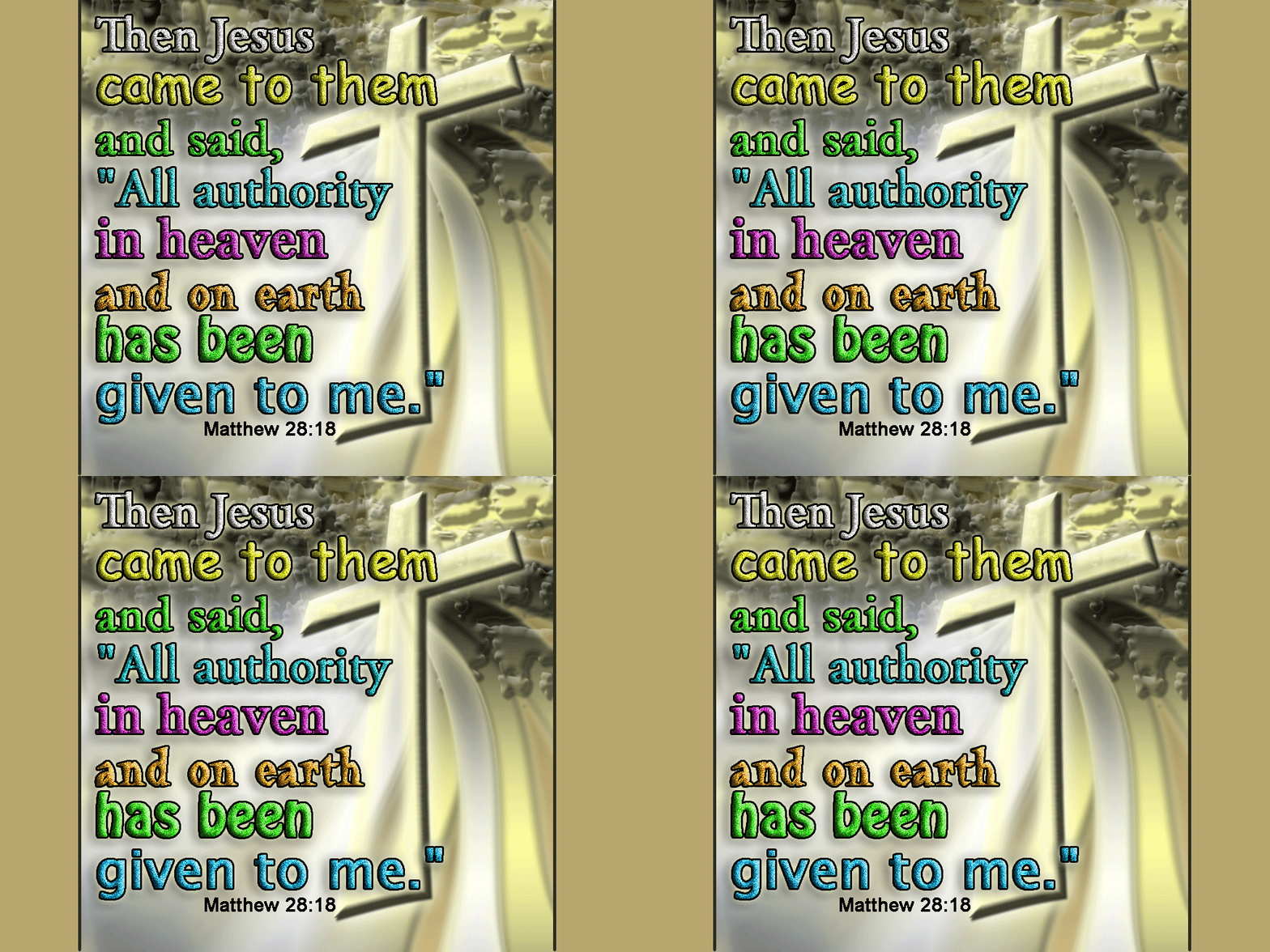
“18 And Jesus came and spake unto them, saying, All power is given unto me in heaven and in earth. 19 Go ye therefore, and teach all nations, baptizing them in the name of the Father, and of the Son, and of the Holy Ghost: 20 Teaching them to observe all things whatsoever I have commanded you: and, lo, I am with you alway, [even] unto the end of the world. Amen.” Mat 28:18-20)

“20 Which he wrought in Christ, when he raised him from the dead, and set [him] at his own right hand in the heavenly [places], 21 Far above all principality, and power, and might, and dominion, and every name that is named, not only in this world, but also in that which is to come: 22 And hath put all [things] under his feet, and gave him [to be] the head over all [things] to the church, 23 Which is his body, the fulness of him that filleth all in all.” (Eph. 1:20-23)

“5 Let this mind be in you, which was also in Christ Jesus: 6 Who, being in the form of God, thought it not robbery to be equal with God: 7 But made himself of no reputation, and took upon him the form of a servant, and was made in the likeness of men: 8 And being found in fashion as a man, he humbled himself, and became obedient unto death, even the death of the cross. 9 Wherefore God also hath highly exalted him, and given him a name which is above every name: 10 That at the name of Jesus every knee should bow, of [things] in heaven, and [things] in earth, and [things] under the earth; 11 And [that] every tongue should confess that Jesus Christ [is] Lord, to the glory of God the Father.” (Philippians 2:5-11)

Certainly, more references could be multiplied. Enough have been cited to show, however, that there is a distinct Dominion given to Messiah. This Mediatorial Dominion is distinct from, additional to, and coterminous with that Dominion which He retains essentially as the Second Person of the Godhead. Note that this additional Dominion is given to Him. It is bestowed upon Him. The reasons for this bestowal by the Father are given, too. This bestowal is a reward for Christ’s “doing and dying.” The Mediatorial Dominion is by purchase. Further, we see that this economy is bestowed in order to bless Christ’s body, the Church.

The extent of this Mediatorial Dominion is universal. This is absolutely necessary for Messiah, as He must rule over all things in order to make them work together for good for those who love Him, and who are the called according to His purpose (Rom. 8:28). It may be objected that the reprobate cannot be under His Mediatorial Reign, for how could He be a Mediatorial King to those who do not benefit from His work of redemption? Let us remember that, in our common experience, we see many who live lives of continual criminality, yet we do not deny that they are under the jurisdiction of the civil magistrate. So it is with the reprobate. Indeed, they get no benefit from the King; only judgment and condemnation (Mat. 25:31ff). Nonetheless, the King sovereignly directs them and all their ways, that His church may be benefitted and the Father made glorious.

Again, it may be objected that the doctrine of a universal Mediatorial King derogates from the dignity, glory, activity, and even the immanence of the Father and the Holy Spirit. Further, Christ’s high dignity as the only-begotten Son is lost sight of. In reply, it should be noted that the orthodox church concurs that the Lord Jesus Christ is Zion’s only King and Head. Does anyone seriously believe that, in the church, the dignity, glory, and activity of the other Persons of the Godhead are in any way impaired? Is there a soul who maintains that teaching that Messiah alone is King of Saints removes the presence of the Father and the Spirit from the Church? And who will say that such teaching leads to the eclipse of His Deity? Who? Such a man, in any orthodox Protestant denomination, would be condemned in the courts of his church for maintaining such positions. If Christ’s Mediatorial Kingship in the church be so obviously acceptable, then there should be no objection of this sort to teaching that He holds sway over all the creation.

One further objection comes to mind. It is that someone else exercises sovereign rule over all things extraneous to the Church. An objector may say that this someone is the Son in His essential Deity. It must be remembered that, although Christ has two distinct natures, He is one Person, one Savior. “Is Christ divided?” (1 Cor. 1:13a) remains a relevant question just at this point. Such an assertion goes against clear Scripture teaching already cited, declaring Christ’s universal dominion as the Mediator. Some bizarre attempts at “exegesis” have been tried in order to elude this conclusion, but such attempts would have been laughable had the subject not been so solemn and majestic.

If not the Son Himself, then perhaps another Person of the Godhead, or the undifferentiated Deity rules in all things extraneous to the Church, it may be said. A problem arises in connection with this proposal. God has determined all blessing, all redemption, all things necessary to the accomplishment of His gracious purposes, to come through the Covenant of Grace. The Covenant, of course, cannot be separated from Him who is its Head. To attempt to approach God apart from a Mediator in these post-Fall times is fatal. To seek any blessing from the Holy and Righteous Judge, deeply offended at sin, is absurdity. To expect anything but God’s wrath and curse, apart from a Mediatorial administration, is folly. If all things extraneous to the Church are in the hands of God essentially, then the Church cannot repose in confidence and trust that all will work for her good. Might they not work for wrath upon her who is still stained, wrinkled, blemished, impure and unrighteous in her current experience? Should she not cower at the approach of the Holy One, strong to smite? Of course she does not, because all things are now ordered through the Covenant of Grace for her benefit. All things, internally and externally, are under the feet of her glorious and loving Husband, the King. His Father becomes Her Father in heaven, strong to save, not the offended Judge mentioned. Her Beloved’s Spirit is sent abroad to be at work as the King’s agent. All Providence, at the King’s command, is ordered for her ultimate good, ultimate purification, ultimate salvation. In the Universal Mediatorial Dominion, and only in it, blessing is certain.

APPLICATIONS

I. For the Church

As noted above, there is a general concensus among Reformed churches that Christ is Mediatorial King of Saints. The Church is His Kingdom of Grace, His “special Kingdom”. As we look at this particular aspect of Christ’s Mediatorial Kingship, we should assume that there would be implications for doctrine, discipline, government, and worship. In these four areas, it must be asserted that the Word of Christ alone determines matters, either as it is “expressly set down in Scripture, or by good and necessary consequence…deduced from Scripture” (WCF 1:6). Therefore, the Church of Christ, and every branch of it, must see that it holds and practices the directions of Him Who is Head and King of Zion. Everything that is truly attained from Scripture must be held tenaciously and perseveringly. Anything that is added must be excised. That which has been dropped must again be carried aloft. This is the reason that the RP Church has retained what she believes to be Scriptural doctrine, although it keeps her apart from other brethren whom she holds dear. This is why the RP Church has tried, though grieving over much of her own inconsistency and negligence, to maintain Scriptural church discipline, especially in the matters of common confession, testimony bearing, and the Sacraments. This is why the RP Church still professes to believe in jure divino Presbyterianism. This is why the RP Church, despite unpopularity and ridicule, retains what she believes to be Scriptural worship principles and practices. These things she believes to be binding upon all the Church of Christ, not mere quirks of her own little circle. Any change on her part must occur as she is convinced that she has erred in her understanding of the Word of God, as has happened in the past. Of course, this is the required basis for change in any part of the Apostolic Church.

This leads to a consideration of church union. That this is a desirable goal, and commanded by Christ no one can deny. Can it come legitimately by the scuttling of the truth of the Bible? Our Savior has commanded His disciples to disciple the nations, teaching them to observe everything that He has commanded (Matt 28:18-20). Putting aside one part of Christ’s commandments in order to effect another is wrong. The one is sinfully ignored and the other is not truly brought about. Both end up lost. Union must be a union in truth. Any true union within the Church of Christ must be a union in the truth, where the formerly divided brethren come to a concensus in their understanding of the King’s gracious decrees. Further, there should then be a corporate pledging of allegiance to the King. In the past, this has been called “public social covenanting”.

2. For the State

Christ is King of nations as well as saints. Nations are distinctly part of His universal Mediatorial Dominion. They are part of His Kingdom of Power, His “subordinate Kingdom”. A very obvious a fortiori argument to this point could be inserted here, but there is no need. Suffice it to say, that since a universal Dominion is demonstrated, there can be nothing remaining outside it, but what is specifically excluded. We have such an exclusion from Messiah’s sway mentioned, but it is not the Civil Magistrate/Civil Government/Nation. “For he hath put all things under his feet. But when he saith all things are put under [him, it is] manifest that he is excepted, which did put all things under him.” (1 Cor 15:27).

That Christ, as the Mediatorial King, claims the allegiance of earth’s nations is quite explicit in Scripture passages already cited. To these testimonies we could add more: “1 O clap your hands, all ye people; shout unto God with the voice of triumph. 2 For the LORD most high [is] terrible; [he is] a great King over all the earth. 3 He shall subdue the people under us, and the nations under our feet. 4 He shall choose our inheritance for us, the excellency of Jacob whom he loved. Selah. 5 God is gone up with a shout, the LORD with the sound of a trumpet. 6 Sing praises to God, sing praises: sing praises unto our King, sing praises. 7 For God [is] the King of all the earth: sing ye praises with understanding. 8 God reigneth over the heathen: God sitteth upon the throne of his holiness. 9 The princes of the people are gathered together, [even] the people of the God of Abraham: for the shields of the earth [belong] unto God: he is greatly exalted.” (Psalm 47) In connection with this citation, it ought to be remembered just who it is that has ascended. It is not God considered in His unity, nor the Heavenly Father, nor the Holy Spirit, nor yet the Son essentially considered, but Messiah. He is the One addressed as God in Psalm 47. The fulness of revelation that we now have in these last days shows us that it is God-man Who is ascended, Who is King, Who reigns over nations, before whom officials, as officials, assemble to learn and to do His will.

Further witness to Christ’s Mediatorial Kingship over the nations can be found in Revelation:

“And the seventh angel sounded; and there were great voices in heaven, saying, The kingdoms of this world are become [the kingdoms] of our Lord, and of his Christ; and he shall reign for ever and ever.” (11:15)

Of Him Who rides forward to conquer the nations with the sword of His Word we read, “And he hath on [his] vesture and on his thigh a name written, KING OF KINGS, AND LORD OF LORDS.” (19:16)

Further official statements on this doctrine as currently confessed by the Reformed Presbyterian Church of North America are in its Testimony, chapter 23, “Of the Civil Magistrate”, pp. A69 – A78 in its Constitution.

From time to time different objections to this teaching come forth. One of the most common comes from misunderstanding the words of our Savior when, before the judgment seat of Pilate, He said, “My kingdom is not of this world.” (John 18:36) Some say that these words are in conflict with a notion of nations formally pledging allegiance to Christ as King. The apparent tension relaxes when we remember what Jesus means when He says that His Kingdom is not of this world. He surely does not mean that it is a purely privatized affair, or something irrelevant to matters of this earth, something of grace as opposed to nature, or something noumenal as opposed to the phenomenal. He does mean that His Kingdom is of a different order, not merely one more kingdom in the midst of many others. He does mean that it is one that acknowledges Him as its immediate supreme overlord, instead of others claiming that role. He does mean that the weapons of conquest are the preaching and teaching of His Word, which bring sinners and societies under Him. He does mean that it is established by the power of the Spirit, rather than that of man. He does mean that it is established in the righteousness and holiness of heaven, not the pride and cruelty of man. This Kingdom is in the world, although not of the world. The nations of this world, along with all else, can, should, and shall be explicitly under the aegis of Christ the King.

Another objection commonly mentioned is that this doctrine seems to force a union of Church and State, with one or the other in ascendancy. While some have perverted this teaching to such an end, proper practical application militates against either an Erastian or Romanist conception of church-state relations. It remains true that Christ alone is Head of the Church, not a pope nor yet a civil magistrate. The proper civil powers remain in their place, too. Scripturally, both Church and State have distinguishable subjects, different ends, different officers, and different sanctions, among other things. Both, nonetheless, are under the same Mediatorial King, the King of Zion and the King of kings. Both Church and State are under the same obligation to covenant with Him in their own appropriate ways, yielding loyalty to their Lord. Both are obliged to support each other in appropriate ways, that the King may be glorified by men in their public lives. Both are obliged to conform to God’s Law, in ways proper to each institution. The State is under constraint in these areas just as much as the Church, in order that it may fulfill its role as God’s ordinance, His ministry for good (Romans 13:2,4). Especially in those nations where the Gospel has been preached, to “Kiss the Son” is an absolute necessity for the national well-being. To resist or refuse such submission is to invite total national annihilation from the offended “King on Zion’s hill.”

In this matter of national submission to Messiah, the Church of Christ has a prominent responsibility. Part of her duty in supporting the State is declaring what is true and false, what is right and wrong, as defined by the Old and New Testament Scriptures. The Church catholic must declare that the State is morally compelled to own Messiah as King and His Law as the law of the land. She must declare the State immoral at these extremely critical points, if it does not repent. Christians, in such a case, in such as we live now, cannot participate in any action that would entrap them in such immorality themselves. There can be no unqualified allegiance sworn to immoral constitutions of government that do not themselves swear allegiance to Christ.

In connection with this national submission, often called “national reform”, the Church has the duty of calling the nation to formal public social covenanting with the King. This follows approved Scriptural example in the times of Joash, Hezekiah, Josiah, Nehemiah, and others. Some may say that the situation of OT Israel was unique. It is true that, in OT times, Israel was unique among the nations of the world in containing the visible Church, and that no nation in these last days can ever make a legitimate claim to be the sole Christian nation. This precludes no land, however, from covenanting to be a Christian nation.

In the matter of putting men into civil office, the Christian citizen must recall, first, that only personally godly men who espouse Scriptural righteousness and justice are worthy of office (Deuteronomy 17:14-20, 2 Samuel 23:3), not those who are of a certain political party or those considered the “lesser of two evils”. Further, these candidates must, themselves, hold to the Christian view of civil government that has just been explained. To elect a man to office who has no conscience qualms about swearing to uphold and defend, without proper qualification, a Christless constitution of government involves both him and the elector in treason to Jesus.

Many, when receiving these teachings for the first time, react negatively. They call them quixotic, out of touch with the rampant ungodliness within our nation. Such principles are unrealistic, they declare. In initial reply, a simple question is appropriate: “But aren’t they Biblical?” If so, then no matter how contrary to common sense they may initially seem to be, we must embrace the doctrines and emplace their practical applications. Many are the times that God has blessed faithful obedience to His Word despite what appear to be pretty long odds, as man perceives. Who knows but that, as we follow the command of Christ to call the nations to repentance in this matter, we shall see them turning contritely to their King by the power of His Spirit? So it happened with Nineveh in the days of Jonah. Our preaching and teaching Christ’s Mediatorial Kingship over the nations will pull people from their pietism and privitization of Christianity. It will prepare the people of God, the Body of Christ, for proper action when the time comes to enact changes in the constitution of civil government, changes that will reflect proper, godly national submission to Messiah.

Another word that may spring up in the mind of some is “triumphalism”. It must be admitted that, historically, the Reformed Presbyterian Church has been postmillenial. Even now, whether they call themselves postmillenial or amillenial, most members of the Synod of the Reformed Presbyterian Church would consider themselves to be optimistic in their eschatology. This optimism, however, is not absolutely necessary in order to hold to the doctrine of Christ’s Mediatorial Reign over the nations, as is known from personal acquaintance. Is it “triumphalist” to teach and act on plain teachings of the Bible? If so, let us triumph in being “triumphalist”! In hoc Christo vinces! (In this Christ conquer!) Really, though, this name-calling is no more profitable in this discussion than that of my fellow theological/eschatological optimists who castigate “pessimillenialists”.

CONCLUSION

This, then, is a very condensed presentation of the doctrine of Christ’s Mediatorial Kingship, with some practical application. The Reformed Presbyterian Church believes it to be Biblical and binding on all the One, Holy, Catholic, and Apostolic Church of Christ. Much of this material may be new to brethren in other branches of the Church, even those branches very near in most points of doctrine, discipline, government, and worship.

The Interchurch Committee of the Reformed Presbyterian Church of North America originally assigned this essay in the spirit of obedience to the church’s Covenant of 1871. In the actual engagement, paragraph 4, we read, “That, believing the Church to be one, and that all the saints have communion with God and with one another in the same Covenant; believing, moreover, that schism and sectarianism are sinful in themselves; and inimical to true religion, and trusting that divisions shall cease, and the people of God become one Catholic church over all the earth, we will pray and labor for the visible oneness of the Church of God in our own land and throughout the world, on the basis of truth and of Scriptural order. Considering it a principal duty of our profession to cultivate a holy brotherhood, we will strive to maintain Christian friendship with pious men of every name, and to feel and act as one with all in every land who pursue this grand end. And, as a means of securing this great result, we will by dissemination and application of the principles of truth herein professed, and by cultivating and exercising Christian charity, labor to remove stumbling-blocks, and to gather into one the scattered and divided friends of truth and righteousness.”

It is hoped that this essay will lead to a better understanding of this vital, yet much overlooked, doctrine; a greater unity in the Church of Jesus Christ; and a determination to work for the recognition of Christ’s crown rights in the nation. May He Who is Head and King of the Church, Zion’s only Potentate; He Who is King of kings and Lord of lords bring it to pass, to the praise of His Name and the glory of His and our Father!

By Philip H. Pockras, minister
Belle Center Reformed Presbyterian Church
Belle Center, Ohio


SELECT BIBLIOGRAPHY

Boyle, Samuel E. The Christian Nation. Pittsburgh: The Christian Government Movement, n. d. [1971].
Edgar, William. “The National Confession Position.” In God and Politics, pp 176-99. Edited by Gary Scott Smith. Foreword by John H. White. Phillipsburg, NJ: Presbyterian and Reformed Publishing Company, 1989.
Hodge, Archibald Alexander. Evangelical Theology. 1890; Reprint ed., Edinburgh: The Banner of Truth Trust, 1976.
McAllister, David. Christian Civil Government in America. 6th ed. Revised by T. H. Acheson and Wm. Parsons. Pittsburgh: National Reform Association, 1927.
Oburn, William. The Dominion of Our Savior Jesus Christ as Mediator. Galion, OH: By the Author, 1878.
Palmer, Benjamin Morgan. “Christ’s Universal Dominion.” The Southern Pulpit I:9 (September, 1881): 526-36.
_____________________. “Sermon, Preached in the First Presbyterian Church, Augusta, Ga., December 4th, 1861, at the Opening of the First General Assembly of the Presbyterian Church of the Confederate States of America.” Minutes of the General Assembly of the Presbyterian Church in the Confederate States of America, 1861.
Reformed Dissenting Presbytery. An Act, Declaration, and Testimony of the Reformed Dissenting Presbyterian Church, in North-America. West-Union, Ohio: Reformed Dissenting Presbytery, 1839.
Reformed Presbyterian Church of North America. The Constitution of the Reformed Presbyterian Church of North America. Pittsburgh: Reformed Presbyterian Church of North America Board of Education and Publication, 1989.
Reformed Presbytery. Act, Declaration, and Testimony. Ploughlandhead, Scotland: 1761; reprint ed. with added historical and declaratory supplement, Philadelphia: Reformed Presbytery [“Steelite”], 1876.
Symington, William. Messiah the Prince, 2nd ed. Edinburgh: John Johnston, 1840.
Thornwell, James Henley. “Relation of the State to Christ. (A Memorial).” The Collected Works of James Henley Thornwell. Vol IV: Ecclesiastical, pp. 549-56. Edited by B. M. Palmer, 1875; reprint ed., Edinburgh: The Banner of Truth Trust, 1986.
United Presbyterian Church of North America. “The Testimony of the United Presbyterian Church of North America,” The Subordinate Standards of the United Presbyterian Church of North America, pp 535-92. Pittsburgh: United Presbyterian Board of Publication, 1903.
Note: William Symington’s tremendously important Messiah the Prince and the Act, Declaration, and Testimonyfrom 1761 are currently in print and obtainable from Still Waters Revival Books Edmonton, AB.

The Mediatorial Kingdom of Christ

The Mediatorial Kingdom of Christ by Dr. Roy Blackwood