
Living Worthy Reflecting God’s Image (Jeremiah Burroughs)

Image

Jeremiah Burroughs

Member of the Westminster Assembly of Divines

The gospel of Christ is the good tidings that God has revealed concerning Christ. As all mankind was lost in Adam and became the children of wrath, put under the sentence of death, God, though He left His fallen angels and has reserved them in the chains of eternal darkness, yet He has thought upon the children of men and has provided a way of atonement to reconcile them to Himself again.

The second Person in the Trinity takes man’s nature upon Himself, and becomes the Head of a second covenant, standing charged with sin. He answers for it by suffering what the law and divine justice required, and by making satisfaction for keeping the law perfectly. This satisfaction and righteousness He tenders up to the Father as a sweet savor of rest for the souls that are given to Him.

And now this mediation of Christ is, by the appointment of the Father, preached to the children of men, of whatever nation or rank, freely offering this atonement unto sinners for atonement, requiring them to believe in Him and, upon believing, promising not only a discharge of all their former sins, but that they shall not enter into condemnation, that none of their sins or unworthiness shall ever hinder the peace of God with them, but that they shall through Him be received into the number of those who shall have the image of God again to be renewed unto them, and that they shall be kept by the power of God through faith unto salvation.

That these souls and bodies shall be raised to that height of glory that such creatures are capable of, that they shall live forever enjoying the presence of God and Christ, in the fullness of all good, is the gospel of Christ. This is the sum of the gospel that is preached unto sinners.

When you hear someone speaking of the gospel, your thoughts may be about this glad tiding that is come into the world for the salvation of sinful creatures through Jesus Christ, and all the good things that Jesus Christ, by His blood, has purchased for sinners. When ministers are called the ministers of the gospel, the meaning is that they are appointed by God as ministers to declare and to preach these glad tidings to the world. Oh, it is glad tidings to the world indeed! Could there be such glad tidings preached at hell’s gates, that there was any such way of reconciling them to God, we could not conceive of the joy that would be there. They would count it as acceptable news indeed.

Now, then, those who believe this gospel, or profess that they have entertained this gospel, these glad tidings, must be careful to walk in their conversation so it becomes this gospel, as becomes such glorious glad tidings sent to them from heaven.

As becomes. The word signifies “worthy of the gospel.” But this cannot mean that our conversation should be such as deserves all the good that there is in the gospel. No, the worthy, that is, as much as becomes the gospel, as is meet for the gospel, or as it is translated in your books, “becoming the gospel.” The Scripture says that he who eats or drinks unworthily eats and drinks to his own damnation. Why, can one eat and drink so as to be worthy of the body and blood of Christ? No, but he who eats and drinks so carries himself so in that ordinance of the Sacrament as is unbeseeming the body and blood of Christ that he comes to receive. On the other hand, those who eat and drink so as to sanctify God’s name in that ordinance (as you have heard) do it worthily, for so the same word is here in the phrase, “worthy of the gospel of Christ.” “And so bring forth fruit worthy of repentance,” said John to those who came to him. It is the same as saying, “Bring forth fruits fitting for, or meet for, repentance,” such fruit as may manifest your repentance, such fruit as may manifest your repentance, such fruit as is suitable for men or women who profess repentance for their sins. Further, I find that the word that is here translated “becoming” in another place is translated “convenient” and “meet.” It can be understood in no other sense. In 1 Corinthians 16:4 we read, “If it be meet that I shall go also…” The word translated “meet” is the same word which is translated “worthy” or, in this passage, “becoming.” If it is a comely thing, or a meet or convenient thing, then I’ll go. So, then, it’s clear that this word which we have here is “meet”, “convenient”, “suitable”, or “becoming the gospel.” “Let your conversation be such as is meet for, or becoming the gospel.”

pp.4-6 Gospel Conversation by Jeremiah Burroughs

God delights to have His image held forth in the world that men may behold something of the glory of His image. But how can the world see the image of God? They cannot see it in your hearts, but God would have it conspicuous. Therefore, have a care of your conversations (conduct) that, in your conversations, you may hold forth the image of God in the world. p.12

The Great Honor That God Puts Upon Human Nature

Image

Portions of Gospel Conversation by Jeremiah Burroughs

There’s nothing in the world that God ever did that reveals the worth of man’s immortal soul as the gospel of Jesus Christ does. There God manifests to all the world what a price He puts upon Man’s soul.
p. 119

The Gospel reveals unto us the great honor that God has put upon human nature above the angels. This could never have been but by the gospel. This is as proper a thing to the gospel as any I have spoken of, and one special design that God had in the gospel was to reveal those thoughts and counsels that He had from all eternity, to put mighty and great excellencies upon our human nature in these two particulars:

One) In the personal union of man’s nature to the Second Person in the Trinity. That’s the first and great way of honor that God has crowned human nature with. Hence the Apostle, in 1 Timothy 3:16, says, “without controversy, great is the mystery of godliness.” What is it? God was manifested in the flesh. God manifested in the flesh? That’s a great mystery of godliness.

Now it could not be such a mystery if God had only taken a human shape upon Him (for so it was in the time of the Law). Jesus Christ often took human shape, as when He strove with Jacob. It was Jesus Christ, as might easily appear, but great is the mystery of godliness. Without controversy it’s great; God manifested in the human flesh. That is, God taking the flesh of a man into a personal union, which is more fully expressed in John 1:14, “The Word was made flesh.” This was a strange speech, but proper to the gospel.

A heathen would have thought this was a strange speech, especially if he knew that by the Word was meant He who was the true and eternal God. And then in Hebrews 2:16 it is said that Christ did not take the nature of angels upon Him, but the seed of Abraham. So it appears that, by the personal union of our natures to the Son of God, God has advanced human nature above angels, above all creatures. Truly, my brethren, in Christ’s taking our nature upon Him, which the gospel holds forth to us, we may see God, as it were, resolving to do a work from Himself to the uttermost, to manifest the uttermost of His glory in a work out of Himself, the work of God within Himself.

It is His eternal generation, and the possession of the Holy Ghost, but now God would work out of Himself, and work out of Himself to the uttermost extent. “I’ll make a world,” said God, “heavens and earth by My Word. Aye, but this is not such a glorious work as I am able to do. I could make ten thousand worlds and, when I have made them, I could make as many more and more glorious. But I would do some work wherein I might manifest even the uttermost of My glory.”

What work is that? The work God pitched upon. He would do no work from without to manifest the uttermost extent of His glory, and the Lord pitches upon this: to take the nature of a man into personal union with His Son. That’s the uttermost; and it is impossible that men or angels, if they were left to all eternity to imagine, could think of a work in which it would be possible for God to express more of His power, wisdom, and glory. We know but little of it now, but we shall know more in heaven.

Now, oh, how God has honored human nature in this: that when He would do a work to the utmost of His excellencies. He would pitch upon man’s nature to take it into personal union with Himself! Here’s the mystery of the gospel.

Now this is, indeed, the marrow of the mystery of the gospel: the Word made Flesh, the Second Person in the Trinity taking man’s nature upon Him. This is the mystery of the gospel that angels and saints admire, and shall be taken up to all eternity in admiring and praising and magnifying God for. That’s the first way of God honoring man’s nature.

Two) The second thing that the gospel reveals is this: God has put honor not only upon the nature of man as having soul and body, but He has put a mighty honor upon the very body of man; the meanest and the very lowest part of a man, the very shell, outside, rind, and the case of man. You have this in 1 Corinthians 6:19, “What, know ye not that your body is the temple of the Holy Ghost. You have no such thing revealed in the Old Testament, this comes by the light of the gospel that the Lord has made the bodies of the saints to be the temples to the Holy Ghost; that the Holy Ghost dwells in their bodies as in a temple. Like the King in his palace, so the Holy Ghost is in His temple. Now these two are great things revealed in the gospel, and did we have a clear understanding of these two things, oh, it would mightily elevate our spirits!

Conversations suitable to these two particulars surely must be a high-raised conversation. For instance, consider the personal union of our natures with the Second Person of the Trinity. Oh, how should this raise our hearts, and we should manifest the elevation of our spirits in our conversation so as it becomes those who may expect great things from God! Surely the fact that God has honored our natures so as to be personally united to His Son shows that He intends great things to some of the children of men.

pp. 124-127
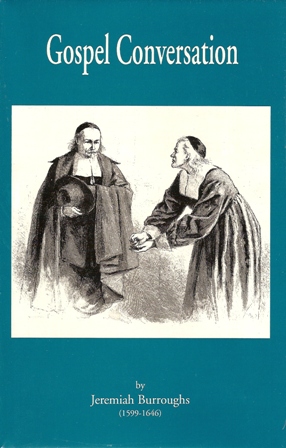
Gospel Conversation
Jeremiah Burroughs

The Psalter: Smartphone of the Soul

I am stealing this from my Pastor James Faris since I uploaded the sermon. Anyways here is a very cool partial blog he did and the sermon that he preached on this.

You can read the whole blog post here.  http://gentlereformation.org/2011/12/22/the-psalter-smart-phone-of-the-soul/#comment-3677

Be very Encouraged,

Randy

Apple used to use that catchy phrase “there’s an app for that.” Need to send flowers to mom? there’s an app for that. Need to know the name of the constellation of stars in the sky overhead? There’s an app for that. Need supper? There’s an app for that.

Well, whatever your circumstance of life, there’s a Psalm for that:

Contemplating origins? Think Psalm 33.
Considering the consummation of the age? Think Psalm 149.
Rising from bed? Think Psalm 5.
Going to bed? Think Psalm 4.
Awake at night? Think Psalm 63.
Ready to eat? Think Psalm 145.
Thirsty? Think Psalm 42.
Going to work? Think Psalm 104.
Celebrating the Lord’s Day? Think Psalm 122.
Checking your genealogy? Think Psalm 16.
Your beginning? Think Psalm 139.
Your birth? Think Psalm 71.
Celebrating a birthday? Think Psalm 104.
Enjoying childhood? Think Psalm 34.
Need motivation to study well? Think Psalm 111.
Gazing at the stars? Think Psalm 19.
Maturing as a youth? Think Psalm 119.
Ready to pop the question? Think Psalm 45.
Bringing children into the world? Think Psalm 128.
Questions about parenting? Think Psalm 103.
Playing with your grandchildren? Think Psalm 71.
Harvest time here? Think Psalm 65.
Seasons changing around you? Think Psalm 147.
Traveling? Think Psalm 121.
On the water? Think Psalm 107.
Remembering history? Think Psalm 78.
Talking with your financial planner? Think Psalm 49.
Tempted by the world? Think Psalm 73.
Disappointed by life? Think Psalm 77.
Weeping over your sins? Think Psalm 51.
Engaged in evangelism? Think Psalm 96.
Overcome by fear? Think Psalm 91.
Angered by the wickedness of men? Think Psalm 94.
Disappointed by civic elections? Think Psalm 2.
Rejoicing in the incarnation? Think Psalm 113.
Prone to worry? Think Psalm 130.
Growing old? Think Psalm 92.
Butchering or preparing meat? Think Psalm 8.
Going to war? Think Psalm 18.
In the process of dying? Think Psalm 6.
Mourning the death of a loved one? Think Psalm 116.
Anticipating eternity? Think Psalm 73.
Of course, you can add other life experiences to the list. Why is the Psalter the smartphone of the soul? Rowland Prothero notes: “The Book of Psalms contains the whole music of the heart of man, swept by the hand of his Maker. In it are gathered the lyrical burst of his tenderness, the moan of his penance, the pathos of his sorrow, the triumph of his victory, the despair of his defeat, the firmness of his confidence, the rapture of his assured hope. In it is presented the anatomy of all parts of the human soul. In it, as Heine says, are collected ‘sunrise and sunset, birth and death, promise and fulfillment – the whole drama of humanity.’”
Thus, we carry the Psalms in our mental pockets daily. Our minds race here to check for truths, to hear from God, and see our decisions and emotions governed when we cannot access the rest of Scripture. This has been my experience of life…from birthdays, to emergency room visits, to maternity wards, to the graveside, and beyond.

Smartphones are great, but they only go so far. They may reveal where you are in a building, but they cannot reveal what is in your building. They may map the stars in the sky, but they cannot unite you to the maker of the stars. They may point you to bread on earth, but they cannot feed you bread from heaven. The Psalms do all of these things and more. Phone programs fail, contracts expire, and phones are dropped in toilets. The Psalms hidden in the heart will never fail you. They will cause the peace of Christ to rule in your heart. They will order your life. But the Psalms only function this way in the hearts of those who own them.

Just because

Image

Just because it is beautiful and I am longing for a day in magnificent beauty. Tyranny of time, the good, and bondage to less means keeps me thankful for the memories we have made and for the pictures we have taken.

I love mspaint!  LOL

Psalm 50:1,2