Herman Bavinck – The Covenant of Grace – Mosaic- (Read Bavinck!)

image

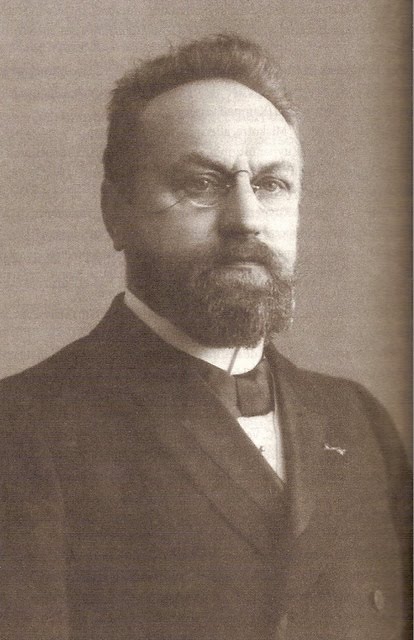
Reading Bavinck on the Covenant of Grace and the Mosaic Covenant is well worth anyone’s time. Put the modern books down and read the good stuff. The difference between Modern Reformed Thought and reading Reformed thought is like going to eat at McDonald’s or Ruth’s Chris Steak House. Read Bavinck!

Enjoy!!

The universal reality of misery evokes in all people a need for deliverance, a deliverance from above. Pagans who construe misery as basically physical know neither the essential character of sin nor the deliverance of grace. Scripture, however, sees our misery as sin, as an ethical violation of communion with God, who alone can restore it. This requires grace, which in biblical revelation assumes the form of a covenant.

This covenant begins immediately after the fall as evidenced by Adam and Eve’s shame in their nakedness, a sign of lost innocence. Guilt and shame reveal both God’s wrath and his grace, but the latter is shown especially when God seeks out Adam and Eve and interrogates them. In his punishment on the serpent and on humanity, God’s mercy triumphs over judgment as he annuls the covenant made with evil and puts enmity between the seed of the serpent and the seed of the woman. Now the path of glory must pass through suffering for man and woman. In the promise of Genesis 3, we find the gospel in a nutshell and, in principle, the entire history of the human race.

The word “covenant” is not found in Genesis 3, but the reality is. Modern critics judge that covenant ideas arose late in Israel’s history but need circular arguments for their case. A history of Israel is constructed by alleging that certain biblical sources are inauthentic, which history is then used to demonstrate the inauthenticity of documents that witness against it. It is better scholarship to see the latter prophets as standing on the foundation of a real covenant made with the patriarchs.

Covenant (ברית) is characterized by three factors: an oath or promise including stipulations, a curse for violation, and a cultic ceremony that represents the curse symbolically. Covenant making is a religious and social act. The covenant of grace is unilateral, indissolubly grounded in the merciful promises of the sovereign God. God cannot break his promise; he has sworn himself to uphold it. The unilateral divine origin and character attributed to the covenant in Hebrew is likely the reason why the Septuagint translates ברית by διαθηκη, or “testament,” rather than συνθηκη.

The doctrine of the covenant achieved dogmatic significance in the Christian church because the Christian religion had to understand its relation to and distinction from Judaism. Over against Gnosticism and Marcion, the church had to maintain the unity of and, over against Judaism, the distinction between the two covenants. Law and gospel, Old Testament and New Testament, are to be distinguished but never separated. During the Reformation this issue became crucial as Anabaptists and others (Arminians, Socinians) devalued the Old Testament. Key differences also arose between the Lutheran and Reformed traditions. It is in the latter, beginning with Zwingli and Calvin, that the doctrine of the covenant is most fully developed, notably in the German Reformed theology of Olevianus and Ursinus, English Puritanism, and the Westminster Confession.

Among the Dutch Reformed, Cloppenburg and Cocceius made the covenant the fundamental premise and controlling principle of dogmatics as a whole. Cocceius had an eccentric view of the covenant, notably the notion of successive covenantal abrogations, which in fact undermined the key element of grace, making it uncertain. After Cocceius, a more general disparagement of the Old Testament took place among modern thinkers such as Spinoza, Kant, Hegel, and Schleiermacher. Judaism was then seen as no better than paganism as preparation for Christianity.

In the Reformed church and theology, covenant became a very important practical encouragement for Christian living. Here the basis of all covenants was found in the eternal counsel of God, in a covenant between the very persons of the Trinity, the pactum salutis (counsel of peace). The work of salvation is an undertaking of the one God in three persons in which all cooperate and each one performs a special task. It is the triune God—Father, Son, and Spirit—who together conceive, determine, carry out, and complete the entire work of salvation. The benefit to the believer is in knowing that the covenant of grace executed and revealed in time and history nevertheless rests on an eternal, unchanging foundation, the counsel of the triune God. The Father is the eternal Father, the Son the eternal Mediator, the Holy Spirit the eternal Paraclete.

Care must be taken in considering the execution of the pact of salvation in time and history. Though God elects Abraham and Israel as his chosen people, his salvific purpose is universal, with all peoples. In the fullness of time, humanity as a whole, Jew and Gentile, is reconciled in the one man, Jesus Christ, at the cross. After the fall, grace and judgment alike are extended to the whole human race. In the beginnings of human history, we see great blessing in remarkable longevity and the great judgment of the flood. After the flood, God makes a covenant with nature not to destroy the world with water again, reduces human life span, and spreads humanity across the world, preventing humans from reaching heaven itself with their ambition. Despite letting the Gentiles walk in their own ways, God providentially grants them significant cultural and social development. He did not leave them without witnesses to himself through the works of his hands. In this way God is present to all people, and they are in some sense “prepared” for the message of salvation.

The universal scope of God’s intention for all peoples—Jew and Gentile—must never obscure the special favor of God to Israel. While Israel is drawn from the nations and there are analogies between Israel’s religious practices and those of the nations, the essential difference is that special grace is reserved for Israel and is not known among the pagans. Pagan religion is self-willed and legalistic. The covenant made with Abraham is new and comes from God alone. Through his covenant with Abraham and Israel, the Creator proves himself to also be the Re-creator and Savior. Elohim, Creator of heaven and earth, is Yahweh, the God of the covenant.

The old covenant with Israel is the necessary preparation for the new covenant in Christ. Though the covenant is one, there are two dispensations. In God’s own time, the promise of the old covenant was fulfilled in the new. The shadow and particularity of the letter became the substance, universality, and freedom of the Spirit. Nothing of the Old Testament is lost in the New, but everything is fulfilled, matured, has reached its full growth, and now, out of the temporary husk, produces the eternal core.

The covenant of grace, fulfilled in the New Testament, was and is surrounded and sustained by God’s covenant with nature, with all creatures. Unlike what Cocceius taught, the covenant of grace is not the successive abolition of the covenant of works but its fulfillment and restoration. “Grace repairs and perfects nature.” God’s demand of obedience remains as the only way to eternal life. The difference between the covenant of works and grace is that God now approaches us not in Adam but in Christ, who fulfilled all the obedience required of Adam. Christ is the second and last Adam who restores what the first Adam had corrupted; he is the head of a new humanity.

The covenant of grace is also integrally united with the counsel of peace, though it should be distinguished from it. In the counsel of peace, Christ is the guarantor and head; in the covenant of grace, he is the mediator. In this way the doctrine of the covenant maintains God’s sovereignty in the entire work of salvation. It is the Father who conceives, plans, and wills the work of salvation; it is the Son who guarantees it and effectively acquires it; it is the Spirit who implements and applies it.

At the same time, the covenant of grace also allows the rational and moral nature of human beings to come into their own. Here it differs from election, in which humans are strictly passive. The covenant of grace describes the road by which elect people attain their destiny; it is the channel by which the stream of election flows toward eternity. Christ sends his Spirit to instruct and enable his own so that they consciously and voluntarily consent to this covenant. The covenant of grace comes with the demand of faith and repentance, which may in some sense be said to be its “conditions.” Yet, this must not be misunderstood. God himself supplies what he demands; the covenant of grace is thus truly unilateral—it comes from God, who designed, defines, maintains, and implements it. It is, however, designed to become bilateral, to be consciously and voluntarily accepted by believers in the power of God. In the covenant of grace, God’s honor is not at the expense of but for the benefit of human persons by renewing the whole person and restoring personal freedom and dignity.

The covenant of grace, with Christ as the new head of humanity, reminds us of the organic unity of the church. The covenant of grace reminds us that election is about not only individual persons but also organic wholes, including families and generations. Therefore, some who remain inwardly unbelieving will for a time, in the earthly administration and dispensation of the covenant of grace, be part of the covenant people. The final judgment belongs to God alone, and in this life the church must regard such with the judgment of charity.(a)

This (Abrahamic) covenant with the ancestors continues, even when later at Sinai it assumes another form. It is the foundation and core also of the Sinaitic covenant (Exod. 2:24; Deut. 7:8). The promise was not nullified by the law that came later (Gal. 3:17). The covenant with Israel was essentially no other than that with Abraham. Just as God first freely and graciously gave himself as shield and reward to Abraham, apart from merits of his, to be a God to him and his descendants after him, and on that basis called Abraham to a blameless walk before his face, so also it is God who chose the people of Israel, saved it out of Egypt, united himself with that people, and obligated it to be holy and his own people. The covenant on Mount sinai is and remains a covenant of grace. “I am The Lord your God, who brought you out of the land of Egypt, out of the ouse of slavery” (Exod. 20:2) is the opening statement and foundation of the law, the essence of the covenant of grace. Yahweh is and perpetually remains Israel’s God before and aside from any dignity or worth that Israel may have. It is an everlasting covenant that cannot be broken even by any sins and iniquities on the part of Israel (Deut. 4:31; 32:26f; Judg. 2:1; Pss. 89:1-5; 105:8; 111:5; Isa. 54:10; Rom. 11:1-2; 2 Cor. 1:20).

The benefits granted to Israel by God in this covenant are the same as those granted to Abraham, but more detailed and specialized. Genesis 3:15 already contains the entire covenant in a nutshell and all the benefits of grace. God breaks the covenant made by the first humans with Satan, puts enmity between them, brings the first humans over to his side, and promises them victory over the power of the enemy. The one great promise to Abraham is “I will be your God, and you and your descendants will be my people” (Genesis 17:1 paraphrase). And this is the principle content of God’s covenant with Israel as well. God is Israel’s God, and Israel is his people (Exod. 19:6; 29:46; etc.) Israel, accordingly, receives a wide assortment of blessings, not only temporal blessings, such as the land of Canaan, fruitfulness in marriage, a long life, prosperity, plus victory over its enemies, but also spiritual and eternal blessings, such as God’s dwelling among them (Exod. 29:45; Lev. 26:12), the forgiveness of sins (Exod. 20:6; 34:7; Num. 14:18; Deut. 4:31; Pss. 32; 103; etc.), sonship (Exod. 4:22; 19:5-6; 20:2; Deut. 14:1; Isa. 63:16; Amos 3:1-2; etc.), sanctification (Exod. 19:6; Lev. 11:44; 19:2), and so on… (b)

Just as Abraham, when God allied himself with him, was obligated to “Walk before his face,” so Israel as a people was similarly admonished by God’s covenant to a new obedience. The entire law, which the covenant of grace at Mount Sinai took into its service, is intended to prompt Israel as a people to “walk” in the way of the covenant. It is but an explication of the one statement to Abraham: “Walk before me, and be blameless” [Gen. 17:1], and therefore nor more a cancelation of the covenant of grace and the foundation of a covenant of works than this word spoken to Abraham. The law of Moses, accordingly, is not antithetical to grace but subservient to it and was also thus understood and praised in every age by Israel’s pious men and women. But detached from the covenant of grace, it indeed became a letter that kills, a ministry of condemnation. Another reason why in the time of the Old Testament the covenant of grace took the law into its service was that it might arouse the consciousness of sin, increase the felt need for salvation, and reinforce the expectation of an even richer revelation of God’s grace. He writes that Israel as a minor, placed under the care of the law, had to be led to Christ (Rom. 10:4; Gal. 3:23f. 4:1f.) and that in that connection sin would be increased and the uselessness of works for justification and the necessity of faith would be understood (Rom. 4:15; 5:20; 7:7f; 8:3; Gal. 3:19). On the one hand, therefore, the law was subservient to the covenant of grace; it was not a covenant of works in disguise and did not intend that humans would obtain justification by their own works. On the other hand, its purpose was to lay the ground work for a higher and better dispensation of that same covenant of grace to come in the fullness of time. The impossibility of keeping the Sinaitic covenant of the meeting of demands of the law made another and better dispensation of the covenant of grace necessary. The eternal covenant of grace was provoked to a higher revelation off itself by the imperfection of the temporary form it has assumed in Israel. Sin increased that grace might abound. Christ could not immediately become human after the fall, and grace could not immediately reveal itself in all its riches. There was a needed for preparation and nurture. “It was not fitting for God to become incarnate at the beginning of the human race before sin. For medicine is given only to the sick. Nor was it fitting that God should become incarnate immediately after sin that man, having been humbled by sin, might see his own need of a deliverer. But what has been decreed from eternity occurred in the fullness of time. (c)

Bavinck, H., Bolt, J., & Vriend, J. (2006). Reformed Dogmatics, Volume 3: Sin and Salvation in Christ ((a) 193–196, (b) 220-221, (c) 222). Grand Rapids, MI: Baker Academic.
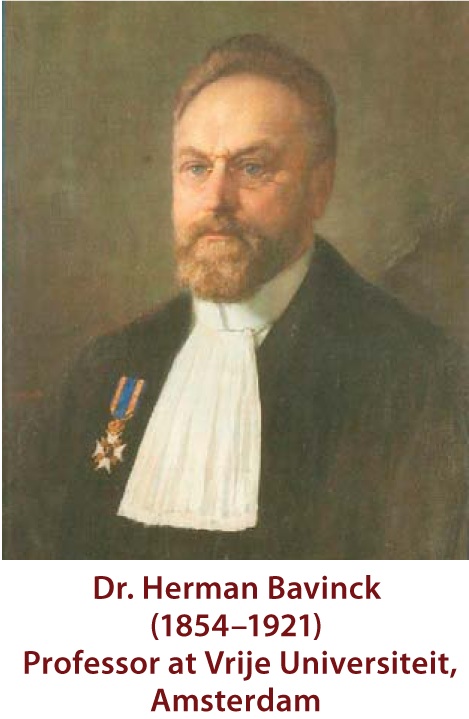
I guess what I am trying to say is read Bavinck!
Old Posts on the Mosaic Covenant / the New Reformed Paradigm

image

Old Posts on the Mosaic Covenant vs. the New Reformed Paradigm

Why I was drawn into this.

https://rpcnacovenanter.wordpress.com/2014/06/28/why-i-was-drawn-into-the-nuanced-republication-and-mosaic-covenant-study/

Dr. Robert Strimple on Republication and the Mosaic Covenant

Dr. Robert B. Strimple on the Mosaic Covenant and Republication of the Covenant of Works

It isn’t about disctinctions it is about dichotomy

The Charge of Lutheranism is not about distinction, it is about dichotomy

A Very Good Discussion on R. Scott Clark’s 7 point Summary of Republication /  He mistakenly thinks

https://rpcnacovenanter.wordpress.com/2014/10/22/very-good-discussion-on-r-scott-clarks-7-point-summary-of-republication/

The Marrow of Modern Divinity and the Recent Republication Issue

The Marrow of Modern Divinity and the Recent Republication Issue.

The Covenant of Grace, the Sinaitic and the New

The Covenant of Grace, The Sinaitic and the New

OPC Special Committee Report

Confusion in the Camp / Merit and Reformed Theology

OPC Presbytery Northwest Debates Republication: Merit, Grace, and the Mosaic Covenant. Vote to send it to General Assembly

OPC Presbytery of the Northwest Debates Republication: Merit, Grace, and the Mosaic Covenant. Votes to Send Overture to the 81st General Assembly.

OPC Video – Session Two – Presentation on Particular view of Republication

OPC-PNW Republication Session 2

WCF 19

Westminster Confession of Faith Chapter 19. The Law and the Covenant of Works.

Republication Beeke / Jones

What is Republication of the Covenant of Works?

Lutheran and Reformed Differences in the Divines.

Lutheran / Reformed differences recognized during the time of the Westminster Divines

Mosaic Covenant and the modern justification / sanctification controversy

The Mosaic Covenant and the Modern Day Justification and Sanctification Controversy

The Mosaic Covenant same in Substance as the New Covenant

The Mosaic Covenant, same in substance as the New?

THe Modern Day Controversy justification / Sanctification

The Mosaic Covenant and the Modern Day Justification and Sanctification Controversy

Depraved Christianity might be antinomian Christianity

(What is the Gospel?) Depraved Christianity might be Antinomian Christianity pt. 3

Samuel Rutherford the Covenant of Life opened.

The Covenant of Life Opened chapter XI

James Durham the Covenant of Works and the Mosaic

The Covenant of Works and the Mosaic Law / James Durham

Vindication of the Law and Covenants Anthony Burgess

Vindication of the Law and the Covenants (1647) pp.231-237

Skirting the Issue  / Clark

Skirting the issue?

Dr. R. Scott Clark is not teaching the Broad View of the Westminster Divines

Clark is not teaching the Broad view of the Westminster Divines.

I know Dr. Clark seems to get a lot of attention here.  It isn’t because I have some personal vendetta.  Dr. Clark is accessible and easy to reference since he writes and contributes often in the world of modern media.

Typology and Republication (Patrick Ramsey)

http://patrickspensees.wordpress.com/2013/11/22/typology-and-republication/

“Two Kingdoms” Propositions and some Responses

https://rpcnacovenanter.wordpress.com/2013/02/06/two-kingdoms-propositions-with-some-responses-or-counterpoints/

Modern Day Reformed Thought and Two Kingdoms

https://rpcnacovenanter.wordpress.com/2012/09/18/modern-day-reformed-thought-two-kingdoms-view-vs-the-biblical-one-kingdom-view/

Sundry Quotes from Solid Reformed Men on Law and Gospel

https://rpcnacovenanter.wordpress.com/2012/09/19/sundry-quotes-from-solid-reformed-men-on-law-and-gospel/


OPC REPORT ON REPUBLICATION

I am somewhat satisfied with the final report.  It should prove and settle the problem that some of our Modern Popular Professors and Authors are teaching contrary to the Scriptures and the Westminster Standards when it comes to the Mosaic Covenant.

http://www.opc.org/GA/republication.html


Confusion in the Camp / Merit and Reformed Theology

Image

Confusion in the Camp

Merit and Reformed Theology

In the Reformed Church, there has been much debate in the past decade over issues such as Natural Law, The Two Kingdoms, the Law-Gospel distinction, Justification and Sanctification, the Covenant of Works, the Covenant of Grace, and even the definition of the Gospel.

In the past few years, it has come to the attention of some ministers of the Orthodox Presbyterian Church that doctrinal confusion has arisen over the doctrine of republication. The heart of the issue lies in a particular formulation of the Mosaic covenant, including the notion that Israel as a “corporate Adam” is under a typological arrangement which entails meritorious works on the temporal level. This confusion is coming to the forefront in OPC Presbyteries when licensure and ordination exams are being conducted. As I understand it, these issues are having far reaching consequences as the church pursues its peace, purity, doctrinal integrity, and practice.

In April of 2012, an Overture was proposed to the Presbytery of the Northwest OPC. This overture called for the 79th General Assembly to establish a study committee to examine teachings propagated in a publication, The Law is Not of Faith, edited by Bryan D. Estelle, J. V. Fesko, and David VanDrunen. Overtures are proposed requests for consideration of doctrinal matters or how things should function in the church. At the April 2012 meeting of the Presbytery of the Northwest OPC, the motion to approve the overture was replaced with a motion to establish a Special Presbytery Committee to study the issues concerning the doctrine of Republication as presented in the teachings of Meredith Kline and the book The Law is Not of Faith. This teaching has far reaching implications concerning the doctrines mentioned in the first paragraph.

Three Ministers from the Presbytery of the Northwest OPC (Randy Bergquist, Andy Elam, and Rob Van Kooten), have submitted their own study regarding the presbytery committee’s new proposed overture for all to review. The study first sets out to give some historical background for the publication the The Law Is Not Of Faith. It discusses the motives and reasons that are stated in the book itself. Next, it analyzes the covenant theologies of John Murray, Norman Shepherd, and Meredith Kline. The authors of the study booklet believe that these three men are the main reasons that this issue of Republication has come to the forefront in recent theological discussion. Their teachings are examined in light of the Westminster Confession of Faith and historic Reformed thought. Part 2 of the booklet turns to a critical examination of the doctrine of republication. Its basic thesis can be summarized as follows: ….the Republication Paradigm (ie., the views of Kline and The Law is not of Faith) uses traditional language and concepts, but redefines them in the service of its own paradigm. Not only do these new definitions fail to harmonize with those contained in the Westminster Standards, they may lead to other systematic changes in our confessional theology.” I would also note that when there are systematic doctrinal changes, there will also be changes in how we apply the Scriptures and practice our faith.

All three ministers are graduates from Westminster Seminary California from which most of this controversial teaching is emanating. A pre-presbytery discussion will be held on September 26, 2013 at First OPC in Portland, Oregon.

https://sites.google.com/site/mosaiccovenant/home

https://sites.google.com/site/mosaiccovenant/paper

What is Republication of the Covenant of Works?

Image

Here is a portion of a book ‘A Puritan Theology Doctrine For Life’ that everyone should read to understand what is being discussed in Modern Circles today.   Dr. Joel Beeke’s and Mark Jone’s book “A Puritan Theology Doctrine for Life” should be read if you want to know if Modern Day Reformed Thought is being historically accurate with how they define their positions and understanding on issues concerning Covenant Theology.  Read Chapters 16-18 and you will notice a difference between them and the Westminster Divines on some things.

The Modern Reformed Thought does not hold to a position that the Mosaic Covenant and the New Covenant are of the same Substance as the Westminster Divines defined things. They also define Republication of the Covenant of Works a bit differently than how the Divines of the Westminster Assembly used this terminology.  Modern Day Reformed Thought holds to a position that the Mosaic Covenant administers both a Covenant of Grace and a Covenant of Works.  They hold to what is known as a Minority Position and it is defined in the book also.  It is not Westminsterian.

Enjoy…

Anthony Burgess likewise comments that the law may be understood largely, “as that whole doctrine delivered on Mount Sinai,” or strictly, “as it is an abstracted rule of righteousness, holding forth life upon no terms, but perfect obedience.”75 In the former sense, the law belongs to the covenant of grace; in the latter sense, the law was not of grace, but of works, which helps explains Paul’s polemic against the law in his New Testament writings (e.g., Galatians). These distinctions also help to explain the idea found in many Puritan authors who speak of the Mosaic covenant as republishing the moral law first given to Adam, written on his heart, engraved on tablets of stone as the Decalogue. For the most part, theologians who spoke in this way, whether dichotomists or trichotomists, made a number of careful qualifications in order to show that the moral law was republished not as a covenant but as a rule of righteousness for those in covenant with God. In other words, the moral law was not republished at Sinai to serve as a means of justification before God. For example, John Owen made clear in his work on justification by faith that the old covenant was not a revival of the covenant of works strictly (i.e., “formally”). Rather, the moral law was renewed declaratively (i.e.,“materially”) and not covenantally: “God did never formally and absolutely renew or give again this law as a covenant a second time. Nor was there any need that so he should do, unless it were declaratively only, for so it was renewed at Sinai.”76 The concept of republication of the moral law does not make Sinai co-extensive with Eden in terms of strict covenantal principles. If the moral law is abstracted “most strictly,” to use Roberts’s language, then Sinai certainly was a formal republication of the covenant of works. But, as Ball tried to argue, that certainly was not the intention of the old covenant. In the end, Ball’s position, which had been argued during the Reformation by Heinrich Bullinger, Peter Martyr, and John Calvin, clearly influenced the Westminster divines.

Accordingly, chapter 19 of the Westminster Confession, “Of the Law of God,” begins by asserting that the moral law was first given to Adam, and goes on to say, “This law, after his fall, continued to be a perfect rule of righteousness, and as such, was delivered by God upon Mount Sinai, in ten commandments, and written in two tables” (19.2). The Confession further asserts, “The moral law doth for ever bind all, as well justified persons as others, to the obedience thereof” (19.5), and is of great use to believers “as a rule of life informing them of the will of God, and their duty…discovering also the sinful pollutions of their nature…together with a clearer sight of the need they have of Christ, and the perfection of his obedience” (19.6). Chapter 19 concludes that for a believer to do good because the law commands it or to refrain from evil because the law forbids it, “is no evidence of his being under the law, and not under grace. Nor are the aforementioned uses of the law contrary to the grace of the gospel, but do sweetly comply with it” (19.6–7).

Likewise, the Confession declares that the covenant of grace was administered “in the time of the law…by promises, prophecies, sacrifices, circumcision, the paschal lamb, and other types and ordinances…all fore-signifying Christ to come.” Such outward forms were “for that time, sufficient and efficacious, through the operation of the Spirit, to instruct and build up the elect in faith in the promised Messiah, by whom they had full remission of sins, and eternal salvation” (7.5). Hence it follows that “the justification of believers under the Old Testament was…one and the same with the justification of believers under the New Testament” (11.6).

p. 270-1

75. Burgess, Vindiciae Legis, 223.
76. Owen, Justification by Faith, in Works, 5:244.

Beeke, Joel R.; Jones, Mark (2012-10-14). A Puritan Theology: Doctrine for Life (Kindle Locations 10634-10647). . Kindle Edition.

For more on the subject of Modern Reformed Thought go to these links.
https://rpcnacovenanter.wordpress.com/2012/09/18/lutheran-reformed-differences-back-during-the-time-of-the-westminster-divines/

https://rpcnacovenanter.wordpress.com/2013/08/02/old-posts-on-the-mosaic-covenant-vs-the-new-reformed-paradigm/

https://rpcnacovenanter.wordpress.com/2014/05/21/the-charge-of-lutheranism-is-not-about-distinction-it-is-about-dichotomy/

You can also read my comments on the Westminster Confession of Faith Chapter 19 here.

https://rpcnacovenanter.wordpress.com/2012/09/02/westminster-confession-of-faith-chapter-19-the-law-and-the-covenant-of-works/

The Mosaic Covenant and the Modern Day Justification and Sanctification Controversy

Image

In light of the modern day controversy concerning justification and sanctification,  let me ask others to look at something that hasn’t been considered much. What is its root problem? The root problem can actually solve a lot of issues from the justification / sanctification issue in soteriology to the Natural Law / Kingdom Issues we are experiencing.  Why?  Because they all have to do with our relationship to the Law of God.

This issue has a root problem that goes back to a hermeneutic of how the Mosaic Covenant is viewed and seen. It is having a rippling effect through much of the theology in our Reformed Camp. It is dichotomizing (divorcing) law and grace (law and gospel) in our doctrines of soteriology. It is also leading others into the various doctrines that are divorcing God from society.  A few friends of mine have referred to these doctrines as old distortions of Natural Law / Two Kingdom Theology that were out of accord and rejected by the Reformers.

The hermeneutic I am referring to is propagated by men who are in the United Reformed Church of North America, Orthodox Presbyterian Church, possibly men in the Presbyterian Church of America, and noted men teaching at a Seminary that trains our Reformed and  Presbyterian Ministers. Most people who know me know of whom I am referring to.  (Westminster Seminary California)  Does this Seminary allow this teaching to go on from the top (Dr. Robert Godfrey) down (Drs. Horton and Clark) without a notification that it is against the Standards we as Presbyterians confess?  It sure seems hidden to me.  I would even venture to say that this teaching is so prevalent in the Church today that it isn’t even recognized as being different from the Westminster Standards.   I know Pastors, Ruling Elders, Drs. of Theology, Seminary Professors,  Seminary Students, and Laymen who know this is true and have affirmed this truth to me.  

Even our Divines at the Westminster Assembly knew this teaching and variants of it were in opposition to sound doctrine.  Here is Anthony Burgess on the difference between Lutheran and Reformed views concerning the Mosaic Covenant.

“We have confuted (proven to be incorrect) the false differences, and now come to lay down the truth, between the law and the Gospel taken in a larger sense.  

And, first, you must know that the difference is not essential, or substantial, but accidental: so that the division of the Testament, or Covenant into the Old, and New, is not a division of the Genus (classification) into its opposite Species; but of the subject, according to its several accidental administrations, both on Gods part, and on mans. It is true, the Lutheran Divines, they do expressly oppose the Calvinists herein, maintaining the Covenant given by Moses, to be a Covenant of Works, and so directly contrary to the Covenant of Grace. Indeed, they acknowledge that the Fathers were justified by Christ, and had the same way of salvation with us; only they make that Covenant of Moses to be a superadded thing to the Promise, holding forth a condition of perfect righteousness unto the Jews, that they might be convinced of their own folly in their self-righteousness.” (Vindication of the Morall Law,  Lecture 26  p.251)

https://rpcnacovenanter.wordpress.com/2012/09/18/lutheran-reformed-differences-back-during-the-time-of-the-westminster-divines/

This view that is being taught was a minority view and evidently refuted without much to do from what I understand.  There isn’t much discussion paid to the topic in the minutes nor much argument about it from what I understand. I guess that might be an indication about how much of a factor this minority view was.  Yet it seems this minority teaching is being taught as though it is a majority position. This doctrine has to do with the substance of the Old and New Covenants being the same as the Westminster Confession of Faith states in chapter 7, sections 5,6.  It also has to do with some forms of Republication of the Covenant of Works and what Republication is.

I can quote one person specifically that does not believe the Mosaic Covenant is of the same substance as the New Covenant.  He holds to views that are specifically contrary to our Standards when considering the Mosaic Covenant. Yet he is teaching future Presbyterian Pastors contrary to our Standards. I wonder if he is teaching our future Pastors that he doesn’t hold to the Westminster Confession of Faith on this topic.  I think he should since he teaches these future Pastors  from a Seminary which distinctively has a namesake taken from our Confessional Standards.  He specifically writes (for everyone to read) that he does not believe that the Mosaic Covenant is renewed in the New Covenant.  He must believe it is of a different substance having a superadded work or Covenant of Works principle in it.  The Mosaic Covenant in his thinking is both an administration (pedagogically) of the Covenant of Works and of Grace. That would make the New Covenant and Mosaic Covenant different and not of the same substance as an administration of the Covenant of Grace.  As I understand it, in this scheme there is an opposition of law and grace that is not found in the Presbyterian or later Reformed hermeneutic of the Majority of the Divines.  Samuel Rutherford, Anthony Burgess, and many other good men have written on this topic and it just seems that this is neglected by these Modern Reformed Thinkers.

http://clark.wscal.edu/covtheses.php
Biblical / Exegetical section…
13. The Mosaic covenant was not renewed under Christ, but the Abrahamic covenant was.

16. With regard to the land promise, the Mosaic covenant was, mutandis, for pedagogical reasons (Galatians 3:23-4:7), a republication of the Adamic covenant of works.

17. With regard to justification and salvation, the Mosaic covenant was an administration of the covenant of grace.

18. The Israelites were given the land and kept it by grace (2 Kings 13:23) but were expelled for failure to keep a temporary, typical, pedagogical, covenant of works (Genesis 12:7; Exodus 6:4; Deuteronomy 29:19-29; 2 Kings 17:6-7; Ezekiel 17).

19. The covenant of grace, initiated in history after the fall, was in its antepenultimate state under Adam, Noah, and Abraham, its penultimate state under the New Covenant administration and shall reach its ultimate (eschatological) state in the consummation.

20.  The term “Old Covenant” as used in Scripture refers to the Mosaic epoch not every epoch before the incarnation nor to all of the Hebrew and Aramaic Scriptures indiscriminately.

21. The New Covenant is new relative to Moses, not Abraham.

Concerning the Covenant of Grace, Richard Sibbesl states it thusly in his writing…

There are four periods of time of renewing this covenant: first, from Adam to Abraham;… Secondly, From Abraham to Moses;… The third period of renewing the covenant of grace was from Moses to Christ; and then it was more clear, whenas to the covenant made with Abraham, who was sealed with the sacrament of circumcision, the sacrament of the paschal lamb was added, and all the sacrifices Levitical; and then it was called a testament. That differeth a little from a covenant; for a testament is established by blood, it is established by death. So was that; but it was only with the blood and death of cattle sacrificed as a type.

But now, to Christ’s time to the end of the world, the covenant of grace is most clear of all; and it is now usually called the New Testament, being established by the death of Christ himself; …

https://rpcnacovenanter.wordpress.com/2012/09/25/covenant-testament-works-grace-love-and-communion/

This is the hermeneutical root and problem in my estimation. This hermeneutical problem is a dichotomizing of Law and Gospel (Grace).  It tells us the Law only commands and that Gospel (Grace) tells us something has been done for us without command.  Just for reference this is what I am talking about.   Dr. Michael Horton in his three minute video clip says this concerning the Gospel,  “It refers to God’s promise of salvation in Christ.  The gospel is a victory announcement.  It never tells us something to do.  That is the business of the law.  Rather, the gospel tells us something that has been done.


This has spilled over into other areas of our theology also.  For instance it has spilled over into Kingdom Theology and how the Law of God applies to all of mankind.   We are slowly removing the requirement and responsibilities of our Magistrates to be in subjection to God and His Ten Commandments.   This is killing our Society.  Anytime you start to partition an Administration of the Covenant of Grace and change its substance like these guys are doing you are treading in strange waters if you are Presbyterian.  The Gospel and Law are not opposed to each other as some want to prove in all cases.  In fact Ursinus says when they are joined together they become the Spirit.

I started discovering this dichotomizing of law and grace a few years ago as I started noting how these men were defining the Gospel.  This dichotomizing of law and Grace seemed unnatural even to this one time Reformed Baptist. I use to be a Reformed Baptist until I came to understand that the Old Covenant and New Covenant were of the same substance as they were from the Administration of the Covenant of Grace. Even then this long time Reformed Baptist didn’t dichotomize Law and Grace in the Gospel and Sanctification to the extreme I saw it being done.  As a Reformed Baptist I did dichotomize the Substance of the Covenants based upon my understanding of Hebrews chapter 8.  I did hold to a similar view of John Owen’s interpretation of the Mosaic and New Covenant when it came to membership of the Covenant but I didn’t dichotomize grace and law in the life of the believer of either Covenant.  I believe that is what is being done by those who hold to this Lutheranized (Not necessarily Luther’s view) / Klinean view of the Mosaic Covenant.

I believe a proper view of the Covenant of Grace as it administers the Covenants historically will give us a proper balance of Law and Grace.  I have already written about the substance of the Covenant before and I think if you read it you will see why I am saying what I am saying.  It views the Law of God and Grace in their proper relationship as they should be viewed in my estimation.  It also views the Gospel correctly as it isn’t just a proclamation outside of us with no commands.

https://rpcnacovenanter.wordpress.com/2012/09/14/the-mosaic-covenant-same-in-substance-as-the-new/

I also want to encourage Westminster California to be forthcoming about their Professors doctrinal stances in relationship to the Westminster Confession of Faith.  I have run into far too many people that look to Westminster West for guidance that don’t know that they are teaching contrary to the Westminster Standards concerning the Mosaic Covenant.   It is eye opening when others discover this.  After they put aside their party spirit and their theological celebrity status blinders things start falling into place and a whole new world of understanding comes to their aid in Christ.  Pieces of the theological puzzle start to fit together as it was meant to be.  People start to have a different appreciation for grace and law as they see it more clearly.

Just my Nickles worth.

The following link is a short paper presented to Dr. Joseph Pipa on this topic. It also helped me clarify some things when I first started looking at this issue.

KLINE, HORTON, AND THE MOSAIC COVENANT

http://citeseerx.ist.psu.edu/viewdoc/download?doi=10.1.1.737.5521&rep=rep1&type=pdf&fbclid=IwAR3Djotk6sWLDlEjIiyRBcm895iEGrpYFZ5RYppsXxF7DG6A7pKKK8Oa9NE

And this is one great website that is pulling the historical truth out concerning the Mosaic Covenant.

https://sites.google.com/site/themosaiccovenant/

James Durham on the Mosaic Covenant

https://rpcnacovenanter.wordpress.com/2012/09/01/taken-frompract/

From A Puritan Theology by Beeke and Jones. What is Republication

https://rpcnacovenanter.wordpress.com/2013/02/04/what-is-republication-of-the-covenant-of-works/

Depraved Christianity?  The Gospel….. Horton…. What is the Gospel?

https://rpcnacovenanter.wordpress.com/2012/12/07/depraved-christianity-might-be-antinomian-christianity-pt-3/

The Mosaic Covenant, same in substance as the New? Not according to Modern Reformed Thought.

Decalogue_parchment_by_Jekuthiel_Sofer_1768

Pressing an old Blog entry…

via The Mosaic Covenant, same in substance as the New? Not according to Modern Reformed Thought..

Also look at this…
https://rpcnacovenanter.wordpress.com/2014/06/28/why-i-was-drawn-into-the-nuanced-republication-and-mosaic-covenant-study/
This is the doctrine that caused me to became a Presbyterian after having been a Reformed Baptist for 30 years.  It is also the doctrine that causes me to be alarmed over much of what is being taught today in the Reformed Camp.  They don’t understand the Mosaic Covenant.   I call today’s understanding Modern Reformed Thought.

Check out the whole thing as I post a small portion here…

I have recently been helped in understanding the Mosaic Covenant by Scripture clarification along with the help of a Pastor Patrick Ramsey. Thank You Pastor Ramsey.I have found that I disagree with Meredith Kline and others that hold to similar positions of a works paradigm in the Mosaic Covenant. While Owen’s view and Kline’s differ a bit by terminology I believe they are closer than people want to credit. I believe Kline holds to something more similar called a superadded subservient view of the Mosaic Covenant which was rejected by the Majority of Divines who wrote the Westminster Confession of Faith. You can learn about this by reading this article that was published in the Westminster Journal.  http://tinyurl.com/9xbtega

In working out this works paradigm I think Patrick Ramsey does a good job in revealing what Romans 10:5 and Leviticus 18:5 say when considering the whole Counsel of God. In fact when we look at Paul’s references we would think that Paul is pitting Moses against Moses and the Old Testament against the Old Testament in his New Testament writings. Especially if we just lift passages out of texts without considering other passages Paul also referenced. Paul isn’t pitting the OT against the OT or Moses against Moses when we look at the fuller context for understanding….

Read on brothers and sisters….  https://rpcnacovenanter.wordpress.com/2012/09/14/the-mosaic-covenant-same-in-substance-as-the-new/

Here is a great reference…. https://sites.google.com/site/themosaiccovenant/

Exposure on Dr. R. Scott Clark from Westminster West.  No wonder why I remained a Reformed Baptist and didn’t understand Covenant Theology from a truly Reformed perspective.
https://rpcnacovenanter.wordpress.com/2014/03/11/clark-is-not-teaching-the-broad-view-of-the-westminster-divines/

https://rpcnacovenanter.wordpress.com/2014/05/21/the-charge-of-lutheranism-is-not-about-distinction-it-is-about-dichotom

https://rpcnacovenanter.wordpress.com/2012/09/02/westminster-confession-of-faith-chapter-19-the-law-and-the-covenant-of-works-2/

Dr. Robert Strimple whose Chair at Westminster Seminary California  David Van Drunen occupies sets the Record straight concerning the book The Law Is Not of Faith and the Mosaic Covenant.

https://rpcnacovenanter.wordpress.com/2014/02/19/dr-robert-b-strimple-on-the-mosaic-covenant-and-republication-of-the-covenant-of-works/

I loved this piece on Klhortonian Theology… http://citeseerx.ist.psu.edu/viewdoc/download?doi=10.1.1.737.5521&rep=rep1&type=pdf&fbclid=IwAR3Djotk6sWLDlEjIiyRBcm895iEGrpYFZ5RYppsXxF7DG6A7pKKK8Oa9NE

Modern Day Reformed Thought and Two Kingdoms…  https://rpcnacovenanter.wordpress.com/2012/09/18/modern-day-reformed-thought-two-kingdoms-view-vs-the-biblical-one-kingdom-view/

The Mosaic Covenant:  a “Republication” of the Covenant of Works?

A Review article: The Law Is Not of Faith: essays on Works and Grace in the Mosaic Covenant

Cornel P. Venema
http://www.midamerica.edu/resources/journal/21/venema21.pdf

You may also want to check out my comments on Galatians 3 and 4.  Some people use this passage to show that the Law and Gospel are opposed to each other but that is a terrible misreading of the text.  The Law and Gospel are not opposed.

https://rpcnacovenanter.wordpress.com/2012/08/30/possible-misconceptions-about-galatians-law-and-gospel-are-opposed/

Dr. Gamble on Two Kingdom Theology.

I am posting a link to the Puritanboard here so that instructions are included for listening to the Video Webinar.  It might have an echo and I already posted on that.  This is a very important subject now days in my estimation.  Please enjoy this discussion by Dr. Richard Gamble from Reformed Presbyterian Theological Seminary.  Also remember that this is a general synopsis. It will not hit everyone who holds to Two Kingdoms. The terminology of Two Kingdom is also used in different ways by others.  Calvin mentioned a Two fold Government. Calvin used those terms interchangeably if I am not mistaken. Anyways, enjoy this.

http://www.puritanboard.com/f15/critique-two-kingdom-theology-dr-richard-gamble-lecture-76540/#post973728

I will still post the direct link.  But….

If you get an echo just click on the pause button in the middle of the video panel. Go to the bottom right of the page and mute the sound on the bottom sound icon. Then click play again. It will eliminate the double voicing. I was getting an Echo with my Google browser.

https://www.fuzemeeting.com/replay_meeting/bffa2e59/2761243

BTW, There are a few hiccups with the feed about 30 minutes in. They pass after a minute or two.

In the Covenant of Grace

Image

Why would anyone want to read my thoughts when they could read Herman Bavinck?  Enjoy this tidbit.  It is very, very, very good.

RMS.

The universal reality of misery evokes in all people a need for deliverance, a deliverance from above. Pagans who construe misery as basically physical know neither the essential character of sin nor the deliverance of grace. Scripture, however, sees our misery as sin, as an ethical violation of communion with God, who alone can restore it. This requires grace, which in biblical revelation assumes the form of a covenant.

This covenant begins immediately after the fall as evidenced by Adam and Eve’s shame in their nakedness, a sign of lost innocence. Guilt and shame reveal both God’s wrath and his grace, but the latter is shown especially when God seeks out Adam and Eve and interrogates them. In his punishment on the serpent and on humanity, God’s mercy triumphs over judgment as he annuls the covenant made with evil and puts enmity between the seed of the serpent and the seed of the woman. Now the path of glory must pass through suffering for man and woman. In the promise of Genesis 3, we find the gospel in a nutshell and, in principle, the entire history of the human race.

The word “covenant” is not found in Genesis 3, but the reality is. Modern critics judge that covenant ideas arose late in Israel’s history but need circular arguments for their case. A history of Israel is constructed by alleging that certain biblical sources are inauthentic, which history is then used to demonstrate the inauthenticity of documents that witness against it. It is better scholarship to see the latter prophets as standing on the foundation of a real covenant made with the patriarchs.

Covenant (ברית) is characterized by three factors: an oath or promise including stipulations, a curse for violation, and a cultic ceremony that represents the curse symbolically. Covenant making is a religious and social act. The covenant of grace is unilateral, indissolubly grounded in the merciful promises of the sovereign God. God cannot break his promise; he has sworn himself to uphold it. The unilateral divine origin and character attributed to the covenant in Hebrew is likely the reason why the Septuagint translates ברית by διαθηκη, or “testament,” rather than συνθηκη.

The doctrine of the covenant achieved dogmatic significance in the Christian church because the Christian religion had to understand its relation to and distinction from Judaism. Over against Gnosticism and Marcion, the church had to maintain the unity of and, over against Judaism, the distinction between the two covenants. Law and gospel, Old Testament and New Testament, are to be distinguished but never separated. During the Reformation this issue became crucial as Anabaptists and others (Arminians, Socinians) devalued the Old Testament. Key differences also arose between the Lutheran and Reformed traditions. It is in the latter, beginning with Zwingli and Calvin, that the doctrine of the covenant is most fully developed, notably in the German Reformed theology of Olevianus and Ursinus, English Puritanism, and the Westminster Confession.

Among the Dutch Reformed, Cloppenburg and Cocceius made the covenant the fundamental premise and controlling principle of dogmatics as a whole. Cocceius had an eccentric view of the covenant, notably the notion of successive covenantal abrogations, which in fact undermined the key element of grace, making it uncertain. After Cocceius, a more general disparagement of the Old Testament took place among modern thinkers such as Spinoza, Kant, Hegel, and Schleiermacher. Judaism was then seen as no better than paganism as preparation for Christianity.

In the Reformed church and theology, covenant became a very important practical encouragement for Christian living. Here the basis of all covenants was found in the eternal counsel of God, in a covenant between the very persons of the Trinity, the pactum salutis (counsel of peace). The work of salvation is an undertaking of the one God in three persons in which all cooperate and each one performs a special task. It is the triune God—Father, Son, and Spirit—who together conceive, determine, carry out, and complete the entire work of salvation. The benefit to the believer is in knowing that the covenant of grace executed and revealed in time and history nevertheless rests on an eternal, unchanging foundation, the counsel of the triune God. The Father is the eternal Father, the Son the eternal Mediator, the Holy Spirit the eternal Paraclete.

Care must be taken in considering the execution of the pact of salvation in time and history. Though God elects Abraham and Israel as his chosen people, his salvific purpose is universal, with all peoples. In the fullness of time, humanity as a whole, Jew and Gentile, is reconciled in the one man, Jesus Christ, at the cross. After the fall, grace and judgment alike are extended to the whole human race. In the beginnings of human history, we see great blessing in remarkable longevity and the great judgment of the flood. After the flood, God makes a covenant with nature not to destroy the world with water again, reduces human life span, and spreads humanity across the world, preventing humans from reaching heaven itself with their ambition. Despite letting the Gentiles walk in their own ways, God providentially grants them significant cultural and social development. He did not leave them without witnesses to himself through the works of his hands. In this way God is present to all people, and they are in some sense “prepared” for the message of salvation.

The universal scope of God’s intention for all peoples—Jew and Gentile—must never obscure the special favor of God to Israel. While Israel is drawn from the nations and there are analogies between Israel’s religious practices and those of the nations, the essential difference is that special grace is reserved for Israel and is not known among the pagans. Pagan religion is self-willed and legalistic. The covenant made with Abraham is new and comes from God alone. Through his covenant with Abraham and Israel, the Creator proves himself to also be the Re-creator and Savior. Elohim, Creator of heaven and earth, is Yahweh, the God of the covenant.

The old covenant with Israel is the necessary preparation for the new covenant in Christ. Though the covenant is one, there are two dispensations. In God’s own time, the promise of the old covenant was fulfilled in the new. The shadow and particularity of the letter became the substance, universality, and freedom of the Spirit. Nothing of the Old Testament is lost in the New, but everything is fulfilled, matured, has reached its full growth, and now, out of the temporary husk, produces the eternal core.

The covenant of grace, fulfilled in the New Testament, was and is surrounded and sustained by God’s covenant with nature, with all creatures. Unlike what Cocceius taught, the covenant of grace is not the successive abolition of the covenant of works but its fulfillment and restoration. “Grace repairs and perfects nature.” God’s demand of obedience remains as the only way to eternal life. The difference between the covenant of works and grace is that God now approaches us not in Adam but in Christ, who fulfilled all the obedience required of Adam. Christ is the second and last Adam who restores what the first Adam had corrupted; he is the head of a new humanity.

The covenant of grace is also integrally united with the counsel of peace, though it should be distinguished from it. In the counsel of peace, Christ is the guarantor and head; in the covenant of grace, he is the mediator. In this way the doctrine of the covenant maintains God’s sovereignty in the entire work of salvation. It is the Father who conceives, plans, and wills the work of salvation; it is the Son who guarantees it and effectively acquires it; it is the Spirit who implements and applies it.

At the same time, the covenant of grace also allows the rational and moral nature of human beings to come into their own. Here it differs from election, in which humans are strictly passive. The covenant of grace describes the road by which elect people attain their destiny; it is the channel by which the stream of election flows toward eternity. Christ sends his Spirit to instruct and enable his own so that they consciously and voluntarily consent to this covenant. The covenant of grace comes with the demand of faith and repentance, which may in some sense be said to be its “conditions.” Yet, this must not be misunderstood. God himself supplies what he demands; the covenant of grace is thus truly unilateral—it comes from God, who designed, defines, maintains, and implements it. It is, however, designed to become bilateral, to be consciously and voluntarily accepted by believers in the power of God. In the covenant of grace, God’s honor is not at the expense of but for the benefit of human persons by renewing the whole person and restoring personal freedom and dignity.

The covenant of grace, with Christ as the new head of humanity, reminds us of the organic unity of the church. The covenant of grace reminds us that election is about not only individual persons but also organic wholes, including families and generations. Therefore, some who remain inwardly unbelieving will for a time, in the earthly administration and dispensation of the covenant of grace, be part of the covenant people. The final judgment belongs to God alone, and in this life the church must regard such with the judgment of charity.*

*Bavinck, H., Bolt, J., & Vriend, J. (2006). Reformed Dogmatics, Volume 3: Sin and Salvation in Christ (193–196). Grand Rapids, MI: Baker Academic.

Covenant, Testament, Works, Grace, Love, and Communion.

This little portion is so good I just have to put it somewhere for others to read.  So please just bare with me and tolerate my love for things simply put down in a simple matter.  I am a bear of very little braiin as A. A. Milne’s Edward Bear.  (Winnie ther Pooh)   Please enjoy this little tidbit.

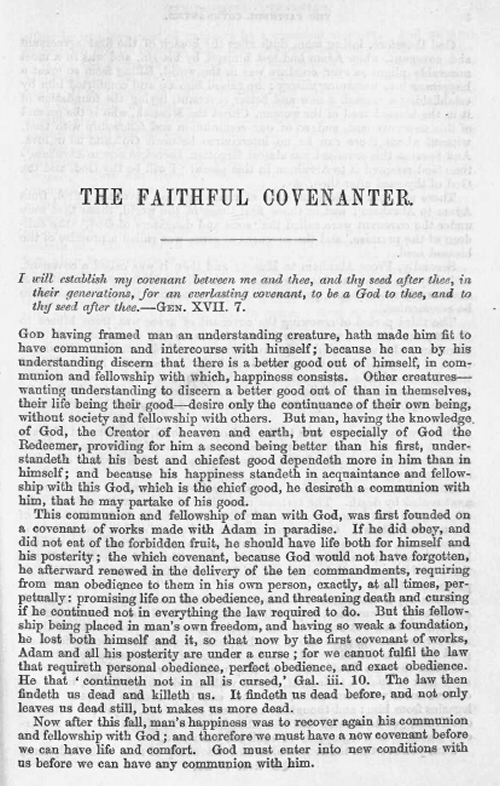
THE FAITHFUL COVENANTER

 Richard Sibbes

Works

Volume 6 pp. 3,4.

I will establish my covenant between me and thee, and thy seed after thee, in their generations, for an everlasting covenant, to be a God to thee, and to thy seed after thee. — Gen. XVII. 7.

God having framed man an understanding creature, hath made him fit to have communion and intercourse with himself; because he can by his understanding discern that there is a better good out of himself, in communion and fellowship with which, happiness consists. Other creatures wanting understanding to discern a better good out of than in themselves, their life being their good desire only the continuance of their own being, without society and fellowship with others. But man, having the knowledge of God, the Creator of heaven and earth, but especially of God the Redeemer, providing for him a second being better than his first, understandeth that his best and chiefest good dependeth more in him than in himself; and because his happiness standeth in acquaintance and fellowship with this God, which is the chief good, he desireth a communion with him, that he may partake of his good.

This communion and fellowship of man with God, was first founded on a covenant of works made with Adam in paradise. If he did obey, and did not eat of the forbidden fruit, he should have life both for himself and his posterity; the which covenant, because God would not have forgotten, he afterward renewed in the delivery of the ten commandments, requiring from man obedience to them in his own person, exactly, at all times, perpetually: promising life on the obedience, and threatening death and cursing if he continued not in everything the law required to do. But this fellowship being placed in man’s own freedom, and having so weak a foundation, he lost both himself and it, so that now by the first covenant of works, Adam and all his posterity are under a curse; for we cannot fulfil the law that requireth personal obedience, perfect obedience, and exact obedience. He that continueth not in all is cursed, Gal. iii. 10. The law then findeth us dead and killeth us. It findeth us dead before, and not only leaves us dead still, but makes us more dead.

Now after this fall, man’s happiness was to recover again his communion and fellowship with God; and therefore we must have a new covenant before we can have life and comfort. God must enter into new conditions with us before we can have any communion with him.

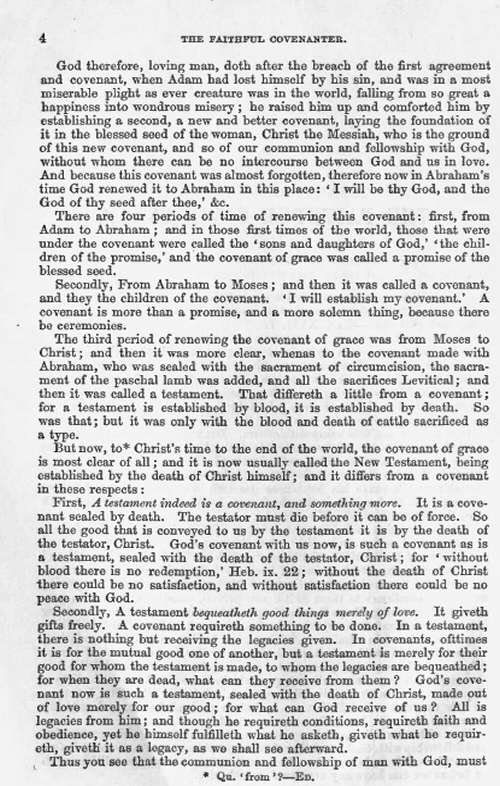
God therefore, loving man, doth after the breach of the first agreement and covenant, when Adam had lost himself by his sin, and was in a most miserable plight as ever creature was in the world, falling from so great a happiness into wondrous misery; he raised him up and comforted him by establishing a second, a new and better covenant, laying the foundation of it in the blessed seed of the woman, Christ the Messiah, who is the ground of this new covenant, and so of our communion and fellowship with God, without whom there can be no intercourse between God and us in love. And because this covenant was almost forgotten, therefore now in Abraham’s time God renewed it to Abraham in this place:  I will be thy God, and the God of thy seed after thee,’ &c.

There are four periods of time of renewing this covenant: first, from Adam to Abraham; and in those first times of the world, those that were under the covenant were called the ‘sons and daughters of God, ‘the children of the promise,’ and the covenant of grace was called a promise of the blessed seed.

Secondly, From Abraham to Moses; and then it was called a covenant, and they the children of the covenant. ‘I will establish my covenant. ‘A covenant is more than a promise, and a more solemn thing, because there be ceremonies.

The third period of renewing the covenant of grace was from Moses to Christ; and then it was more clear, whenas to the covenant made with Abraham, who was sealed with the sacrament of circumcision, the sacrament of the paschal lamb was added, and all the sacrifices Levitical; and then it was called a testament. That differeth a little from a covenant; for a testament is established by blood, it is established by death. So was that; but it was only with the blood and death of cattle sacrificed as a type.

But now, to Christ’s time to the end of the world, the covenant of grace is most clear of all; and it is now usually called the New Testament, being established by the death of Christ himself; and it differs from a covenant in these respects:

First, A testament indeed is a covenant, and something more. It is a covenant sealed by death. The testator must die before it can be of force. So all the good that is conveyed to us by the testament it is by the death of the testator, Christ. God’s covenant with us now, is such a covenant as is a testament, sealed with the death of the testator, Christ; for ‘without blood there is no redemption’ Heb. ix. 22; without the death of Christ there could be no satisfaction, and without satisfaction there could be no peace with God.

Secondly, A testament bequeatheth good things merely of love. It giveth gifts freely. A covenant requireth something to be done. In a testament, there is nothing but receiving the legacies given. In covenants, ofttimes it is for the mutual good one of another, but a testament is merely for their good for whom the testament is made, to whom the legacies are bequeathed; for when they are dead, what can they receive from them? God’s covenant now is such a testament, sealed with the death of Christ, made out of love merely for our good; for what can God receive of us? All is legacies from him; and though he requireth conditions, requireth faith and obedience, yet he himself fulfilleth what he asketh, giveth what he requireth, giveth it as a legacy, as we shall see afterward.

Thus you see that the communion and fellowship of man with God, must either be by a covenant of works or by a covenant of grace. And we must distinguish exactly between these two covenants and the periods of them.

 Image

Image

Lutheran / Reformed differences recognized during the time of the Westminster Divines

Image

Anthony Burgess on the difference between Lutheran and Reformed views of the covenant and law/gospel:

“We have confuted (proven to be incorrect) the false differences, and now come to lay down the truth, between the law and the Gospel taken in a larger sense.  

And, first, you must know that the difference is not essential, or substantial, but accidental: so that the division of the Testament, or Covenant into the Old, and New, is not a division of the Genus (classification) into its opposite Species; but of the subject, according to its several accidental administrations, both on Gods part, and on mans. It is true, the Lutheran Divines, they do expressly oppose the Calvinists herein, maintaining the Covenant given by Moses, to be a Covenant of Works, and so directly contrary to the Covenant of Grace. Indeed, they acknowledge that the Fathers were justified by Christ, and had the same way of salvation with us; only they make that Covenant of Moses to be a superadded thing to the Promise, holding forth a condition of perfect righteousness unto the Jews, that they might be convinced of their own folly in their self-righteousness.” (Vindication of the Morall Law,  Lecture 26  p.251)

I so need to get a copy of this book.  I know Reformation Heritage books has it.  Thanks ole buddy Mark Van Der Molen for bringing this small tidbit to life.

Book can be downloaded here.

http://westminsterassembly.org/wp-content/uploads/Burgess-Vindiceae-text-complete.pdf

I am sorry but it has dawned on me that this might be hard to grasp and understand on one level because Aristotelian terminology is being used above.  I am speaking about the terms essential, substantial, and accidental in the quote above.  It is Aristotelian thought.  Accidental is non essential property of the substance.  It is a part of it but it is not essential.  That doesn’t mean it is randomly thrown in or unnecessary when we consider God’s providential working. It is unnecessary for the substantial to exist.  As an example most people have legs. It is not necessary for you to have a leg to exist and survive but God did put it there for a reason and purpose. The term accidental should not be read as a modern day American would read it and think of a mishap or car wreck.  I am not sure I am explaining it well but the language above has a context and I hope I have helped out a bit.  Historical context and understanding are very important here. I hope that helps out a little.

To help further explain the above situation, one of the differences between Lutheran and the Westminsterian understanding is that Lutherans believe that the substance of the Mosaic and New Covenant differ.  The position of the Westminster Confession of Faith is that the Substance of the New Covenant and Mosaic Covenant is the same.  Some Modern Day Reformed Thinkers do not believe that to be the case as Lutherans described back in Anthony Burgess’ day didn’t either.  Meredith Kline in his later years departed from the biblical and confessional understanding of the Westminster Confession of Faith.  Doctors Michael Horton, R. Scott Clark, and I believe Darryl G. Hart and David Van Drunnen depart from it also.  This has lead to the unbiblical way they dichotomize law and grace instead of proving the proper distinctions between them.    It is also leading to various views concerning Natural Law and Kingdom Theology that some theologians are having problems with today.

Just for reference let me link to a few blog posts to help us understand what I am communicating.

What is Republication of the Covenant of Works?

https://rpcnacovenanter.wordpress.com/2013/02/04/what-is-republication-of-the-covenant-of-works/

(What is the Gospel?) Depraved Christianity might be Antinomian Christianity pt. 3

(What is the Gospel?) Depraved Christianity might be Antinomian Christianity pt. 3

‘Modern Day Reformed Thought’ and Two Kingdoms

‘Modern Day Reformed Thought’ and Two Kingdoms

The Mosaic Covenant, same in substance as the New? 

The Mosaic Covenant, same in substance as the New?

Possible Misconceptions about Galatians. Law and Gospel are opposed?

Possible Misconceptions about Galatians. Law and Gospel are opposed?

Westminster Confession of Faith Chapter 19. The Law and the Covenant of Works.

Westminster Confession of Faith Chapter 19. The Law and the Covenant of Works.

The Mosaic Covenant and the Modern Day Justification and Sanctification Controversy

The Mosaic Covenant and the Modern Day Justification and Sanctification Controversy

That should be enough to help you get started in understanding this discussion now.