Confusion in the Camp / Merit and Reformed Theology

Image

Confusion in the Camp

Merit and Reformed Theology

In the Reformed Church, there has been much debate in the past decade over issues such as Natural Law, The Two Kingdoms, the Law-Gospel distinction, Justification and Sanctification, the Covenant of Works, the Covenant of Grace, and even the definition of the Gospel.

In the past few years, it has come to the attention of some ministers of the Orthodox Presbyterian Church that doctrinal confusion has arisen over the doctrine of republication. The heart of the issue lies in a particular formulation of the Mosaic covenant, including the notion that Israel as a “corporate Adam” is under a typological arrangement which entails meritorious works on the temporal level. This confusion is coming to the forefront in OPC Presbyteries when licensure and ordination exams are being conducted. As I understand it, these issues are having far reaching consequences as the church pursues its peace, purity, doctrinal integrity, and practice.

In April of 2012, an Overture was proposed to the Presbytery of the Northwest OPC. This overture called for the 79th General Assembly to establish a study committee to examine teachings propagated in a publication, The Law is Not of Faith, edited by Bryan D. Estelle, J. V. Fesko, and David VanDrunen. Overtures are proposed requests for consideration of doctrinal matters or how things should function in the church. At the April 2012 meeting of the Presbytery of the Northwest OPC, the motion to approve the overture was replaced with a motion to establish a Special Presbytery Committee to study the issues concerning the doctrine of Republication as presented in the teachings of Meredith Kline and the book The Law is Not of Faith. This teaching has far reaching implications concerning the doctrines mentioned in the first paragraph.

Three Ministers from the Presbytery of the Northwest OPC (Randy Bergquist, Andy Elam, and Rob Van Kooten), have submitted their own study regarding the presbytery committee’s new proposed overture for all to review. The study first sets out to give some historical background for the publication the The Law Is Not Of Faith. It discusses the motives and reasons that are stated in the book itself. Next, it analyzes the covenant theologies of John Murray, Norman Shepherd, and Meredith Kline. The authors of the study booklet believe that these three men are the main reasons that this issue of Republication has come to the forefront in recent theological discussion. Their teachings are examined in light of the Westminster Confession of Faith and historic Reformed thought. Part 2 of the booklet turns to a critical examination of the doctrine of republication. Its basic thesis can be summarized as follows: ….the Republication Paradigm (ie., the views of Kline and The Law is not of Faith) uses traditional language and concepts, but redefines them in the service of its own paradigm. Not only do these new definitions fail to harmonize with those contained in the Westminster Standards, they may lead to other systematic changes in our confessional theology.” I would also note that when there are systematic doctrinal changes, there will also be changes in how we apply the Scriptures and practice our faith.

All three ministers are graduates from Westminster Seminary California from which most of this controversial teaching is emanating. A pre-presbytery discussion will be held on September 26, 2013 at First OPC in Portland, Oregon.

https://sites.google.com/site/mosaiccovenant/home

https://sites.google.com/site/mosaiccovenant/paper

What is Republication of the Covenant of Works?

Image

Here is a portion of a book ‘A Puritan Theology Doctrine For Life’ that everyone should read to understand what is being discussed in Modern Circles today.   Dr. Joel Beeke’s and Mark Jone’s book “A Puritan Theology Doctrine for Life” should be read if you want to know if Modern Day Reformed Thought is being historically accurate with how they define their positions and understanding on issues concerning Covenant Theology.  Read Chapters 16-18 and you will notice a difference between them and the Westminster Divines on some things.

The Modern Reformed Thought does not hold to a position that the Mosaic Covenant and the New Covenant are of the same Substance as the Westminster Divines defined things. They also define Republication of the Covenant of Works a bit differently than how the Divines of the Westminster Assembly used this terminology.  Modern Day Reformed Thought holds to a position that the Mosaic Covenant administers both a Covenant of Grace and a Covenant of Works.  They hold to what is known as a Minority Position and it is defined in the book also.  It is not Westminsterian.

Enjoy…

Anthony Burgess likewise comments that the law may be understood largely, “as that whole doctrine delivered on Mount Sinai,” or strictly, “as it is an abstracted rule of righteousness, holding forth life upon no terms, but perfect obedience.”75 In the former sense, the law belongs to the covenant of grace; in the latter sense, the law was not of grace, but of works, which helps explains Paul’s polemic against the law in his New Testament writings (e.g., Galatians). These distinctions also help to explain the idea found in many Puritan authors who speak of the Mosaic covenant as republishing the moral law first given to Adam, written on his heart, engraved on tablets of stone as the Decalogue. For the most part, theologians who spoke in this way, whether dichotomists or trichotomists, made a number of careful qualifications in order to show that the moral law was republished not as a covenant but as a rule of righteousness for those in covenant with God. In other words, the moral law was not republished at Sinai to serve as a means of justification before God. For example, John Owen made clear in his work on justification by faith that the old covenant was not a revival of the covenant of works strictly (i.e., “formally”). Rather, the moral law was renewed declaratively (i.e.,“materially”) and not covenantally: “God did never formally and absolutely renew or give again this law as a covenant a second time. Nor was there any need that so he should do, unless it were declaratively only, for so it was renewed at Sinai.”76 The concept of republication of the moral law does not make Sinai co-extensive with Eden in terms of strict covenantal principles. If the moral law is abstracted “most strictly,” to use Roberts’s language, then Sinai certainly was a formal republication of the covenant of works. But, as Ball tried to argue, that certainly was not the intention of the old covenant. In the end, Ball’s position, which had been argued during the Reformation by Heinrich Bullinger, Peter Martyr, and John Calvin, clearly influenced the Westminster divines.

Accordingly, chapter 19 of the Westminster Confession, “Of the Law of God,” begins by asserting that the moral law was first given to Adam, and goes on to say, “This law, after his fall, continued to be a perfect rule of righteousness, and as such, was delivered by God upon Mount Sinai, in ten commandments, and written in two tables” (19.2). The Confession further asserts, “The moral law doth for ever bind all, as well justified persons as others, to the obedience thereof” (19.5), and is of great use to believers “as a rule of life informing them of the will of God, and their duty…discovering also the sinful pollutions of their nature…together with a clearer sight of the need they have of Christ, and the perfection of his obedience” (19.6). Chapter 19 concludes that for a believer to do good because the law commands it or to refrain from evil because the law forbids it, “is no evidence of his being under the law, and not under grace. Nor are the aforementioned uses of the law contrary to the grace of the gospel, but do sweetly comply with it” (19.6–7).

Likewise, the Confession declares that the covenant of grace was administered “in the time of the law…by promises, prophecies, sacrifices, circumcision, the paschal lamb, and other types and ordinances…all fore-signifying Christ to come.” Such outward forms were “for that time, sufficient and efficacious, through the operation of the Spirit, to instruct and build up the elect in faith in the promised Messiah, by whom they had full remission of sins, and eternal salvation” (7.5). Hence it follows that “the justification of believers under the Old Testament was…one and the same with the justification of believers under the New Testament” (11.6).

p. 270-1

75. Burgess, Vindiciae Legis, 223.
76. Owen, Justification by Faith, in Works, 5:244.

Beeke, Joel R.; Jones, Mark (2012-10-14). A Puritan Theology: Doctrine for Life (Kindle Locations 10634-10647). . Kindle Edition.

For more on the subject of Modern Reformed Thought go to these links.
https://rpcnacovenanter.wordpress.com/2012/09/18/lutheran-reformed-differences-back-during-the-time-of-the-westminster-divines/

https://rpcnacovenanter.wordpress.com/2013/08/02/old-posts-on-the-mosaic-covenant-vs-the-new-reformed-paradigm/

https://rpcnacovenanter.wordpress.com/2014/05/21/the-charge-of-lutheranism-is-not-about-distinction-it-is-about-dichotomy/

You can also read my comments on the Westminster Confession of Faith Chapter 19 here.

https://rpcnacovenanter.wordpress.com/2012/09/02/westminster-confession-of-faith-chapter-19-the-law-and-the-covenant-of-works/

The Mosaic Covenant, same in substance as the New? Not according to Modern Reformed Thought.

Decalogue_parchment_by_Jekuthiel_Sofer_1768

Pressing an old Blog entry…

via The Mosaic Covenant, same in substance as the New? Not according to Modern Reformed Thought..

Also look at this…
https://rpcnacovenanter.wordpress.com/2014/06/28/why-i-was-drawn-into-the-nuanced-republication-and-mosaic-covenant-study/
This is the doctrine that caused me to became a Presbyterian after having been a Reformed Baptist for 30 years.  It is also the doctrine that causes me to be alarmed over much of what is being taught today in the Reformed Camp.  They don’t understand the Mosaic Covenant.   I call today’s understanding Modern Reformed Thought.

Check out the whole thing as I post a small portion here…

I have recently been helped in understanding the Mosaic Covenant by Scripture clarification along with the help of a Pastor Patrick Ramsey. Thank You Pastor Ramsey.I have found that I disagree with Meredith Kline and others that hold to similar positions of a works paradigm in the Mosaic Covenant. While Owen’s view and Kline’s differ a bit by terminology I believe they are closer than people want to credit. I believe Kline holds to something more similar called a superadded subservient view of the Mosaic Covenant which was rejected by the Majority of Divines who wrote the Westminster Confession of Faith. You can learn about this by reading this article that was published in the Westminster Journal.  http://tinyurl.com/9xbtega

In working out this works paradigm I think Patrick Ramsey does a good job in revealing what Romans 10:5 and Leviticus 18:5 say when considering the whole Counsel of God. In fact when we look at Paul’s references we would think that Paul is pitting Moses against Moses and the Old Testament against the Old Testament in his New Testament writings. Especially if we just lift passages out of texts without considering other passages Paul also referenced. Paul isn’t pitting the OT against the OT or Moses against Moses when we look at the fuller context for understanding….

Read on brothers and sisters….  https://rpcnacovenanter.wordpress.com/2012/09/14/the-mosaic-covenant-same-in-substance-as-the-new/

Here is a great reference…. https://sites.google.com/site/themosaiccovenant/

Exposure on Dr. R. Scott Clark from Westminster West.  No wonder why I remained a Reformed Baptist and didn’t understand Covenant Theology from a truly Reformed perspective.
https://rpcnacovenanter.wordpress.com/2014/03/11/clark-is-not-teaching-the-broad-view-of-the-westminster-divines/

https://rpcnacovenanter.wordpress.com/2014/05/21/the-charge-of-lutheranism-is-not-about-distinction-it-is-about-dichotom

https://rpcnacovenanter.wordpress.com/2012/09/02/westminster-confession-of-faith-chapter-19-the-law-and-the-covenant-of-works-2/

Dr. Robert Strimple whose Chair at Westminster Seminary California  David Van Drunen occupies sets the Record straight concerning the book The Law Is Not of Faith and the Mosaic Covenant.

https://rpcnacovenanter.wordpress.com/2014/02/19/dr-robert-b-strimple-on-the-mosaic-covenant-and-republication-of-the-covenant-of-works/

I loved this piece on Klhortonian Theology… http://citeseerx.ist.psu.edu/viewdoc/download?doi=10.1.1.737.5521&rep=rep1&type=pdf&fbclid=IwAR3Djotk6sWLDlEjIiyRBcm895iEGrpYFZ5RYppsXxF7DG6A7pKKK8Oa9NE

Modern Day Reformed Thought and Two Kingdoms…  https://rpcnacovenanter.wordpress.com/2012/09/18/modern-day-reformed-thought-two-kingdoms-view-vs-the-biblical-one-kingdom-view/

The Mosaic Covenant:  a “Republication” of the Covenant of Works?

A Review article: The Law Is Not of Faith: essays on Works and Grace in the Mosaic Covenant

Cornel P. Venema
http://www.midamerica.edu/resources/journal/21/venema21.pdf

You may also want to check out my comments on Galatians 3 and 4.  Some people use this passage to show that the Law and Gospel are opposed to each other but that is a terrible misreading of the text.  The Law and Gospel are not opposed.

https://rpcnacovenanter.wordpress.com/2012/08/30/possible-misconceptions-about-galatians-law-and-gospel-are-opposed/

(What is the Gospel?) Depraved Christianity might be Antinomian Christianity pt. 3

Image

Rev. Phillips stated this in his first paragraph of his blog critiquing Rev. Tullian Tchividjian….

One of the most pressing concerns in Reformed churches today is the importance of getting the gospel right. Recently, Reformed churches have had to oppose the Federal Vision theology, which compromises justification by inserting good works into the definition of faith. Unfortunately, Christians tend to defend doctrines by erring in the opposite direction. So it is that Reformed churches are presently facing a corruption of the gospel by the virtual denial of sanctification and good works….

David Murray’s critique is very good…. Does Jesus + Nothing = Everything?  HeadHeartHand Blog
Does Jesus + Nothing = Everything? | HeadHeartHand Blog

Pastor Tullian’s quote from his book ‘Jesus Nothing Everything’…

I used to think that growing as a Christian meant I had to somehow go out and obtain the qualities and attitudes I was lacking. To really mature, I needed to find a way to get more joy, more patience, more faithfulness, and so on. Then I came to the shattering realization that this isn’t what the Bible teaches, and it isn’t the gospel. What the Bible teaches is that we mature as we come to a greater realization of what we already have in Christ. The gospel, in fact, transforms us precisely because it’s not itself a message about our internal transformation but about Christ’s external substitution. We desperately need an advocate, mediator, and friend. But what we need most is a substitute—someone who has done for us and secured for us what we could never do and secure for ourselves. (94, Kindle Edition)

Tullian Tchividjian sounds like Horton, doesn’t he? Remember the three minute video?

 Horton notes…

The term “gospel” is a very precise term, a particular kind of word, or kind of speech in the Bible.  It refers to God’s promise of salvation in Christ.  The gospel is a victory announcement.  It never tells us something to do.  That is the business of the law.  Rather, the gospel tells us something that has been done.

Consequently, those who speak of living the gospel or doing the gospel commit a category mistake.   More importantly, they make the most basic theological mistake a person could make, namely, confuse the law and the gospel.  And if we confuse the law and the gospel, then we will make ourselves partly your own saviors, adding to the work of Christ.

Is Horton Correct?  …. As a Pastor aquaintance has noted….

The most serious problem is that Horton’s indictment is based upon a shaky foundation.  Horton’s critique is predicated upon his narrow and strict definition of the term “gospel.”  But is that the only way the Bible uses or defines the term “gospel”?  The answer is no!  Romans 2:16 connects the future judgment with the gospel and 2 Thess. 1:8 and 1 Pet. 4:17 both speak of obeying the gospel.  The gospel is to be obeyed.  But how do you obey a victory announcement?  How do you obey what God has done?  So either the Bible itself confuses law and gospel or it uses the word “gospel” differently (at times) than Horton.  Since the latter must be true, then Horton shouldn’t make the strict definition of the gospel, the one and only definition of the gospel.  And he most certainly shouldn’t make any charges of legalism towards those who use a broader yet biblical definition of the gospel.

Fyi, the note on 2 Thess. 1:8 in the Reformation Study Bible is as follows:

§ 1:8 obey the gospel. The gospel must be accepted, believed, and obeyed (1 Pet. 4:17). Its divine command is for absolute surrender to God through the peace made by Jesus Christ.

Dr. David Murray writes…

I agree that the Gospel is certainly a message about Christ’s external substitution. But it does not stop there. The Gospel is also a message about internal transformation (a major part of sanctification). Christ saves us from our sins objectively and subjectively, from the penalty of sin and the presence of sin.

Guys, this is a problem. Others are seeing it. This is a truncated Gospel that is being proclaimed and one without the full truth and power of a message that has to do with the whole of Reconciliation. Reconciliation is about more than just justification before God.  The Gospel is about man’s reconciliation with God, totally.   The Gospel is about a restored relationship with God.  And this is Life Eternal that they know… (John 17:3)

Justification removes fear from Eternal Condemnation but it shouldn’t remove fear from chastisement or judgement from God when we are living in sin. That is what First Corinthians Chapter 10 is all about.  And it is precisely the Mosaic Covenant that St. Paul is referencing when appealing to how we should live as Christians in the Spirit of Christ.

In this Modern Reformed Thought some are weakening the sensitivity of the Conscience which needs to be awakened unto holy living. Sure we aren’t condemned before God in Eternity because Christ has removed the curse of the Covenant of Works, but we should fear our heavenly Father when we sin. That is something the World lacks.  It lacks a Heavenly Father who cares about how we live in His Kingdom.  Remember God chastises his children because He loves them.  If we had good fathers growing up they disciplined us because they loved us and wanted us to live peaceably with them.

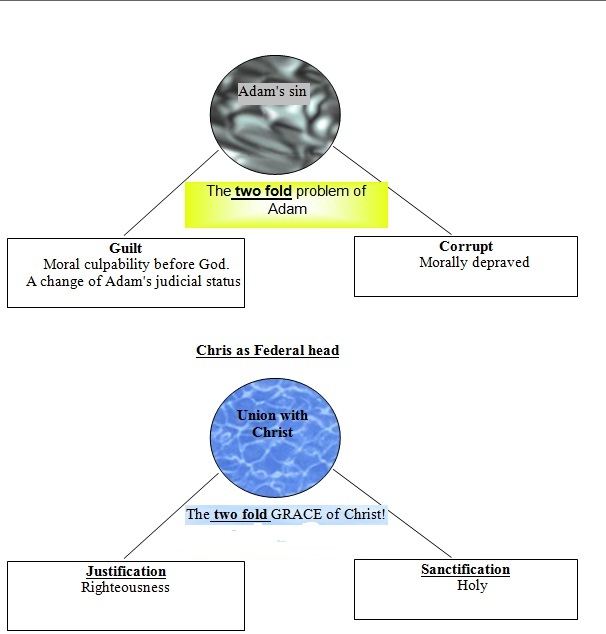
This reconciliation thing is also about 1 John 1:9 and our daily life. It is about sanctification and our daily walk with our King in His Kingdom. This truncated gospel these guys are proclaiming is growing void of the part  that runs next to our justification in the Gospel.  It takes Sanctification and removes it from the Gospel because it is supposedly of the law, which is not a part of the Gospel. They say so themselves. That is antinomian because according to them we should look only to justification for all things according them.  Our Union with Christ is where we should look for all things.  Justification and Sanctification both proceed from that.  Their scheme divorces our daily walk with God from the sanctifying grace of reconciliation.  The law is opposed to us soteriologically because the law opposes the Gospel.  The Law only Condemns in the scheme of soteriology according to them.  It is not a part of the Gospel or salvation.  The Gospel is only about justification and not about sanctification in their understanding.  The Gospel and Reconciliation have a a two fold benefit though, Justification and Sanctification.  Both are made realities by the Spirit of God in our Union with Christ.

The Gospel is about our Adoption and our living with God daily.  We should look to our Union with Christ which brings a two-fold Grace as Calvin put it. This Modern Reformed Thought Gospel that is only declarative is a subtle moving away from the Gospel of the Kingdom.

I will say this.  At least these Modern Day Reformed Thought guys get justification correct.

Edited to accommodate those whom want to defend Horton.

Did Jason really know the Gospel and Presbyterian Covenant Theology?

Image

Pastor Gordon,

To avoid blog wars with the discussion Forum I moderate I need to separate myself from it and express that these are my musings separate of that Confessional Discussion Forum.

This is in response to your post here.

http://christopherjgordon.blogspot.com/2012/09/the-problem-of-theological-narcissism.html

You wrote…

 “Jason did understand the gospel and decided it was not the answer for him. I repeat, it was not that he misunderstood it, and has departed in ignorance. Jason grasped it, confessed it, was ordained to it, promised to defend it, and then defected consciously from the system of doctrine he promised to uphold. “

Note to a Pastor,

In all due respect I have a few problems with your blog concerning Jason Stellman and his turning to the Roman Papist Church.  Yes, you may know Jason.  I have been acquainted with him for years also.  If you mean he knew the Gospel the way that Horton and his Clan know the Gospel then I would have to say that Jason knew a Truncated Gospel.  Especially in light of how Dr. Michael Horton defines it in his three minute clip on YouTube and the Westminster California site.  I have listened to him and the White Horse Inn Panel for hours discussing the Great Commission and the Gospel.  I believe that poor Jason had a Truncated view of the Gospel and Covenant Theology.

Your attention drawing to Jason’s Narcissism is quite commendable if you are spot on.  If it is a man trying to strive to know what he believes then you might be incorrect.   I have seen this departure happen with other Presbyterians also.  I actually address some of this situation and issues on a theological discussion forum that brought your blog to my attention.   Gotta love Dr. Clark..

Dr. Scott Clark states…

The ISSUES should be engaged. I’ve been doing that on the HB. Responsible representatives of the Roman church should be engaged but not everyone speaking up just now meets that test.

I responded with this…

Jason might not be considered one who meets that test. But he is one who is being noted. He is worthy to be dealt with just as the Papists that Calvin dealt with in his time.

Having watched Jason do what he did I have to say that I can understand why some people get mixed up sometimes. At least Jason has the integrity to voice his understanding. Is he cocky? Maybe. I know many of our kind who have been accused of being ungracious and know-it-alls also. Okay, my hand can be raised on that also.

I have had a few friends cross from the Presbyterian side to Eastern Orthodox, Roman Catholic, and the New Paul Perspective due to a struggle with trying to understand Covenant Theology in relation to law and gospel (or grace). Some of you might not remember or know but I use to moderate another theological forum that was a split off from the PB.  I use to Moderate the Reformation Super Highway and the PB at the same time. The RSH was a home of things departing from what it means to be Reformed. I didn’t understand why they were doing it. It was hard for me since I was a Reformed Baptist. Law and Gospel were opposed but then I wasn’t as sure how it all worked out. I understand it a bit more now I think……. Well, maybe….. I can honestly say they all abandoned a form of Lutheranism or various dichotomous views of Law and Gospel which have been formulated based upon an interpretation (hermeneutic) concerning the Mosaic Covenant. I believe it is a view that the Westminster Divines rejected as it was a Minority view when they were constructing the Biblical Confession. I also believe that some of this wayward confusion could have been prevented if these persons learned the Westminster Confession’s position on Chapter 7.5,6 a bit more. I could be wrong. (BTW, I don’t sense that all Papists or deceived people are going to Hell. That is just my estimation) I also don’t feel it is right to give a free pass to those who deny the Westminster on this point. Especially when they are by name attached to Westminsterian theology and Institution. Some people are doing that in my estimation. It is confusing a lot of people. I also believe it is part of the problem. I am patiently waiting to see how this issue is going to turn out as it is being brought to the forefront more and more daily. I do know men who have Doctorates, are Professors, Teachers of History and Systematic Theology, whom I have conferred with and with whom I agree that this issue has a root problem. I believe it stems from a poor understanding of the Mosaic Covenant and dichotomizing Law and Gospel too much.

I was recently reminded that the Law / Gospel dichotomy issue was what helped me see this issue initially. So maybe…. Just maybe… It will do the same for others.  This issue is like watching a pendulum of a Grandfather clock to me.  The pendulum has swung one way (Federal Vision, NPP, etc.). It swung hard away from it (Klineanism).  Now it is going back the other way again. It saddens me. The Divines at the Westminster Assembly got it right and rejected the minority view, Roman Catholicism, and Antinomiansm. This swinging of the pendulum just needs to stop and we need to listen to the Westminster Divines in my estimation. They had to deal with it also. Oh yeah, and Bavinck also does a good job when he discusses the Reformed doctrine in comparison to the Lutheran doctrine (not necessarily Luther’s doctrine) of soteriology.

I am positive that I don’t meet the test to discuss issues in some people’s eyes. I fully understand why. I do know good men who are, have, and will meet the test. Orthodoxy leads to Orthopraxy There are many good laymen and Trained men who are capable.

As a side note. I am not fearful of Jason’s departure. I am saddened for him, His physical family, and His Church family members. As for addressing those who are competent on Roman Dogma….. Didn’t Calvin take on Roman Dogma by using the Church Fathers that the Papists claimed? The Papists back then were refuted by Calvin. Why not use Jason the same way? His distortions can be reproved and shown for what they are. Just like the Papists were refuted when Calvin confronted them by quoting their Church Fathers back to them in context.

A turning to Idolatry is never a good thing. Anyone who wants to be deceived by love for icons, Popish Ceremonies, or carnality are going to be. We have idolatry growing all around us. My advice is read Gillespies’ book Popish Ceremonies, try to discuss it calmly with them, then hand them a copy hoping that they will read it. Love them as your friends. That will go farther than getting upset with them and claiming they are brain dead and unfit for discussing it.

Randy

My opinion of your blog post is that you might have some things put down correctly but I believe you are missing the mark on a few major issues.  It is my opinion.  And I have been saying for the past 25 years that opinions are like armpits.  We all have a few and they usually end up stinking.  LOL.

JMHO….

Be Encouraged Pastor and everyone who suffered through this.,

P.S. I want one of those Icons (bobble heads) of Jason!  That is Rockin Cool!

Dr. Gamble on Two Kingdom Theology.

I am posting a link to the Puritanboard here so that instructions are included for listening to the Video Webinar.  It might have an echo and I already posted on that.  This is a very important subject now days in my estimation.  Please enjoy this discussion by Dr. Richard Gamble from Reformed Presbyterian Theological Seminary.  Also remember that this is a general synopsis. It will not hit everyone who holds to Two Kingdoms. The terminology of Two Kingdom is also used in different ways by others.  Calvin mentioned a Two fold Government. Calvin used those terms interchangeably if I am not mistaken. Anyways, enjoy this.

http://www.puritanboard.com/f15/critique-two-kingdom-theology-dr-richard-gamble-lecture-76540/#post973728

I will still post the direct link.  But….

If you get an echo just click on the pause button in the middle of the video panel. Go to the bottom right of the page and mute the sound on the bottom sound icon. Then click play again. It will eliminate the double voicing. I was getting an Echo with my Google browser.

https://www.fuzemeeting.com/replay_meeting/bffa2e59/2761243

BTW, There are a few hiccups with the feed about 30 minutes in. They pass after a minute or two.

Covenant, Testament, Works, Grace, Love, and Communion.

This little portion is so good I just have to put it somewhere for others to read.  So please just bare with me and tolerate my love for things simply put down in a simple matter.  I am a bear of very little braiin as A. A. Milne’s Edward Bear.  (Winnie ther Pooh)   Please enjoy this little tidbit.

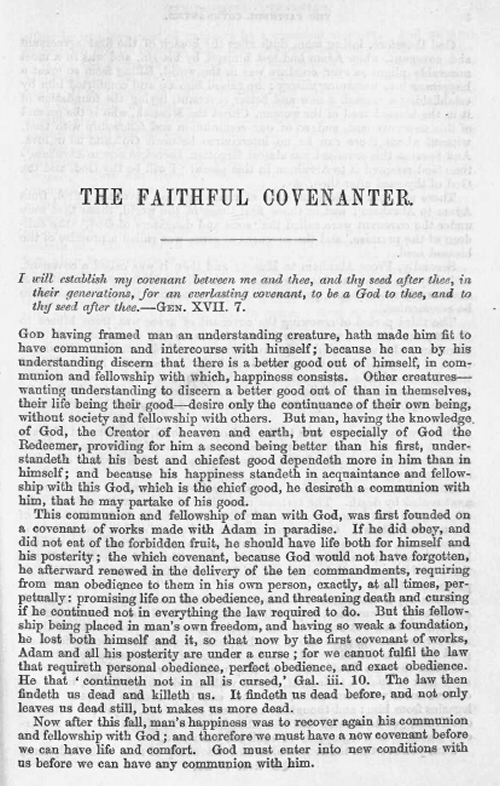
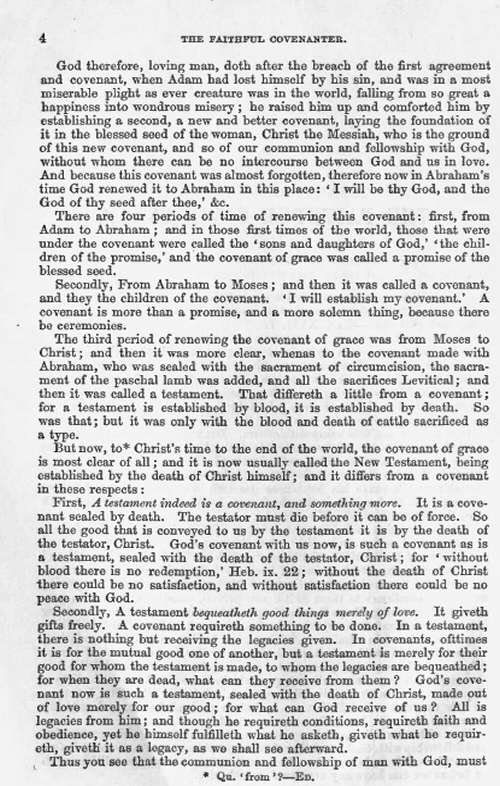
THE FAITHFUL COVENANTER

 Richard Sibbes

Works

Volume 6 pp. 3,4.

I will establish my covenant between me and thee, and thy seed after thee, in their generations, for an everlasting covenant, to be a God to thee, and to thy seed after thee. — Gen. XVII. 7.

God having framed man an understanding creature, hath made him fit to have communion and intercourse with himself; because he can by his understanding discern that there is a better good out of himself, in communion and fellowship with which, happiness consists. Other creatures wanting understanding to discern a better good out of than in themselves, their life being their good desire only the continuance of their own being, without society and fellowship with others. But man, having the knowledge of God, the Creator of heaven and earth, but especially of God the Redeemer, providing for him a second being better than his first, understandeth that his best and chiefest good dependeth more in him than in himself; and because his happiness standeth in acquaintance and fellowship with this God, which is the chief good, he desireth a communion with him, that he may partake of his good.

This communion and fellowship of man with God, was first founded on a covenant of works made with Adam in paradise. If he did obey, and did not eat of the forbidden fruit, he should have life both for himself and his posterity; the which covenant, because God would not have forgotten, he afterward renewed in the delivery of the ten commandments, requiring from man obedience to them in his own person, exactly, at all times, perpetually: promising life on the obedience, and threatening death and cursing if he continued not in everything the law required to do. But this fellowship being placed in man’s own freedom, and having so weak a foundation, he lost both himself and it, so that now by the first covenant of works, Adam and all his posterity are under a curse; for we cannot fulfil the law that requireth personal obedience, perfect obedience, and exact obedience. He that continueth not in all is cursed, Gal. iii. 10. The law then findeth us dead and killeth us. It findeth us dead before, and not only leaves us dead still, but makes us more dead.

Now after this fall, man’s happiness was to recover again his communion and fellowship with God; and therefore we must have a new covenant before we can have life and comfort. God must enter into new conditions with us before we can have any communion with him.

God therefore, loving man, doth after the breach of the first agreement and covenant, when Adam had lost himself by his sin, and was in a most miserable plight as ever creature was in the world, falling from so great a happiness into wondrous misery; he raised him up and comforted him by establishing a second, a new and better covenant, laying the foundation of it in the blessed seed of the woman, Christ the Messiah, who is the ground of this new covenant, and so of our communion and fellowship with God, without whom there can be no intercourse between God and us in love. And because this covenant was almost forgotten, therefore now in Abraham’s time God renewed it to Abraham in this place:  I will be thy God, and the God of thy seed after thee,’ &c.

There are four periods of time of renewing this covenant: first, from Adam to Abraham; and in those first times of the world, those that were under the covenant were called the ‘sons and daughters of God, ‘the children of the promise,’ and the covenant of grace was called a promise of the blessed seed.

Secondly, From Abraham to Moses; and then it was called a covenant, and they the children of the covenant. ‘I will establish my covenant. ‘A covenant is more than a promise, and a more solemn thing, because there be ceremonies.

The third period of renewing the covenant of grace was from Moses to Christ; and then it was more clear, whenas to the covenant made with Abraham, who was sealed with the sacrament of circumcision, the sacrament of the paschal lamb was added, and all the sacrifices Levitical; and then it was called a testament. That differeth a little from a covenant; for a testament is established by blood, it is established by death. So was that; but it was only with the blood and death of cattle sacrificed as a type.

But now, to Christ’s time to the end of the world, the covenant of grace is most clear of all; and it is now usually called the New Testament, being established by the death of Christ himself; and it differs from a covenant in these respects:

First, A testament indeed is a covenant, and something more. It is a covenant sealed by death. The testator must die before it can be of force. So all the good that is conveyed to us by the testament it is by the death of the testator, Christ. God’s covenant with us now, is such a covenant as is a testament, sealed with the death of the testator, Christ; for ‘without blood there is no redemption’ Heb. ix. 22; without the death of Christ there could be no satisfaction, and without satisfaction there could be no peace with God.

Secondly, A testament bequeatheth good things merely of love. It giveth gifts freely. A covenant requireth something to be done. In a testament, there is nothing but receiving the legacies given. In covenants, ofttimes it is for the mutual good one of another, but a testament is merely for their good for whom the testament is made, to whom the legacies are bequeathed; for when they are dead, what can they receive from them? God’s covenant now is such a testament, sealed with the death of Christ, made out of love merely for our good; for what can God receive of us? All is legacies from him; and though he requireth conditions, requireth faith and obedience, yet he himself fulfilleth what he asketh, giveth what he requireth, giveth it as a legacy, as we shall see afterward.

Thus you see that the communion and fellowship of man with God, must either be by a covenant of works or by a covenant of grace. And we must distinguish exactly between these two covenants and the periods of them.

 Image

Image

The Mosaic Covenant, same in substance as the New?

Image

Westminister Confession of Faith

Chapter VII

Of God’s Covenant with Man

4. This covenant of grace is frequently set forth in Scripture by the name of a testament, in reference to the death of Jesus Christ the Testator, and to the everlasting inheritance, with all things belonging to it, therein bequeathed.

5. This covenant was differently administered in the time of the law, and in the time of the gospel: under the law, it was administered by promises, prophecies, sacrifices, circumcision, the paschal lamb, and other types and ordinances delivered to the people of the Jews, all foresignifying Christ to come; which were, for that time, sufficient and efficacious, through the operation of the Spirit, to instruct and build up the elect in faith in the promised Messiah, by whom they had full remission of sins, and eternal salvation; and is called the old testament.

6. Under the gospel, when Christ, the substance, was exhibited, the ordinances in which this covenant is dispensed are the preaching of the Word, and the administration of the sacraments of baptism and the Lord’s Supper: which, though fewer in number, and administered with more simplicity, and less outward glory, yet, in them, it is held forth in more fullness, evidence and spiritual efficacy, to all nations, both Jews and Gentiles; and is called the new testament. There are not therefore two covenants of grace, differing in substance, but one and the same, under various dispensations.

I started to discover some troubling trends in the Reformed Faith concerning views of Law and Gospel that made me start to dig deeper into why men were saying the Law and Gospel totally opposed each other.  These men were saying that the Law only condemns and that the Gospel no where commands anything.  These kind of comments were leading other men to become and teach Antinomianism (antinomian basically teaches that the Law of God (even the moral Law) is irrelevant to life) and deny certain aspects of the Gospel.  My search led me to the place where many of these men were divorcing Grace and Law.  I found the source for this teaching to be worked out from doctrines formulated during the time of the Reformation.  It had its root in a hermeneutic that was trying to relate how the Mosaic Covenant and New Covenant related to each other.  This led me to other places and to different questions.  Ultimately it led me to the Westminister Confession of Faith since one of the main propagators of this teaching was an Orthodox Presbyterian Minister named Meredith G. Kline.   I started to question even if his teaching even lined up with the confessional standard he claimed to adhere to.   You can read that discussion at this link.

http://www.puritanboard.com/f30/kline-karlburg-not-confessional-concerning-mosaic-69258/

At that link I was trying to get some feedback concerning an article which was published in the Westminster Theological Journal. VL. 66.2 Fall which you can download in pdf form.

PDF download.

http://tinyurl.com/9xbtega

I use to hold to a theological position somewhat similar to the Orthodox Presbyterian Professor named Meredith Kline and somewhat that of John Owen concerning the Mosaic Covenant.

5). This covenant thus made, with these ends and promises, did never save nor condemn any man eternally. All that lived under the administration if it did attain eternal life, or perished for ever, but not by virtue of this covenant as formally such. It did, indeed, revive the commanding power and sanction of the first covenant of works; and therein, as the apostle speaks, was “the ministry of condemnation,” 2 Corinthians 3:9; for “by the deeds of the law can no flesh be justified.” And on the other hand, it directed also unto the promise, which was the instrument of life and salvation unto all that did believe. But as unto what it had of its own, it was confined unto things temporal. Believers were saved under it, but not by virtue of it. Sinners perished eternally under it, but by the curse of the original law of works.
John Owen
Commentary on Hebrews Chapter 8
pp. 85.86 Goold

I have recently been helped in understanding this situation a bit more clearly by Pastor Patrick Ramsey’s Journal article and I have found that I disagree with Meredith Kline and others that hold to similar postions of a works paradigm that is found being taught in the Mosaic Covenant. While Owen’s view and Kline’s differ a bit I believe they have some similarities when it comes to the idea of Republication of the Covenant of Works.  I believe Kline and his modern day disciples hold to something called a “co-ordinate” covenant view (which sees two covenants working side by side, law and grace in antithesis) concerning the Mosaic Covenant.  This view  was rejected by the Majority of Divines who wrote the Westminster Confession of Faith. These modern day reformers do not believe the Mosaic Covenant is purely an administration of the Covenant of Grace although it is partially administered through it.  These men believe the  Mosaic Covenant is an administration of the Covenant of Grace as it relates only to justification.  You can learn about this by reading the article that was published in the Westminster Journal (http://tinyurl.com/9xbtega) and by reading chapters 16-18 in ‘A Puritan Theology Doctrine for Life’  by Mark Jones and Joel Beeke.

Trying to understand this works paradigm is not easy.  I think Patrick Ramsey does a good job in revealing the misconceptions that surround the issues from the most noted passages Romans 10:5 and Leviticus 18:5.  In fact when we look at Paul’s references Pastor Ramsey notes how we might perceive that St. Paul is pitting Moses against Moses and the Old Testament against the Old Testament by his New Testament writings. Especially if we just lift passages out of texts without considering other passages Paul also referenced. Paul isn’t pitting the OT against the OT or Moses against Moses when we look at the fuller context for understanding.

I believe I will let Pastor Ramsey’s words explain at this point.

Paul’s Use of Lev. 18:5 in Rom. 10:5
Pastor Patrick Ramsey

The following is (I trust) a simple but not simplistic explanation of Paul’s use of Leviticus 18:5 in Romans 10:5.

In 9:30-10:5 Paul explained the reason the Jews did not attain righteousness even though they pursued it. They mistakenly pursued it by works (9:32). Hence, they stumbled over the stumbling stone (9:33). They sought to establish their own righteousness (10:3). Ignorant of the right way to righteousness, although they should have known better, they zealously pursued life on the basis of their own obedience to the law.

In Rom. 10:5 Paul describes this wrong way of pursuing life (righteousness) from the OT, namely Leviticus 18:5 (see also Neh. 9:29; Eze. 20:11, 13, 21): “For Moses writes about the righteousness that is based on law, that the person who does the commandments shall live by them.” Now the fact that Paul appeals to Moses to describe the wrong way, or if you will, the Pharisaical way of pursuing righteousness, is somewhat perplexing. As a result, this verse, along with its counterpart in Gal. 3, is quite controversial among commentators and theologians.

Here is the difficulty from three different perspectives. First, in 9:32, Paul had said that the law itself did not teach that righteousness was based on works or obedience to the law. The Jews pursued the law as if it led to righteousness. The Jews, as the NT says elsewhere, misread the OT. And yet Paul seems to be saying in vs. 5 that the OT did in fact teach and exhort the people to pursue life/righteousness by keeping the law. How then can Paul (or the rest of the NT) condemn the Pharisees for seeking righteousness by works if that is what Moses told them to do?

Second, in vs. 8 Paul will quote Deut. 30 and later on he will cite Isaiah and Joel in direct contrast to Lev. 18:5 to describe the right way to find life and righteousness. So then it would seem that Paul pits Moses against Moses and the OT against the OT.

Third, the context of Lev. 18:5 doesn’t seem to support the way Paul uses it in Rom. 10:5. Moses exhorts Israel to keep God’s commandments in the context of redemption and covenant. Verses 1-3 highlight the point that Israel already belongs to God as his redeemed people. These verses are very similar to the prologue to the Ten Commandments, which teaches that salvation precedes obedience. God didn’t give Israel the law so that they might be saved. He saves them so that they might keep the law. In short, the context of Lev. 18:5 speaks against the idea that it teaches legalism or a work-based righteousness. Yet, that is how Paul is using this verse!

Now some have sought to solve this difficulty by saying that there is no actual contrast between verses 5 and 6. The “but” of vs. 6 should be translated “and.” The problem with this, however, is that it doesn’t fit the context of Paul’s argument. The apostle, beginning in 9:30 is contrasting two ways of seeking righteousness—works and faith—and this contrast clearly continues in vs. 5. This is confirmed by the fact that Paul speaks of works righteousness or righteousness based on law elsewhere (Gal. 3; Phil. 3:9) in a negative way.

So then how are we to understand what Paul is saying in vs. 5 (and in Gal. 3)? Well, Paul is citing Lev. 18:5 according to how it was understood by the Jews of his day; and no doubt how he understood it before his conversion. The Jews of Paul’s day saw obedience to the law (which included laws pertaining to the atonement of sins) as the source of life and as the basis of salvation. Keeping the law was the stairway to heaven. The way to have your sins forgiven and to be accepted by God was to observe the law. Lev. 18:5 provided biblical support for this Pharisaical position. And it is not hard to see why they would appeal to this verse since it says that the person who does the commandments shall live by them.

In Rom. 10:6ff Paul refutes this works-based righteousness position including the Jewish appeal to Lev. 18:5. Now he doesn’t do it in the way you or I might think of doing it. We might tend to respond to the Pharisee and say: “Look, you have completely misunderstood what Moses is saying in Lev. 18:5. The specific and general context of that verse indicates that your interpretation is incorrect…” Instead, Paul uses a technique that was quite common in his day. He counters their interpretation of Lev. 18:5 by citing another passage: Deut. 30:12-14. In other words, Paul is saying that Deut. 30 demonstrates that the Jewish understanding of Lev. 18:5 is incorrect. We of course sometimes use this type of argument today. For example, some people today appeal to James 2 to prove that we need to obey the law in order to be justified. One way to disprove that interpretation would be to cite Paul in Romans or Galatians. So Paul is not pitting Moses against Moses in vv. 5-6 or saying that Moses taught salvation by works. Rather the apostle is using one Mosaic passage to prove that the legalistic interpretation of another Mosaic passage is wrong.

A statement was also made how the Mosaic should be viewed as an administration of death. I actually believe the above helps us answer this problem but I also saw this. We as fallen people tend to want to turn the Covenant of Grace into a Covenant of Works. Many people even do this concerning the New Covenant today when they add works to the equation of justification by faith.

In light of the passage mentioned in 2 Corinthians 3, which calls the Old an administration of Death, one must also read the prior passages to understand what context St. Paul is referring to the Mosaic Covenant in.

(2Co 2:14) Now thanks be unto God, which always causeth us to triumph in Christ, and maketh manifest the savour of his knowledge by us in every place.
(2Co 2:15) For we are unto God a sweet savour of Christ, in them that are saved, and in them that perish:
(2Co 2:16) To the one we are the savour of death unto death; and to the other the savour of life unto life. And who is sufficient for these things?
(2Co 2:17) For we are not as many, which corrupt the word of God: but as of sincerity, but as of God, in the sight of God speak we in Christ.

Christ and the Gospel were Preached in Moses and the Old Testament. In fact Jesus said as much as did the author of Hebrews.

(Luk 24:27) And beginning at Moses and all the prophets, he expounded unto them in all the scriptures the things concerning himself.

(Joh 5:46) For had ye believed Moses, ye would have believed me: for he wrote of me.
(Joh 5:47) But if ye believe not his writings, how shall ye believe my words?

(Heb 4:2)
For unto us was the gospel preached, as well as unto them: but the word preached did not profit them, not being mixed with faith in them that heard it.
(Heb 4:3)
For we which have believed do enter into rest, as he said, As I have sworn in my wrath, if they shall enter into my rest: although the works were finished from the foundation of the world.

The Mosaic was an administration of death the same way the New Covenant is to those who seek to turn the New Covenant into a Covenant of Works. We are so inclined to stumble because we will not believe Moses or Christ. We naturally tend to corrupt the Word of God and the Covenant of Grace by wanting to add our works into our justification before God. In doing so we are refusing the Cornerstone and Saviour.  We become like those that Paul is speaking about, “to one they [Paul and the Apostles] are a savour of death unto death.” And how is to be considered that Paul and the Church is a savour unto death?  They are because they do what Paul says he doesn’t do in the proceeding verse, “For we are not as those who corrupt the Word of God.”  Those who corrupt the word are rejecting the Chief Cornerstone and depending upon their works or acts that contribute to their justification. The book of Galatians, Romans, and Hebrews have warnings and correctives for those who corrupt the word. But when they reject the truth they fall deeper into death. Even St. Paul acknowledged that the Law didn’t kill him. He was already dead and discovered it.

Rom 7:13    Did that which is good, then, bring death to me? By no means! It was sin, producing death in me through what is good, in order that sin might be shown to be sin, and through the commandment might become sinful beyond measure.

On another note I would mention that some say that the Mosaic was a Covenant that administered the Covenant of Grace as well as the Covenant of Works. Some differentiate that works was required in order for the Israelite’s to stay in and be blessed in the Land. They stayed in the Land based upon their works. Some say that this is different from the New Covenant. I am not seeing this difference. There are conditions set for us to remain in the Church even. For one thing Jesus himself said in Revelation 2 that he would remove a local Church’s candlestick if they didn’t repent. In 1 Corinthians 5 a man who was found to be exceedingly sinful was to be delivered to Satan and excommunicated from the Church. In Galatians 6:7 we are told that we reap what we sow.

I actually see what happened to the Church in the Old Covenant to be very gracious and just a form of discipline and general equity which we should experience now. It was grace that chastisement happened. It was grace that brought Israel back into the Land. They were the Church that was redeemed from bondage. God called them His people. They grew from dwelling in the wilderness to possessing the land. If it was by works then they would have never been brought back as they were. It looks quite the same to me as the man in 1 Corinthians 5. A casting out was performed. Excommunication was evident. Restoration by God’s grace was confirmed. The substance of both the Old pedagogical Covenant and the New are essentially the same. Salvation, regeneration, faith, repentance, justification, and sanctification for the Church is the same between both the old and new. It is all by God’s Covenant of Grace. The substance seems to be the same to me.

Well, this is some of the stuff I am seeing now days. I do believe that works are important and a big part of our salvation. But I speak of salvation as a whole. Not in the respect of purely justification. There are no works considered in our justification. I do believe that our Union in Christ brings a twofold Grace of justification and sanctification. You can not separate them from our salvation. They are not dichotomized but are distinct in the process of salvation. It is all by Grace as St. Paul said. It is all by Grace as St. Paul said. This tension seems hard to process but it is summed up in Ephesians 2:8-10 and Philippians 2:12,13.

(Eph 2:8-10) For by grace are ye saved through faith; and that not of yourselves: it is the gift of God: Not of works, lest any man should boast. For we are his workmanship, created in Christ Jesus unto good works, which God hath before ordained that we should walk in them.

(Php 2:12,13)Wherefore, my beloved, as ye have always obeyed, not as in my presence only, but now much more in my absence, work out your own salvation with fear and trembling. For it is God which worketh in you both to will and to do of his good pleasure.

Now a word from our Covenant Theologian John Ball…..

Under this Covenant, the natural seed of Abraham bore the face of the Church and state, and God had promised abundance of temporals, and of spiritual a scantling; But all under the outward administration of the Covenant, were not in like manner partakers of the blessings promised in Covenant.  For some had their part in temporal blessings only, and the outward ordinances; others were partakers of the spiritual blessings promised.  But whatever good thing any of them enjoyed either temporal or spiritual, it was conferred upon them freely according to the Covenant of Grace, and not for the dignity of their works.  It is true, the promise is conditional, if they obey, they shall reap the good things of the Land: but obedience was not a causal condition, why they should inherit the Land…So that herein there appears no intexture of the Covenant of works with the Covenant of Grace, nor any moderation of the Law to the strength and power of nature for the obtaining of outward blessings.  But rather that God out of his abundant goodness is pleased freely to confer outward blessings promised in the Covenant upon some that did not cleave to him unfainedly, that he might make good his promise unto the spiritual seed, which by word and oath he had confirmed unto the Fathers.

(John Ball, A Treatise of the Covenant of Grace [1645], 142).

I also hope you take some time to look at my blog on Galatians, the WCF and Chapter 19, and my posts on the Mosaic and the Covenant of Works in reference to republication.

Speaking of historical quotes, we see here the beautiful essential unity in substance between Old/New Covenant and law/gospel:

“These things no doubt sufficiently shew that God has never made any other covenant than that which he made formerly with Abraham, and at length confirmed by the hand of Moses. This subject might be more fully handled; but it is enough briefly to shew, that the covenant which God made at first is perpetual.
Let us now see why he promises to the people a new covenant. It being new, no doubt refers to what they call the form; and the form, or manner, regards not words only, but first Christ, then the grace of the Holy Spirit, and the whole external way of teaching. But the substance remains the same. By substance I understand the doctrine; for God in the Gospel brings forward nothing but what the Law contains. We hence see that God has so spoken from the beginning, that he has not changed, no not a syllable, with regard to the substance of the doctrine. For he has included in the Law the rule of a perfect life, and has also shewn what is the way of salvation, and by types and figures led the people to Christ, so that the remission of sin is there clearly made manifest, and whatever is necessary to be known.” ~ John Calvin on Jeremiah 31:31

Galatians 3 and 4

https://rpcnacovenanter.wordpress.com/2012/08/30/possible-misconceptions-about-galatians-law-and-gospel-are-opposed/

https://rpcnacovenanter.wordpress.com/2012/09/02/westminster-confession-of-faith-chapter-19-the-law-and-the-covenant-of-works/

https://rpcnacovenanter.wordpress.com/2012/09/18/lutheran-reformed-differences-back-during-the-time-of-the-westminster-divines/

https://rpcnacovenanter.wordpress.com/2013/02/04/what-is-republication-of-the-covenant-of-works/

The other blogs are listed in the one above for reference.

Be Encouraged,

RMS
The Covenant of Life Opened chapter XI

The Covenant of Life Opened
Chapter XI

The Three-fold Covenant Considered.
The Law Pressed upon Israel was not a Covenant of Works, but a darker dispensation of Grace.

The three-fold Covenant of Arminians refuted.
Diverse considerations of the Law and the Gospel

by
Image
Samuel Rutherford
edited by Randy Martin Snyder

CHAP. XI. 1. The three-fold Covenant considered. 2. The Law pressed upon Israel was not a Covenant of Works, but a darker dispensation of Grace. 3. The three-fold Covenant of Arminians refuted. 4. Diverse considerations of the Law and the Gospel.


 There are those who hold that there are three Covenants.

  1. Covenant of Nature, whereby God as Creator required [pg 58] perfect obedience from Adam inParadise, with promise of life, and threat of death.
  2. The Covenant of Grace, whereby he promises life and forgiveness in Christ’s Blood to believers.
  3. subservient Covenant, made
    1. With Israel, not with Adam, and all mankind.
    2. For a time with Israel, not forever, as the natural Covenant.
    3. In Mount Sinai, not in Paradise.
    4. To terrify and keep in bondage (the other from an inward principle required, obedience.)
    5. To restrain Israel from outward sins, to prove the people, “that the fear of God might be before their eyes, that they should not sin.” So they expound Ex. 20:20.  The other Covenant was to restrain from all sin. Yea and so was that on Mount Sinai, to do all that are written in the Book of the Law, Deut.27:26Deut. 28:1-4etc. to that same end, “to love God with all the heart, and with all the soul,Deut. 10:12. Deut. 5:1-3. Deut. 6.1-3. Deut. 5:29. Deut. 6:5. “With all the heart, with all the soul, with all the might,” which is expounded by Christ, Matt. 22:37, Luke 10:27. in as full a height of perfection as ever was required of Adam.
    6. It was written to Israel in Tables of stone: The natural Covenant was written in the heart; so was there a circumcised heart promised to Israel, (Deut. 30:6) though sparingly.
    7. It was (say they) given by the Mediator Moses, as that of nature was without a Mediator. Yea,Moses was the Typical Mediator of the young Covenant of Grace.


The differences between the subservient Covenant, and that of Grace.

  1. In the subservient [covenant], God only approves righteousness and condemns sin in [the covenant] of Grace he pardons and renews. We answer: Acts 15.11: “We believe through the Grace of the Lord Jesus, we shall be saved even as they under that Covenant.” Acts 10.43: “To him gave all the Prophets witness, that through his Name, whosoever believeth in him, shall receive remission of sins.” Abraham and Davidwere justified, in that “sin was not imputed to them, not by works” (Rom. 4:1-3, 6-9, etc.; Gen. 15:6).Psalm 32:1-2, 5: “I said I will confess my transgression, and you forgave the iniquity of my sin.” Isa. 43:25.I, euen I am he that blots out [pg59] thy transgressions for my own sake, and I will not remember your sins.” So David was a man according to the heart of God, So Asa, Josiah, Jehosaphat, Samuel, Barack, Gideon, Daniel, the Prophets, under that subservient Covenant (except they be under a fourth Covenant) were renewed, justified, and saved by faith (Heb. 11) as under a Covenant of Grace.  
  2. The former [subservient covenant] was, “do this and live,” this [covenant of grace] was, “believe and live.” We answer” Doing and living was but a shutting them up under the Law, that they might flee to Christ in whom they believed; otherwise the fathers must be saved and justified by works contrary to Rom. 2, Rom.4, and Heb. 11.
  3. In antiquity, the former came in as added 430 years after the promise of grace (Gal. 3.17).  We answer:True, but he speaks of the Covenant in Sinai, according to the strict Law part, which could not save, and so it is different. But that does not prove two Covenants.
  4. In the former [subservient covenant] there is compulsion and the Spirit of bondage, in this [the covenant of grace] heart inclining freedom and the Spirit of Adoption. We answer: Yet the differences are accidental, there was a legal awing of the hearts, as if they had been Servants, yet Heirs and Sons they were (Gal. 4:1-2.  The whole Book of the Proverbs spoke to the Godly as to Adopted Sons. They were believers (Heb.11; Rom. 4; Acts 10:43) and so Sons as touching a spiritual state (John 1.11-12). In regard to the Economy, it was somewhat more rigid and legal, they were restrained as servants. Yet it was the Covenant of Grace, by which believing Jews were justified and saved (Acts 15:11; Acts 10:43).
  5. In the former [the subservient covenant] man is dead, in this [the covenant of grace] man is humbled for sin.We answer. Legally dead, except they would flee to Christ, and legally condemned, but there was true humiliation for sins under that Covenant: As David, Josiah, Hezekiah, and all beleivers then, as now, were pardoned and justified.
  6. In the former [subservient covenant] there are commands, not strength, but here [the covenant of grace] there be promises and grace given? We answer: the full abundance of grace and of a new heart, was reserved until now. And the Law could not make perfect nor give pardon, in the blood of beasts; as touching that legal dispensation: But both grace, the Spirit, [pg. 60] pardon, righteousness and life were received and believed; by looking upon Christ to come.
  7. In the former [subservient covenant], Canaan was promised, in this [the covenant of grace], Heaven. WeanswerCanaan is promised only but sacramentally, and that was a pedagogical promise for the infancy of that Church, but a type which was then in that Covenant, and is not now, make not two Covenants, one then, and another now?  Except you say, there was then a Lamb in the Passover, which was a Type of Christ to come, and there is now no such Type, because the body is come, and Christ the true High Priest offered himself. Therefore there are two Christ’s, one then to come, another now who hath come already. The Lord’s dispensation with Israel is often called a Covenant, now it must either be a Covenant of Works, or of Grace, or a third Covenant.

But the truth is, the Law as pressed upon Israel was not a Covenant of Works.


  1. The Law as the Law or as a Covenant of Works is made with perfect men who need no mercy; But this Covenant is made with sinners, with an express preface of mercy: “I am the Lord your God that brought you out of the land of Egypt, etc.” It is made with stiff-necked Israel, (Deut. 29; Deut. 30, 31, 32).  And that is called a Covenant from the end and object, as motions are denominate from their end: for the end of the Lord’s pressing the Law upon them was to bring them under a blessed necessity to seek salvation in their true City of Refuge, Christ Jesus, who redeemed them out of the spiritual bondage of sin.
  2. It was the Covenant made with Abraham, which was a Covenant of Grace: and though it be called, (Deut.29:1) a Covenant beside that which was made in Horeb, because [it was]
    1. Renewed again after their breach.
    2. Repeated a little before the death of Moses, Deut. 31.28.29.30.
    3. Because there were some additions of special blessings, cursings, Ceremonial Commands, that were not in the formerly proposed Covenant, (Exod. 20).  Yet the same it was in substance, to love the Lord with all the heart (Deut. 2:10, 12-14).  The same with that of Abraham, Deut. 8:18: “That he may establish his Covenant, which he swore unto your fathers, as it is this day,” when he is to deliver them out of Egypt (Exod. 2:24). And God [pg61“heard their groaning, and remembered his Covenant with Abraham and Isaac and Jacob.” So the Lord expones [expounds?] it in his appearing to Moses, Exod. 3:6. Jer. 31:32: “Not according to the Covenant which I made with their fathers, in the day that I took them by the hand, to bring them out of the Land of Egypt.”  Now that was the Covenant which God made with Abraham, of which Circumcision was a seal (Gen. 17), not of a temporary Canaan only, but of heart Circumcision, (Col. 2.11). For the Lord expressly tells them, when he “took them by the hand” as his married people, “to bring them out of the Land of Aegypt, and out of the house of bondage” (Exod. 20). He meant no other Covenant then he made withAbraham, of believing, (Gen. 15) and of walking before him and being perfect, (Gen. 17:1-2) which is somewhat more legal, as Moses and the Lord himself expones [expounds?] it (Exod. 2:24, 3:6.Exod. 20:1-2). And he shows them, (Lev. 26:42) if in their enemies’ land they repent and shall come out and meet the rod, and their “uncircumcised hearts shall willingly accept of the punishment of their iniquity.” “Then (saith the Lord) I will remember my Covenant with Jacob, and also my Covenant with Isaacand also my Covenant with Abraham will I remember.”  Besides there are not here three Covenants, but one, there is no word of the subservient Covenant with Israel in Sinai. Except that when he mentions the one, he excludes not the other. For to walk before the Lord required inAbraham’s Covenant (Gen. 17”1) is to walk in all the ways of the Lord, to fear and love him (Deut.10:12-13) and Samuel (1 Sam. 12:22) and Joshua (Josh. 24:22-25). And Mary (Luke 1.55) andZachariah (Luke 1:70-73) refer to the Covenant made with Abraham, and Deut. 6:10, the Covenant at Horeb, the Lord made with Abraham to give Canaan to his seed. Deut. 7:12: “If you hearken to these judgments to do them, it shall come to pass that the Lord your God will keep unto you the Covenant of mercy that he swore unto your fathers, etc.”
  3. This Covenant hath the promise of a circumcised heart (Deut. 30:6). and “of the word of faith that is near in the mouth,” and of the righteousness of faith clearly differenced from the righteousness of the Law by doing. For so Paul (Rom. 10:5-7, etc.) expones [expounds?] Moses (Deut. 30:11-14. [pg. 62]
  4. The Covenant of Works taught nothing of the way of expiation of sin by blood typifying the Ransom of blood that Christ was to pay for our sins, as this Covenant, all along had sacrifices and blood to confirm it.Exod. 24:8: “And Moses took the blood and sprinkled it on the people, and said, behold this is the Blood of the Covenant which the Lord has made with you, concerning all these words. Now the words were the Ten Commandments. See: Heb. 9:18-24.
  5. This Covenant is made with Israel only (Exod. 20; Deut. 5:6; Deut. 6:5-7, 12). The Covenant of Works is made with all mankind.
  6. No people under the Law can be justified and saved thereby, nor have their sins pardoned (Rom. 3:9-11, 19-20; Rom. 4:1-4; Rom. 9; Rom. 10; Psalm 130:3; Psalm 143:2; Gal. 3.1-3, 10-13).  But in this Covenant, Abraham, David (Gen. 15; Psalm 32; Rom. 4.1-9). And the Jews by faith, have remission of sins and salvation, as also the Gentiles have (Acts 10:43. Acts 15:11).
  7. The Lord minds to lay aside the Law as inconsistent with the Covenant of Grace. Gal. 3:18: “If the inheritance be by the Law, then it is not by promise, but God gave it to Abraham by promise.”  For to live by this Covenant, is a life of promises, all being here promised, both faith the condition, and perseverance therein, and a new heart, righteousness, pardon, and life. A man that has his estate in papers and in good words that are transient things, may seem a poor man, but to live by promises here is the rich life of the heirs of hope, this is strong consolation under deadness, absence, faith working underground in the dark. Gal.3:21: “If there had been a Law which could have given life, verily righteousnesse should have been by the Law.

Though he commanded them to do the Law, it was not that they should live thereby, and though he commanded us the same, it is another command, as it were, it is not so much now that we obey from the Authority of God the Law-giver under pain of damnation (though that be not laid aside, but urged in a Gospel intention upon heirs) as from the love of God, a Grace-giver; as also there is an intrinsic amenity in Christ drawing, and obedience now becomes connatural, free, delightful. Let these consider, to whom the yoke of obedience is a torment and a man-mill. [pg63]

  1. The Passover and Circumcision (Gen. 17:7) all along were seals of the Covenant, as Baptism one with Circumcision in substance (Col. 2.11) is the seal of the same Covenant, (Acts 2.39, 40, 41). Now the Law required no Circumcision, no shedding of blood, no Repentance, no new heart, but eternal condemnation followed the least breach thereof. Paul says indeed, Gal. 5:3: “If you be Circumcised (as the false Apostles would have, that thereby you may be justified & saved) you are debtors to keep the whole Law” perfectly, as the only way to life, and by no other Covenant can you be justified and saved, now Abraham was not circumcised that way, circumcision did bind Abraham to keep the Law, as a Ceremony and Seal of the Covenant of Grace commanded of God. But the Law as a Covenant of Works commands no Ceremony, no Sacrifice, no Type of Christ Mediator at all.


 It is true that first Covenant had Moses for its mediator, but as he was a Type of Christ, so Christ yesterday and today was the real Mediator, but veiled. The New Covenant has better promises, (Heb. 8:6; Heb. 7:22) it is a better Covenant (Heb. 7:22) has a better real, not a Typical surety, a better Priest who offered himself through the eternal Spirit (Heb. 9:14), a better Sacrifice, because of the plainness (John 16:29; 2 Cor. 3:18), because the real promises are made out to us, because of a larger measure of Grace (2 Cor. 3:1-4). And the first “Covenant isfaulty,” (Heb. 8:7) not because there was no Salvation by it, the contrary is Heb. 11, but that is comparatively spoken: because the blood of beasts therein could not take away sins (Heb. 10.1-4), because forgiveness of sins is promised darkly in the first Covenant, but plainly in the other, because Grace is promised sparingly in the former, but here abundantly, the Law being written in the heart, (John 7:39. Is. 54.13).


And it is true (Gal. 4.22-24, etc.) they seem to be made contrary Covenants: 1. But Paul speaks, Gal. 3. of the Law as relative to that people, and so it pressed them to Christ, and keeps them as young Heirs under nonage. 2. He speaks of the Law absolutely, as contradistinguished from the Gospel (Gal. 4:21) so it is a Covenant of Works begetting children to bondage: 2. Who come short of righteousness and the inheritance, and shall not be [pg. 64] saved. 3. Who are cast out of the Kingdome of Grace. 4. Who persecute the Godly the Sons of promise, so is the Law as it was in Adam’s days, and is now to all the Reprobate; so the Godly are not under the Law and the Covenant of Works. The Covenant urged upon Believers is to prove them, when they stand afar off and tremble,Exod. 20:20. “Fear not (says Moses) God has come to prove you (not to damn you) and therefore Calvin solidly observes that PaulCor. 3. speaks with less respect of the Law then the Prophets do, for their cause, who out of a vain affectation of the Law-Ceremonies, gave too much to the Law and darkened the Gospel, and says the one was 1. Literal. 2. Written in stone. 3. A Sermon of death and wrath. 4. To be done away and less glorious, whereas the Gospel is Spiritual. 2. Written on the heart. 3. The Ministry of life. 4. And glorious: and praises put upon the Law, agree not to it of its own nature, but as it was used by the Lord to prove them, (Exod. 29:20) and chase them to Christ.


The Arminians also (especially Episcopius) make three Covenants.

  1. One with Abraham, in which he requires sincere worship and putting away strange gods: Beside 2. Faith and Universal obedience, and promised Canaan to his seed and Spiritual blessings darkly.
  2. One in Mount Sinai in these three Laws Moral, Ceremonial and Judicial, with a promise of Temporal good things, but to no sinners promise of life Eternal.
  3. A Covenant of Grace, with a promise of pardon and life to all that believe and repent, to all mankind, but he denies 1. All infused habits, contrary to Isa. 44:1-3, Isa. 59:20-21, Zech. 12:10, John 4:14, John 7:37. John16:7-8. 1 John 3:9.  He says that 2. all commands are easy by Grace. 3. That the promise of earthly things in their abundance is abolished, in that we are called to patient suffering. 4. That there is no threatening in this Covenant, but that of Hell fire. But the Covenant made with Abraham is that of Grace made with all the Seed (Deut. 30:6. Deut. 7.5-7, 12. Lev. 26.40-41) and made with all Believers, who are Abraham’schildren (Gal. 3.13-14, 18-19; Rom. 4.1-4; Luke 19:9) yea with the whole race of man without exception. (2.) The second Covenant which promises only blessings is made rather with beasts, that [pg65] well fed, then with men, contrary to Psalm 73:25, Isa. 57:1-3. Psalm 37:37, and it must build some Chalmer in hell, where the fathers were before Christ, a dream unknown to Scripture. The third Covenant makes the Covenant of Grace a Covenant of Works, and holds out life and pardon, upon condition that freewill repent and believe and stand on its own feet, for there is neither faith, nor a new heart nor repentance promised contrary to Deut. 30:6, Ezek. 11:19-20, Ezek. 36:26-27, Isa. 59:19-21, Isa. 44:1-5. Zech. 12:10.

Borrowed with permission from

https://sites.google.com/site/themosaiccovenant/samuel-rutherford/the-covenant-of-life-opened